Establishing secure connection…Loading editor…Preparing document…

Kansas Lien Statement for Contractor

This template is fully customizable. Edit the text, fill out the fields, and send it for signature. Give it a try!
Kansas Lien Statement for Contractor

What the Kansas Lien Statement for Contractor Is

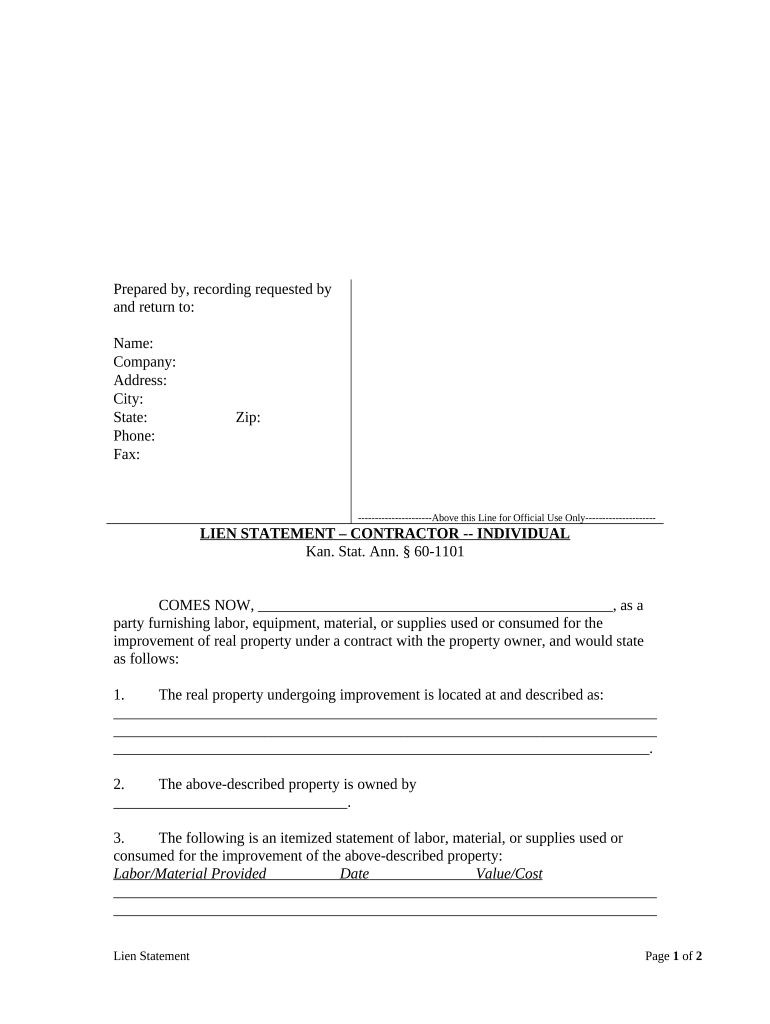
The Kansas Lien Statement for Contractor is a written claim used by contractors and subcontractors to preserve a lien right against real property for unpaid labor, materials, or services furnished to a construction project in Kansas. It identifies the claimant, the property, the contract or job, the amount claimed, and the date work was last provided. Proper completion and timely filing are prerequisites to enforceability and to preserve statutory remedies under state lien laws.

Why a Proper Lien Statement Matters

A correctly prepared lien statement preserves payment rights and priorities, provides formal notice to owners and lenders, and is a statutory prerequisite to foreclosure remedies. Electronic preparation and proper retention support enforceability under federal and state e-signature laws such as the ESIGN Act (15 U.S.C. ch. 96, 2000) and UETA (1999) where adopted.

Why a Proper Lien Statement Matters

Who Typically Prepares and Uses This Lien Statement

The Kansas Lien Statement for Contractor is used by a variety of parties connected to construction projects; understanding common users helps determine responsibilities and signatory authority.

  • General contractors and subcontractors protecting payment rights on private projects
  • Material suppliers documenting amounts owed for delivered goods
  • Construction attorneys preparing foreclosure-ready lien packages

Each party should confirm statutory notice periods, filing locations, and required attachments before sending or filing a lien statement.

Representative Signatories and Roles

Contractor — Project Lead

A contractor or authorized company officer who managed or supplied the work; signs to attest to amounts owed and dates of last furnished labor or materials. The signer should have corporate authority and access to contract records for verification and potential litigation.

Subcontractor — Claimant

A subcontractor or supplier who did not contract directly with the property owner but seeks to preserve lien rights; must identify the prime contract, billing, and the last date of labor or material provided to establish statutory timelines.

Core Elements of a Professional Kansas Lien Statement

A complete lien statement contains consistent identifying information, a clear description of the work, and precise monetary details. The document should be organized to support filing, service, and potential enforcement.

Claimant Details

Full legal name, business entity type, mailing address, and contact information as shown on license or contract documents to ensure proper service and record matching.
Property Description

Street address plus legal description or parcel number where available. Precise property identification reduces risk of rejection or misfiling with the county records office.

Contract Reference

Contract or purchase order number, contract date, and name of the party who contracted directly for the work to establish the chain of performance for lien priority.

Amount Claimed

Itemized or lump sum amount owed with currency notation and a brief calculation or invoicing reference; include retainage or previously disputed amounts where applicable.

Dates of Performance

Start date, completion or last furnishing date, and billing period. The last date of work often governs statutory filing deadlines and priority.

Signature and Verification

Signature block for claimant or authorized representative, printed name, title, and date; notary or acknowledgement if state or county practice requires it for recordability.

Step-by-Step: Filling and Preparing the Statement

Follow these practical steps to populate, review, and prepare the lien statement for filing or service.

  • 01
    Collect records: Gather contracts, invoices, delivery tickets, and completion notices to substantiate the amount claimed.
  • 02
    Populate fields: Complete claimant, property, contract, date, and amount fields verbatim from source documents.
  • 03
    Review for accuracy: Verify name spellings, parcel identifiers, and dates to avoid indexing errors or challenges.
  • 04
    Sign and notarize: Obtain required signature, and notarization if applicable, before submitting to the recording office.

How Filing and Notice Typically Flow

Understand the usual sequence from claim preparation through filing and notice to affected parties.

  • Prepare claim: Draft the lien statement with supporting invoices and contract references.
  • Service notice: Provide required notice to the owner and prime contractor as statutorily required.
  • File with county: Record the lien statement at the county register or recorder's office where the property is located.
  • Preserve enforcement: Track statutory deadlines for foreclosure or suit to enforce the lien if payment is not received.

Digital Workflow Settings for Online Completion

Configure an online workflow to collect signatures, attach evidence, and track deadlines when preparing lien documents.

Field Configuration
Signer Authentication Email + SMS code or ID verification for higher assurance
Attachment Requirement Require invoices and delivery proofs before finalizing
Signature Order Claimant signs first, then notary or witness if required
Retention Enable audit trail and long-term storage for 7+ years

Technical Considerations for eFiling and eSigning

Use platforms that support PDF, DOCX, and secure attachments and that produce an auditable certificate of completion.

  • File formats: PDF and DOCX supported
  • Integrations: Connects to Procore, NetSuite, and Google Workspace
  • Security: TLS and AES-256 encryption

Ensure chosen software can produce a tamper-evident signed PDF, retain an audit trail, and support any required notarization or identity verification workflows.

Key Timing and Statutory Deadlines to Track

Statutory time limits and the last date of furnishing often determine whether a lien can be filed and enforced; track these carefully.

Last Furnishing Date:

Determines start of filing period; document accurately

Notice Deadlines:

Send required preliminary notices per contract or state rule

Filing Window:

File with county within the state-specific statutory period

Enforcement Period:

Commence foreclosure suit within statutory enforcement timeframe

Record Retention:

Retain copies for enforcement and audit purposes

Milestone Timeline from Performance to Enforcement

Typical milestones show when notices, filing, and enforcement actions occur following last furnished work or materials.

01

Performance Completed

Last date claimant provided labor or materials.

02

Preliminary Notice

Send notices required by contract or state law.

03

File Lien Statement

Record with county within statutory filing window.

04

Enforce Lien

Begin suit or foreclosure before enforcement deadline.

Common Preparation Pitfalls to Avoid

  • Incomplete property descriptions that omit parcel or legal identifiers cause rejection or misindexing and delay enforcement actions.
  • Mismatched claimant or owner names between contract, invoices, and the lien statement can lead to easy challenges and indexing errors.
  • Failing to notarize or to obtain required witness signatures where county practice demands them undermines recordability and enforceability.
  • Missing or late preliminary notices required by contract or state statute can forfeit priority or bar enforcement in some jurisdictions.

Consequences of Incorrect or Untimely Lien Statements

Loss of Priority: May forfeit lien priority
Invalid Lien: Claim may be rejected or void
Costly Litigation: Increases legal fees and delay
Sanctions: Potential court sanctions in bad faith
Damaged Reputation: Owner and lender relations harmed
Statute Bars: May permanently bar enforcement

Vendor Pricing Snapshot for eSignature and eFiling Support

Compare baseline pricing and select features relevant to lien preparation and secure eFiling. signNow is listed first in the comparison for consistency.

signNow DocuSign Adobe Sign PandaDoc HelloSign
Starting Price $8/user/mo $15/user/mo $14/user/mo $19/user/mo $15/user/mo
Free Trial 7-day free trial No No Yes, limited Yes, limited
Bulk Send Yes Yes Yes Yes No
Audit Trail Yes Yes Yes Yes Yes
HIPAA Compliant Yes Yes Yes No No

Practical Tips for Accurate and Efficient Completion

Follow best practices to reduce errors, speed filing, and preserve enforcement options.

Use precise names
Match claimant and owner names exactly to contract and title records; avoid abbreviations.
Attach evidence
Include invoices, delivery records, and change orders to substantiate amounts and dates.
Track deadlines
Record the last date of furnishing and set calendar reminders for filing and enforcement windows.
Keep audit trails
Use systems that preserve signing metadata, IP addresses, and document history for disputes.

Real-World Use Cases

Examples showing how contractors and their advisors use a lien statement to protect payment rights.

Contractor Claim Example

A mid-size general contractor documents unpaid change orders and records a lien statement to preserve priority.

  • The claimant attached invoices and delivery logs.
  • The recorded statement enabled negotiation with the owner and lender that resulted in partial payment and an agreed schedule for the remainder without immediate litigation.

Subcontractor Example

A subcontractor supplies materials to a large build but is unpaid after final completion.

  • The subcontractor files a lien statement with supporting invoices.
  • The filed claim triggered a title company inquiry and led to a timely settlement that included payment and release language to clear title.

Frequently Asked Questions and Troubleshooting

Answers to common questions about completing, filing, and enforcing a Kansas lien statement.


Need help? Contact support

be ready to get more
Join over 28 million airSlate SignNow users