Establishing secure connection…Loading editor…Preparing document…

Kansas Property Settlement Agreement

This template is fully customizable. Edit the text, fill out the fields, and send it for signature. Give it a try!
Kansas Property Settlement Agreement

What the Kansas Property Settlement Agreement Is

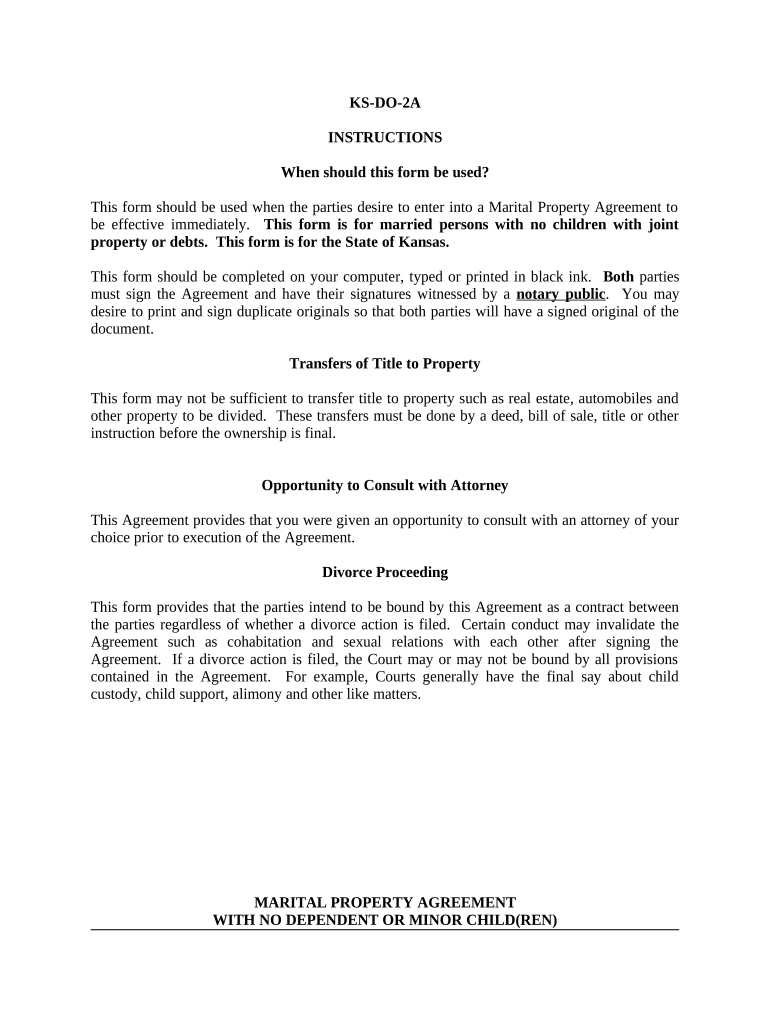
A Kansas Property Settlement Agreement is a written contract used to allocate ownership, liens, debts, expenses, and disposition of real property interests between parties, commonly during divorce, separation, or post-transaction disputes. The document records each party's rights and obligations, identifies parcels or ownership percentages, and may include conveyance language, mortgage pay-off instructions, maintenance responsibilities, indemnities, and timelines for performance. When properly executed and, if required, notarized or recorded, the agreement creates enforceable obligations under Kansas law and can be used as the basis for deeds, lien releases, or court submissions.

Why a Formal Settlement Agreement Matters

A written Kansas Property Settlement Agreement reduces ambiguity, documents mutual promises, and creates a clear path for transferring or encumbering real property. It supports recording, enforcement, and future title continuity and helps avoid litigation by memorializing negotiated terms.

Why a Formal Settlement Agreement Matters

Who Typically Prepares and Signs This Agreement

The document is useful for any party who needs a clear, enforceable record of who owns, pays for, or is responsible for property-related obligations in Kansas.

  • Divorcing spouses and their counsel negotiating the division of marital real estate and related liabilities.
  • Buyers and sellers settling post-closing allocation issues, such as repairs or prorations.
  • Lenders, title companies, or trustees drafting release or reconveyance language tied to payoffs.

Representative Roles and Their Perspectives

Family Law Attorney

A family law attorney drafts or reviews settlement provisions to ensure enforceability, confirm compliance with Kansas divorce decree requirements, and coordinate with the court when the agreement is incorporated into a judgment or decree.

Title Officer

A title officer validates conveyance language, confirms satisfaction of mortgages or liens per the agreement, and determines whether recorded deeds, releases, or affidavits are necessary to clear title for transfer or refinancing.

Core Elements to Include in a Professional Agreement

A comprehensive Kansas Property Settlement Agreement clearly identifies parties and property, states the effective date, allocates ownership and liabilities, specifies conveyance mechanics, sets payment or lien release terms, and contains choice-of-law and dispute resolution clauses.

Parties and Identifiers

Full legal names, contact information, and distinguishing details (e.g., marital status or corporate capacity). Accurate identification avoids future title or enforcement disputes.
Property Description

Legal description or parcel ID, street address, and tax parcel number. Use the recorded legal description for recording purposes and deed drafting.

Allocation of Interests

Precise statement of who will hold fee simple, tenancy type, or percentage interests, and whether the transfer is conditional or absolute.

Liens and Mortgage Handling

Instructions for paying, assuming, or releasing mortgages and lien priorities, including escrow or payoff timelines and required documentation.

Conveyance Mechanics

Description of the deed type (quitclaim, warranty), closing steps, covenant language, and who will sign and record the instrument.

Governing Law and Disputes

State choice-of-law (typically Kansas) and dispute resolution approach, plus provisions for fees, costs, and attorney review.

Step-by-Step: Completing the Agreement

Follow these sequential steps to prepare, sign, and effectuate a Kansas Property Settlement Agreement to minimize risk and support recording.

  • 01
    Gather Documents: Collect deed, mortgage statements, tax parcel ID, and title report.
  • 02
    Draft Terms: Describe allocations, conveyance mechanics, and payment obligations in clear language.
  • 03
    Confirm Signatories: Verify authorized signers, corporate authority, or trustee powers.
  • 04
    Execute and Authenticate: Sign before a notary or follow RON procedures if remote notarization will be used.

How the Agreement Moves from Draft to Recorded Instrument

A clear workflow reduces delays. These steps show the typical progression from negotiation to recording or enforcement.

  • Drafting: Prepare agreement with legal description and conveyance language.
  • Review: Each party (and counsel) reviews for accuracy and legal effect.
  • Authentication: Signatures are notarized or executed under compliant e-sign standards.
  • Recording: Record deeds or releases at the county register of deeds where property is located.

Digital Workflow Settings to Consider

When assembling the agreement for e-signature, configure fields and authentication to match the document's legal requirements.

Field Configuration
Signature Type Visible signature with date field; enable signer authentication.
Notary Block Include a notary acknowledgement or RON section where required.
Conditional Fields Show payoff clauses only if mortgage balance exceeds threshold.
File Output Generate a flattened PDF with audit trail attached.

Digital Signing and Authentication Options

Ensure chosen platform supports required outputs (certificates of completion), secure storage, and any necessary BAAs or compliance controls.

  • Email + Audit Trail: Basic authentication with audit trail and timestamp.
  • Two-Factor / SMS: Adds signer verification via code or phone for stronger attribution.
  • Remote Notarization: Use RON where permitted and when a recorded acknowledgment or notary certificate is required.

Timing Considerations and Typical Deadlines

Certain actions have practical or statutory deadlines; plan document execution, recording, and payoff windows to meet those timelines.

Effective Date:

Set by the parties (MM/DD/YYYY) and determines when obligations begin.

Mortgage Payoff Window:

Often 30–45 days after agreement to obtain payoff statements and complete releases.

Recording Window:

Record at county level promptly to protect title; delays risk intervening encumbrances.

Deed Delivery:

Typically delivered for recording within the agreed closing period (e.g., 30 days).

Statute of Limitations Impact:

Effective date can affect filing deadlines for claims; consult counsel for limitations.

Key Milestones from Agreement to Cleared Title

A typical timeline highlights stages that must occur in sequence to transfer interests and clear encumbrances.

01

Agreement Signed

Parties execute the settlement and any attached exhibits.

02

Payoff and Release

Obtain mortgage payoff statements and lien releases as required.

03

Deed Preparation

Prepare the appropriate deed with notarization or RON acknowledgement.

04

Recording Completed

Record deed and releases at the county register of deeds to perfect title.

Security and Compliance Considerations for Electronic Execution

Encryption: AES-256 at rest
Transport Security: TLS 1.2/1.3 in transit
Audit Trail: Timestamp, IP, and action log included
HIPAA Support: BAA available when required
ESIGN / UETA: Meets ESIGN and UETA standards
Certifications: SOC 2 Type II, ISO 27001

Common Risks and Consequences of Errors

Recording Delay: Intervening liens may attach
Name Mismatch: Title problems and rejection
Improper Notarization: County may refuse to record
Unclear Conveyance: Ambiguity invites litigation
Missing Payoff: Mortgage remains encumbering title
Unsigned Pages: Agreement may be unenforceable

Frequent Preparation Errors to Avoid

  • Using a mailing address instead of a recorded legal description causes rejection at the register of deeds and delays recording.
  • Failing to list the party capacity (e.g., trustee, corporate officer) can result in questions about authority and may require corrected instruments.
  • Omitting mortgage payoff instructions or dates leaves responsibility unclear and can postpone lien releases or closings.
  • Relying on unsigned initial pages or missing notarization blocks leads to invalidation for recording purposes.

Practical Tips for Accurate and Efficient Completion

Apply consistent drafting practices to reduce friction when recording and enforcing the agreement.

Use Recorded Descriptions
Always use the exact legal description from the current deed or tax assessor to avoid recording rejection and ensure correct parcel identification.
Confirm Authority
Verify and document signing authority for corporate, trustee, or executor signers to prevent post-recording challenges.
Coordinate Payoffs
Obtain up-to-date payoff statements and lien release language before signing to streamline recording.
Preserve Audit Trail
When using e-signature, retain the certificate of completion and any notary audio-video record for evidentiary support.

Representative Use Cases

These examples illustrate common scenarios where a Kansas Property Settlement Agreement resolves ownership and lien issues.

Divorce Property Division

A divorcing couple agreed to transfer the former marital home to one spouse

  • Deed executed and notarized
  • The agreement allocated mortgage responsibility and required recording, preventing future title disputes and allowing the retaining spouse to refinance.

Post-Closing Adjustment

Buyers and sellers negotiated seller-paid repairs after closing

  • Settlement memorialized responsibilities and escrow release
  • The agreement instructed the seller to record a release for a minor lien after payment, enabling the buyer to clear title for resale.

eSignature Vendor Comparison for Executing the Agreement

Basic pricing and feature availability for common eSignature providers. signNow is listed first per platform comparison conventions.

signNow DocuSign Adobe Sign PandaDoc HelloSign
Starting Price $8/user/mo $15/user/mo $14/user/mo $19/user/mo $15/user/mo
Free Trial 7-day trial Trial available Trial available Trial available Trial available
Bulk Send Yes Yes Yes Yes No
Audit Trail Yes Yes Yes Yes Yes
HIPAA Compliant Yes (BAA) Yes (BAA) Yes (BAA) Varies Varies
Envelope Cap No cap 100 envelopes/user/year Varies Varies Varies

Frequently Asked Questions About Kansas Property Settlement Agreements

Answers to common questions about drafting, signing, notarization, recording, and electronic execution for Kansas property settlements.


Need help? Contact support

be ready to get more
Join over 28 million airSlate SignNow users