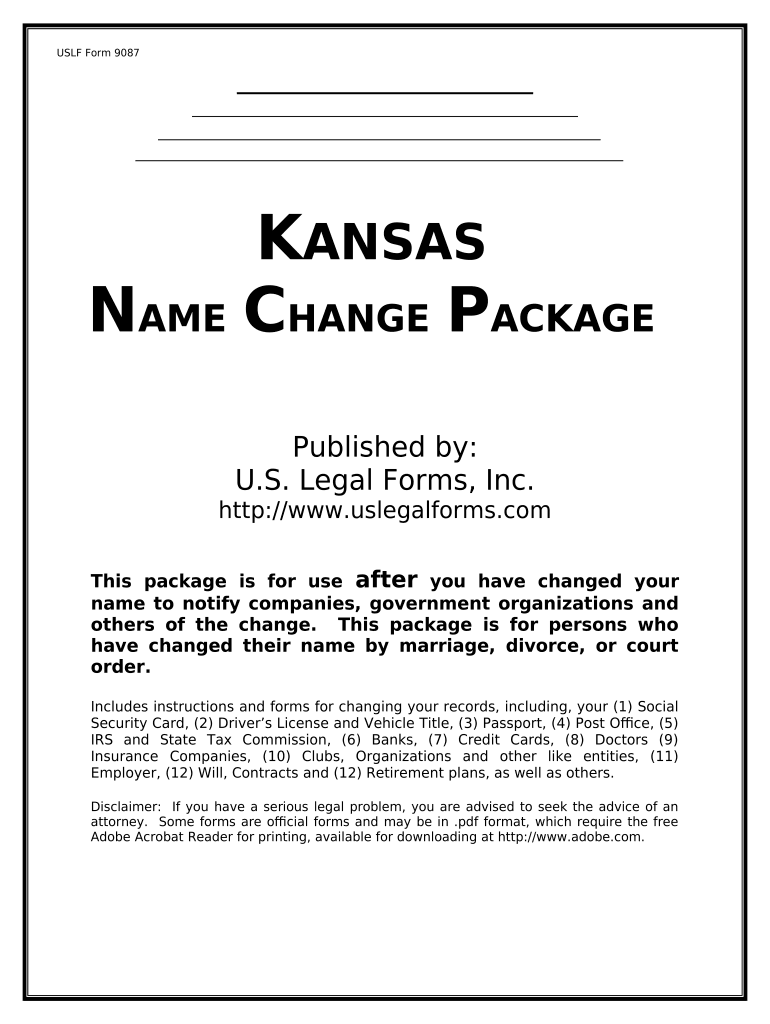
Kansas Name Change Package
What the Kansas Name Change Package Includes
Why a Complete Package Matters for Court Acceptance
Provides a consolidated roadmap for completing Kansas name-change proceedings, reducing incomplete filings and court delays. It clarifies required evidence, notarization, publication steps, and typical timelines so applicants and attorneys can prepare accurate petitions and supporting exhibits consistent with Kansas statutes and local court rules.
Who Typically Uses This Package
Typical users include self-represented petitioners, family law attorneys, and court clerks assisting pro se filers.
- Self-represented petitioners preparing local court petitions and required publication notices.
- Attorneys assembling exhibits, drafting orders, and ensuring compliance with Kansas procedural rules.
- Court clerks using checklists to verify filings before docketing or scheduling a hearing.
Primary Roles Involved
Petitioner
An individual seeking to change their legal name in Kansas. Must complete the petition, disclose criminal history if applicable, provide identity documents, comply with publication or sealing rules, and attend any scheduled hearing. Accuracy reduces the risk of continuance or denial.
Attorney
Family law or civil attorneys representing clients for name changes. They prepare petitions, draft proposed orders, advise on publication or sealing options, verify service and identity documents, and represent clients at hearings to resolve objections or statutory eligibility issues.
Consequences of Inaccurate or Incomplete Filings
Common Preparation Pitfalls to Avoid
- Failing to match petition name to government-issued ID creates verification problems and often requires amended filings or supplemental documentation.
- Omitting required criminal-history disclosures can lead to continuances, denial, or referral for further background checks by the court.
- Incorrect or incomplete publication information—such as wrong newspaper or failure to file proof—results in rejected submissions or re-noticing orders.
- Using initials, nicknames, or truncated legal names can delay processing; always use the full legal name shown on primary identification.
Realistic Filing Examples
Adult Petition
A 34-year-old petitioner updated a surname after marriage and assembled the petition with ID, birth certificate, and a proposed order.
- No criminal history reported; judge granted.
- The filer used the package checklist to confirm publication in the county newspaper, submitted proof of publication, and attended the hearing where the judge signed the order. Total elapsed time from filing to final order was six weeks.
Minor Petition
A guardian petitioned for a minor to adopt a shortened first name; the petition included parental consent and the child's birth certificate.
- Court required guardian affidavit and physician letter.
- The judge requested redaction of sensitive medical details from the public record and sealed portions of the file. The package's sealing template and instructions simplified the clerk's handling and preserved the child's privacy while completing the legal process.
Step-by-Step: Filling and Filing in Kansas
-
01Prepare Petition: Complete petition form with full legal name and details.
-
02Assemble Exhibits: Attach birth certificate, ID, and any consent forms.
-
03Publication: Publish notice if required and retain proof of publication.
-
04Court Hearing: File documents, pay fee, and appear for hearing.
How to Configure an Online Submission Workflow
| Field | Configuration |
|---|---|
| Authentication | Email + SMS code for signer verification. |
| Conditional Fields | Show supporting exhibits only when required. |
| Bulk Send | Use for multiple simultaneous petitions. |
| File Export | Produce PDF/A with audit trail and timestamps. |
Platform and File Requirements for eSubmission
Online submission supports PDF, DOCX, and signed PDF/A export; integrate with court e-filing if available.
- Formats: PDF, DOCX, PDF/A supported.
- Integrations: Google Drive, Box, NetSuite, Salesforce.
- Authentication: Email, SMS OTP, KBA options.
Timing Expectations and Common Deadlines
Filing Window:
No set pre-deadline; file when prepared; court assigns hearing.
Publication Period:
Publication required in some counties; usually once weekly for three consecutive weeks.
Proof of Publication:
Affidavit or certificate filed before final hearing in most counties.
Hearing Scheduling:
Court schedules hearing after filing and publication proof submitted.
Final Order:
Judge signs order at hearing unless objections are sustained.
eSignature Vendor Comparison for Submitting the Package
| signNow | DocuSign | Adobe Sign | PandaDoc | HelloSign | |
|---|---|---|---|---|---|
| Starting Price | $8/user/mo | $15/user/mo | $14/user/mo | $19/user/mo | $15/user/mo |
| Free Trial | 7-day free trial | Varies by plan | Varies by plan | Varies by plan | Varies by plan |
| Bulk Send | Yes (Business Premium) | Varies by plan | Varies by plan | Varies by plan | Varies by plan |
| Audit Trail | Yes | Yes | Yes | Yes | Yes |
| HIPAA Compliant | Yes (BAA available) | Yes (BAA available) | Yes (BAA available) | Varies | Varies |
Tips for Accurate and Efficient Completion
Frequently Asked Questions and Common Solutions
-
Do I need to publish a notice?
Publication rules vary by county. Many Kansas counties require published notice for a set number of weeks; you must file proof of publication before the final hearing in jurisdictions that require it.
-
Can I e-sign the petition?
Electronic signatures are generally valid under the federal ESIGN Act (15 U.S.C. ch. 96, 2000) and state UETA adoption, but confirm the court accepts e-signed petitions and whether notarization or in-person signing remains required.
-
Is notarization always required?
Some petition forms or supporting affidavits require notarization; where required, sign only in the presence of a notary. Remote online notarization may be permitted if the county and notary comply with applicable RON rules.
-
What if I omitted criminal history?
Omissions can lead to continuance, additional requests from the court, or in some cases denial. File an amended petition or disclose the information promptly following clerk guidance.
-
How do I update other records after the order?
Use certified copies of the final court order to update government IDs, Social Security records, DMV licenses, and financial accounts. Each agency has its own requirements for certified orders.
-
Where do I confirm local fees and procedures?
Contact the county district court clerk for exact filing fees, publication rules, and scheduling processes. Local clerk instructions supersede general templates for procedural details.