Establishing secure connection…Loading editor…Preparing document…

Kentucky Marital Separation and Property Settlement Agreement

This template is fully customizable. Edit the text, fill out the fields, and send it for signature. Give it a try!
Kentucky Marital Separation and Property Settlement Agreement

What the Kentucky Marital Separation and Property Settlement Agreement Is

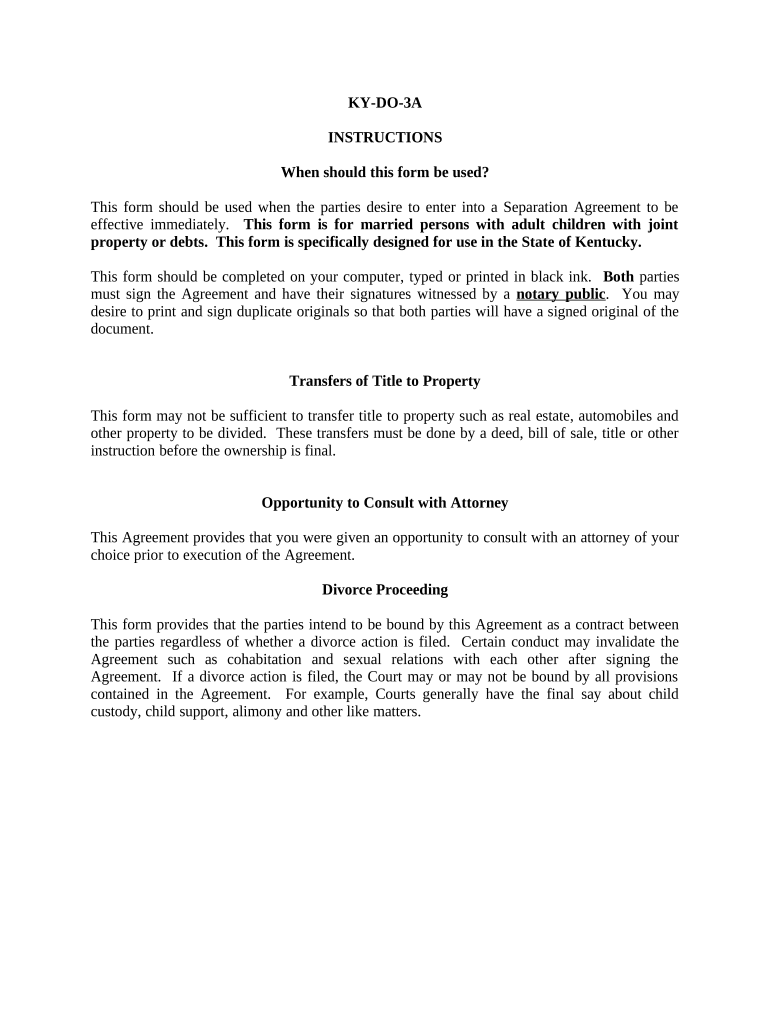
The Kentucky Marital Separation and Property Settlement Agreement is a written contract used by spouses in Kentucky to record terms for separation, division of marital property, support obligations, debt allocation, and parenting arrangements where applicable. It creates a clear record of negotiated terms while parties live apart and can be incorporated into a later dissolution or used as evidence in court. The document is customizable and typically includes signatures, dates, and notarization or witness acknowledgments to strengthen enforceability under state and electronic signature laws.

Why a Clear, Written Separation Agreement Helps

Use a Kentucky Marital Separation and Property Settlement Agreement to reduce uncertainty, document negotiated property divisions and support terms, and create a clear record for courts or attorneys. It helps prevent disputes and supports enforceability of agreed terms.

Why a Clear, Written Separation Agreement Helps

Who Typically Prepares and Signs This Agreement

Typical users include separating spouses, family law attorneys, mediators, and paralegals preparing enforceable separation terms.

  • Separating spouses: record negotiated division of assets and liabilities with clarity.
  • Family law attorneys: prepare enforceable settlement language for court incorporation.
  • Mediators and counselors: document interim parenting time and financial arrangements.

Essential Sections to Include in the Agreement

Core sections clarify separation terms, property division, support, debt allocation, parenting plans, and procedures for future modification or enforcement, including dispute resolution and attorney fees.

Identification

Names, addresses, dates of marriage and separation, and full legal descriptions of parties; identifies whether agreement is temporary, interim, or final, and confirms residence and legal capacity to contract.
Property

Allocate marital and separate property with specific line-item descriptions, account numbers, percentages, and transfer mechanics including deed execution, title changes, and retirement account rollovers instructions.

Support

Spousal support terms, payment schedule, duration, tax treatment, and early-termination triggers; specify method of payment, remedies for missed payments, and an indexing formula for cost-of-living adjustments.

Debts

Assign responsibility for joint and individual debts, describe creditor notifications, and state who indemnifies the other against future collections, and procedures for refinancing or payoff.

Parenting

If children involved, include parenting time schedule, decision-making authority, custody allocations, holiday arrangements, transportation responsibilities and dispute-resolution steps, and temporary child support pending final decree.

Modifications

Specify process for future amendment, notice requirements, mediation or arbitration clauses, jurisdiction selection, and how to submit changes for court approval, including filing costs and service methods.

Step-by-Step: From Draft to Signed Agreement

Follow these steps to draft, review, sign, and preserve a legally sound Kentucky Marital Separation and Property Settlement Agreement.

  • 01
    Draft Terms: List assets, liabilities, support, and parenting provisions in clear detail.
  • 02
    Review With Counsel: Have an attorney or neutral mediator review language and tax implications.
  • 03
    Sign & Notarize: All parties sign; notarize or obtain witnesses as required.
  • 04
    Retain Copies: Keep originals and certified copies; store digital copies securely.

Configuring an Online Signing Workflow

Set up an online workflow to collect signatures, conditional fields, and notifications when completing the agreement.

Field Configuration
Choose signer authentication method and strength Email link is standard; SMS code adds verification.
Use conditional fields for parenting schedules Show child-support fields only if children are listed.
Require notarization or witness blocks where needed Enable remote notarization option if Kentucky-approved RON provider.
Set retention and export options for signed copies Export to PDF/A and store audit trail with signed document.
Configure reminders and expiration notifications for signers Automate email reminders at configurable intervals before deadline.

Platform Capabilities That Matter

Use platforms that support PDFs, conditional fields, secure storage, and compliant audit trails for electronically executed settlement agreements.

  • File Formats: PDF, Word DOCX, and HTML supported.
  • Integrations: Connectors for NetSuite, Salesforce, Microsoft 365.
  • Authentication Options: Email, SMS, KBA, and two-factor.

How Electronic Signing Works for This Agreement

This workflow explains how to send, sign, and archive the agreement using electronic signature tools.

  • Upload Document: Import the agreement as PDF or DOCX and confirm fields.
  • Assign Signers: Add parties, set signing order and role.
  • Authenticate Signers: Choose email link or stronger verification methods.
  • Complete & Store: Finalize signatures; archive signed PDF and audit trail.

Best Practices to Reduce Risk and Disputes

Follow practical steps to minimize disputes, ensure enforceability, and simplify future enforcement or modification of the agreement.

Use clear, itemized property schedules
List each asset and liability separately with identifying details: account numbers, property addresses, vehicle VINs, and estimated values. Specify whether items are marital or separate property and state mechanics for transfers or title changes to reduce ambiguity.
Include dispute resolution and modification procedures
Require mediation before court action, set notice periods for proposed changes, specify venue and governing law, and describe how amended terms will be documented and executed to avoid later evidentiary disputes.
Verify tax and benefit consequences with counsel
Clarify tax treatment of support and property transfers; consult a tax professional about reporting, potential gift tax, and impact on filing status to prevent unexpected liabilities or IRS penalties.
Use notarization and witness evidence where helpful
Obtain notarization and witness attestations when permitted; retain the notary journal entry or RON session record. These steps strengthen proof of execution and can simplify enforcement in later proceedings.

Potential Consequences of an Incorrect Agreement

Enforceability Risk: Unclear terms may be voided.
Tax Consequences: Improper transfers trigger tax liabilities.
Creditor Claims: Creditors may challenge asset allocations.
I-9 Issues: Employment verification separate from agreement.
Support Disputes: Missed payments lead to arrearage actions.
Fraud Allegations: Undisclosed assets can prompt rescission.

Common Preparation Mistakes to Avoid

  • Failing to describe property with enough detail causes ambiguity, making transfers or title changes difficult and increasing court disputes over ownership.
  • Using vague phrases like 'equitable division' without percentages or assets listed leaves the allocation open to interpretation and future litigation.
  • Neglecting to address retirement accounts, tax penalties, and qualified domestic relations orders can cause costly corrections and tax exposure later.
  • Failing to notarize or secure proper witness statements where state practice expects them weakens the evidentiary weight of the agreement.

Security and Compliance Considerations

Data in Transit: TLS 1.2/1.3 encryption for all transfers.
Data at Rest: AES-256 encryption protects stored documents.
Certifications: SOC 2 Type II, ISO 27001, PCI DSS certified.
HIPAA Support: BAA available for covered entities.
eSignature Law: Compliant with ESIGN and UETA.
Audit Trail: Complete timestamped logs and IP addresses.

Timing and Deadline Considerations

Key timing considerations include effective dates, support start dates, filing windows for related motions, and statutory limitation implications.

Effective Date and Commencement of Obligations:

Effective date triggers support obligations and governs modification timelines.

Spousal and Child Support Payment Start Date:

Specify exact monthly due date and first payment month.

Notarization and Witness Execution Deadlines:

Complete notarization at signing or within a short agreed period.

Filing Motions or Court Incorporation:

File any motions promptly if incorporating agreement into decree.

Effect on Statute of Limitations:

The effective date may start limitation periods for contract enforcement.

Typical eSignature Plan Pricing and Feature Comparison

Compare typical plan starting prices and common features across leading eSignature providers to assess cost and compliance considerations for executing this agreement.

signNow DocuSign Adobe Sign PandaDoc HelloSign
Starting Price $8/user/mo $15/user/mo $14/user/mo $19/user/mo $15/user/mo
Free Trial 7-day free trial Varies Varies Varies Varies
Bulk Send Yes Yes Yes Yes No
Audit Trail Yes Yes Yes Yes Yes
HIPAA Compliant Yes Yes Yes No No

Frequently Asked Questions

Answers to common questions about completing, signing, and enforcing a Kentucky Marital Separation and Property Settlement Agreement.


Need help? Contact support

be ready to get more
Join over 28 million airSlate SignNow users