Establishing secure connection…Loading editor…Preparing document…

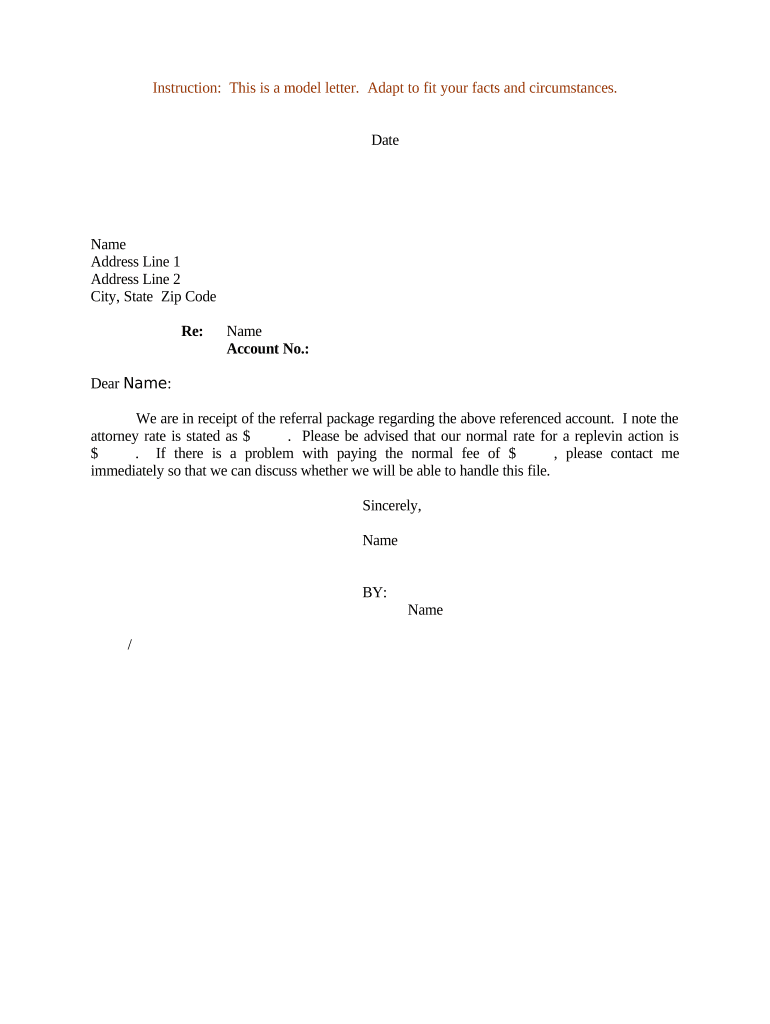
Letter Regarding Attorney Fees for Replevin Action

This template is fully customizable. Edit the text, fill out the fields, and send it for signature. Give it a try!
Letter Regarding Attorney Fees for Replevin Action

What this Letter Is and when it is used

A Letter Regarding Attorney Fees for a Replevin Action is a formal legal communication from counsel or a party that documents, demands, or clarifies responsibility for attorney fees incurred in a replevin lawsuit seeking recovery of possession of specific personal property. The letter typically states the basis for fee entitlement, cites contract or statutory fee-shifting provisions, itemizes billed hours or a flat fee estimate, and may propose payment terms or notice of intent to seek fees in court. It helps preserve claims, encourage settlement, and provide written evidence before seeking fee awards.

Why a clear fee letter matters in a replevin case

The letter preserves contractual or statutory fee claims, creates a record of costs, and can prompt settlement or quick resolution. A concise, documented demand reduces ambiguity about payment responsibility and supports later motions or billing disputes in court.

Why a clear fee letter matters in a replevin case

Common senders and recipients

Plaintiffs' attorneys, secured creditors, bailment holders, and repossession agents commonly prepare or send this letter during replevin proceedings.

  • Plaintiff's counsel documenting fee claims before a hearing or settlement.
  • Secured creditor notifying debtor of obligation to pay attorney fees.
  • Defense counsel responding with fee disputes or proposing alternative arrangements.

Who typically prepares and signs the letter

Plaintiff's Counsel

Plaintiff's counsel drafts the attorney fees letter to assert contractual or statutory entitlement, summarize billed time or costs, and notify opposing parties of intent to move for fees. The narrative should link invoices to time entries and cite the legal basis for recovery.

Secured Creditor

A secured creditor or lienholder may use the letter to demand reimbursement for attorney fees incurred to repossess or recover collateral. The letter should reference the security agreement, contractual fee-shifting clause, and itemize amounts to facilitate settlement or court adjudication.

Core elements of an effective attorney-fees letter

A professional letter combines precise case details, the legal basis for fees, clear itemization, and evidentiary attachments to support a later fee motion or settlement negotiation. The tone should be factual and preserve rights without prejudicing litigation strategy.

Formal Heading

Include court name, case caption, docket number, and date so the letter is immediately identifiable and can be attached to filings or correspondence.
Legal Basis

Cite the contract clause, statute, or rule authorizing fee recovery; link to pleadings or judgments showing entitlement when available.

Itemized Fees

List rates, hours, dates, and a brief description of work performed. Use attachments or an invoice to provide full time-entry detail for verification.

Exhibits Attached

Attach invoices, retainer agreements, the security agreement, and any court orders that reference fees to create a self-contained evidentiary package.

Signature Block

Signed by the attorney of record or authorized representative, with printed name, bar number, firm, and contact information for verification.

Preservation Language

State that the demand preserves rights to seek attorney fees and interest if not promptly resolved, while avoiding inflammatory or threatening language.

Essential case and contact details to include

Case Caption: Court name and parties
Docket Number: Court-assigned case number
Date of Letter: MM/DD/YYYY format
Legal Basis: Contract or statute cited
Fee Summary: Total amount claimed
Payment Terms: Deadline and remittance instructions

Step-by-step: drafting and sending the letter

Follow a concise sequence: confirm entitlement, compile invoices, prepare the letter, include exhibits, and serve on opposing counsel and the court if required.

  • 01
    Confirm Entitlement: Verify contract or statute that allows attorney fees.
  • 02
    Compile Evidence: Gather invoices, time entries, and retainer agreements.
  • 03
    Draft Letter: State basis, itemize fees, set payment deadline.
  • 04
    Serve Notice: Send to opposing counsel and retain proof of delivery.

How to update or amend the letter later

If fees change or new costs arise, amend the letter with a dated supplement and attach supporting entries; ensure service to all previously notified parties.

01

Identify Amendment:

Determine added charges and reason for update.
02

Draft Addendum:

Prepare a dated supplemental letter with itemization.
03

Obtain Signatures:

Sign the addendum and note original document reference.
04

Serve Parties:

Send to counsel and file if required by court.
05

Link Exhibits:

Attach incremental invoices and time entries.
06

Preserve Records:

Save transmission receipts and filing confirmations.

Where to send the letter and common routing paths

Deliver the letter to opposing counsel and the client; file with the court only when local rules require or when attaching to a motion for fees or enforcement.

  • Opposing Counsel: Primary recipient for negotiation and dispute resolution.
  • Client Copy: Provide the client with the letter and invoices for approval.
  • Court Filing: File with a fee motion or declaration if local rules demand.
  • Collections/Servicer: Send to internal collections when pursuing out-of-court payment.

How to customize the letter using digital templates

Set up a reusable template with standard fields, attachments, and routing to streamline repeated fee demands and preserve consistent evidence across matters.

Field Configuration
Template Name Standard legal-letter template
Signature Field E-signature block with date
Authentication Email or SMS code for signer identity
Attachments Invoice PDF and time-entry spreadsheet

Technical considerations for e-signing and delivery

Use a platform that supports PDF, Word DOCX, and audit-trail exports, and that can attach invoices and retain evidence of delivery.

  • File Formats: PDF and DOCX supported
  • Audit Trail: Timestamp, IP, and action log
  • Integrations: CRM and cloud storage options

Choose authentication strength appropriate to the matter; stronger verification helps preserve enforceability and evidentiary weight in court.

Timing considerations and typical deadlines

Adhere to court rules and local practice: serve promptly, allow reasonable cure periods, and include dates to support interest or late-fee calculations.

Before Filing:

Send demand early to preserve settlement opportunities.

Service Proof:

Retain delivery receipts or certified mail records.

Motion Timing:

File fee motion in accordance with local rules.

Payment Deadline:

State clear payment due date in the letter.

Interest Start:

State when interest or collection costs begin accruing.

Key milestones from demand to enforcement

Track milestones so fee recovery steps are timely and supported by records.

01

Draft and Verify

Prepare letter with supporting invoices and authorities.

02

Serve Demand

Deliver to opposing counsel with proof of service.

03

Await Response

Allow reasonable time for payment or dispute.

04

File Motion

If unresolved, file a motion for fees with evidence.

Common pitfalls to avoid when preparing the letter

  • Insufficient detail: vague fee descriptions invite disputes and require additional discovery to support claims.
  • Mismatched parties: addressing the incorrect party or using out-of-date case captions can invalidate notice.
  • Missing exhibits: failing to attach invoices or the fee-shifting clause weakens enforceability.
  • Improper tone: using threatening language may provoke sanctions or slow settlement discussions.

Risks and potential consequences of errors

Fee Claim Rejection: Court may deny unsubstantiated claims
Reduced Recovery: Incomplete records can reduce award amounts
Court Sanctions: Frivolous or misleading statements risk sanctions
Statute Bar: Delay may affect statutory limitations
Interest Accrual: Incorrect dates can miscalculate owed interest
Tax Treatment: Incorrect classification may affect tax reporting

Download, save, and archive formats to preserve evidence

Export the signed letter and exhibits in immutable formats and retain an audit trail for admissibility and long-term storage.

PDF Archive

Save a flattened PDF/A copy containing the visible signature and appended audit certificate to ensure a single-file evidentiary record.

Source DOCX

Keep the original DOCX for edits and version control, but rely on PDF for court exhibits and filings.

Audit Trail

Retain the platform audit log showing timestamps, IP addresses, authentication method, and signer actions for evidentiary support.

Secure Storage

Store signed records in encrypted cloud storage or a secure archive with access controls and retention policies.

eSignature platform comparison for issuing this letter

Basic vendor features and starting prices for common eSignature providers. Choose a vendor that meets your authentication and retention needs while supporting required file formats.

signNow DocuSign Adobe Sign PandaDoc HelloSign
Starting Price $8/user/mo $15/user/mo $14/user/mo $19/user/mo $15/user/mo
Free Trial 7-day free trial (no card) Varies by promotion Varies by plan Free trial available Free trial available
Bulk Send Yes Yes Yes Yes No
Audit Trail Yes Yes Yes Yes Yes
HIPAA Compliant Yes Yes Yes No No

Frequently asked questions about fee letters and e-signatures

Answers to common questions about validity, e-signing, notarization, and enforcement when sending an attorney-fees letter in a replevin matter.


Need help? Contact support

be ready to get more
Join over 28 million airSlate SignNow users