Establishing secure connection…Loading editor…Preparing document…

Letter Requesting Vehicle Title Information for Estate

This template is fully customizable. Edit the text, fill out the fields, and send it for signature. Give it a try!
Letter Requesting Vehicle Title Information for Estate

What this letter is and when it’s used

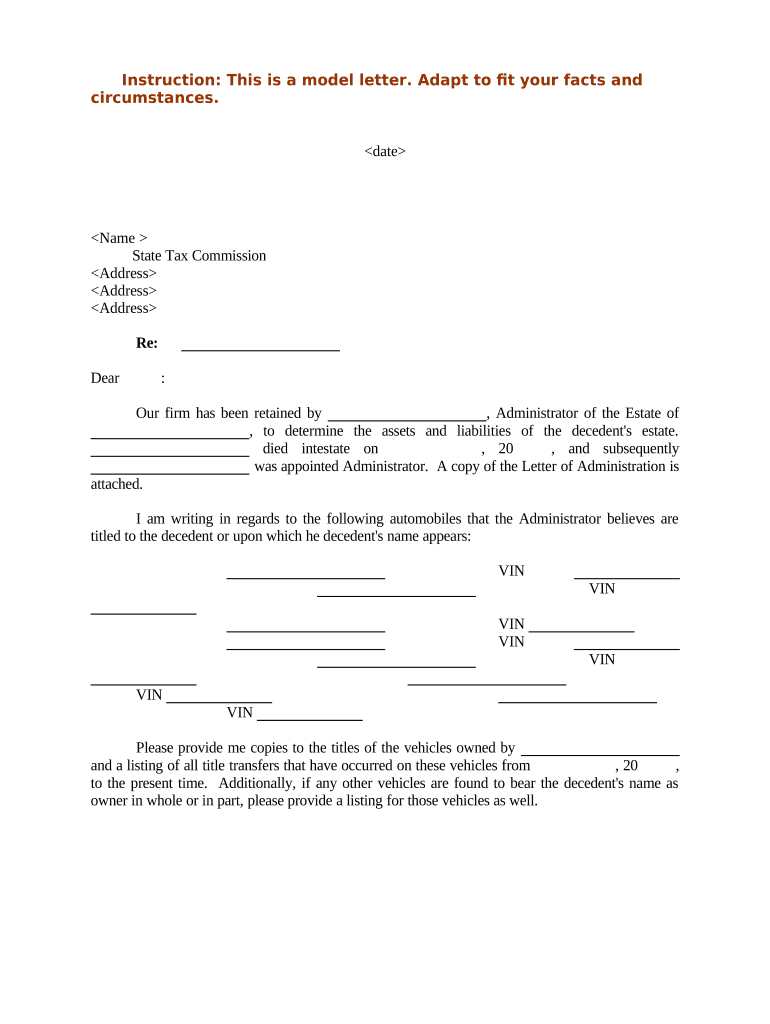
A Letter Requesting Vehicle Title Information for Estate is a formal written request sent to a state motor vehicle agency, lienholder, or title service to obtain vehicle title details for a decedent’s estate. The letter identifies the decedent, describes the vehicle (VIN, make, model), states the requester’s authority (executor, personal representative, or probate attorney), and asks for certified title copies, lien information, odometer disclosures, or transfer instructions. It typically attaches proof of death and proof of authority and explains how the recipient should return the requested documents and any applicable fees.

Why this letter matters for estate settlement

The letter clarifies ownership, identifies liens, and prevents delays when transferring or selling a decedent’s vehicle. Proper documentation reduces probate friction and supports accurate asset inventories while complying with electronic signature laws such as the ESIGN Act (15 U.S.C. ch. 96) and applicable state UETA rules.

Why this letter matters for estate settlement

Who commonly prepares and sends this request

Typical users include estate representatives, probate attorneys, and designated family members acting under court authority.

  • Estate executor or personal representative — prepares and signs requests to identify assets and facilitate title transfer.
  • Probate attorney — verifies authority, assembles supporting probate documents, and handles complex lien or ownership issues.
  • Family member or agent — may send requests when authorized by court order or a valid power of attorney.

Primary signers and their responsibilities

Executor / Personal Representative

The executor is appointed by the will or court and must present letters testamentary or administration to prove authority. They sign the letter, attach certified court documents and the decedent’s death certificate, and coordinate title transfer with the DMV or lienholder.

Probate Attorney

A probate attorney drafts or reviews the request to ensure it meets statutory and DMV-specific requirements, confirms authority documentation is complete, and may follow up on lien searches or contested title issues on behalf of the estate.

Security and compliance considerations to include

Encryption in transit: TLS 1.2/1.3
Encryption at rest: AES-256
Audit trail: Timestamps and signer IP
HIPAA concerns: BAA required if PHI
E-signature law: ESIGN / UETA compliant
Access control: Role-based permissions

Risks and legal consequences of errors

Delayed probate: Executor faces processing delays
Title transfer denied: Missing or incorrect documentation
Unexpected liens: Estate may bear unresolved encumbrances
Tax consequences: Potential withholding or penalties
Identity risk: Incorrect recipient causes theft risk
Rejected request: No authority or wrong forms

Common preparation errors to avoid

  • Submitting a request without certified proof of authority or a court-issued letters testamentary — agencies frequently reject unsigned or unsupported requests.
  • Providing inaccurate vehicle identifiers such as a truncated VIN or wrong title number, which prevents a valid search and delays response.
  • Failing to include a certified death certificate or notary when the state or lienholder specifically requires original or certified copies for estate transactions.
  • Using informal or ambiguous language about authority or requested documents; be explicit about asking for certified title copy, lien details, and required transfer instructions.

Step-by-step: prepare and send the letter

Follow this sequence to assemble required evidence, draft the request, and submit it to the appropriate title authority or lienholder.

  • 01
    Identify the vehicle: Record VIN, year, make, model, and title number if available.
  • 02
    Prove authority: Attach letters testamentary, letters of administration, or court order.
  • 03
    Draft the letter: State requester identity, decedent details, and exact documents requested.
  • 04
    Submit and follow up: Send via required channel and confirm receipt and processing timeline.

How requests are processed and returned

Requests typically flow from sender to agency or lienholder, are verified, and then a certified response or copy is returned by mail or secure electronic delivery.

  • Upload or prepare: Assemble letter and supporting certified documents for submission.
  • Verification: Agency confirms authority and validates decedent records.
  • Search and retrieval: Title office locates records and checks for liens.
  • Return of documents: Certified title copies or instructions are mailed or sent electronically.

Essential elements to include in a professional request

Include these six components to ensure the request is complete, easily processed, and accepted by motor vehicle agencies or lienholders.

Header and contact

Provide requester name, estate role, complete mailing address, daytime phone, and email so the agency can confirm identity and return documents.
Decedent identification

List full legal name, date of death, last known address, and social security number if required by the recipient for matching.

Proof of authority

Attach certified letters testamentary, letters of administration, probate court order, or a valid power of attorney accepted by the recipient.

Vehicle details

Record VIN, year, make, model, title number, and license plate if known to facilitate an accurate title search.

Requested records

Specify certified copy of title, lienholder history, odometer disclosure, and any other specific documents you need returned.

Signature and notarization

Include signature block for the authorized signer plus notarization if the state or recipient requires an acknowledged signature or notary seal.

Practical tips for accuracy and faster processing

Adopt these practices to reduce rejections, speed responses, and maintain a clear audit trail for estate administration.

Verify legal names
Enter the decedent’s and requester’s full legal names exactly as shown on government IDs or court documents; mismatches commonly cause rejections and delays during title searches.
Attach certified documents
Provide certified copies of the death certificate and letters testamentary or administration; uncertified photocopies are often not accepted by DMVs or lienholders for title issuance.
Be explicit about deliverables
List each document requested (certified title copy, lien report, odometer statement) and indicate preferred return method to avoid ambiguity and additional correspondence.
Track and log communications
Keep a dated record of submission method, tracking numbers, and contact names; this audit trail supports follow-up and helps resolve disputes if processing stalls.

Typical timing and processing expectations

Processing times vary by state office and whether the request is by mail, in person, or electronic; plan for variable response periods and allow extra time for certified copies.

Probate establishment:

Obtain letters testamentary before requesting title; probate timelines vary by court.

DMV response:

Agency response times differ; expect an administrative processing interval before certified copies issue.

Notary or RON:

Notarization requirements affect timing if in-person or RON sessions are required.

Follow-up window:

Allow time for return mail or secure electronic delivery after verification completes.

Record keeping:

Keep originals and certified copies until title transfer is finalized and retained per retention rules.

How this letter differs from related estate documents

Compare the Letter Requesting Vehicle Title Information with common alternatives to choose the right instrument for your purpose.

Document Comparison Title request letter Power of attorney
Purpose obtain records authorize actions
Authority required probate proof principal signature
Notarization sometimes required often required
Typical recipient dmv or lienholder institutions, vendors

eSignature vendor comparison for title requests

Compare starting prices and key capabilities for common eSignature vendors when sending and receiving title documentation electronically.

signNow DocuSign Adobe Sign PandaDoc HelloSign
Starting Price $8/user/mo $15/user/mo $14/user/mo $19/user/mo $15/user/mo
Free Trial 7-day free trial Varies by vendor Varies by vendor Varies by vendor Varies by vendor
Bulk Send Yes Yes Yes Yes No
Audit Trail Yes Yes Yes Yes Yes
HIPAA Compliant Yes Yes Yes No No

Frequently asked questions and troubleshooting

Answers to common questions about authority, required attachments, electronic signatures, notarization, and resolving title discrepancies.


Need help? Contact support

be ready to get more
Join over 28 million airSlate SignNow users