Establishing secure connection…Loading editor…Preparing document…

Letter Informing Debt Collector of Unfair Practices

This template is fully customizable. Edit the text, fill out the fields, and send it for signature. Give it a try!
Letter Informing Debt Collector of Unfair Practices

What this Letter Is and When to Use It

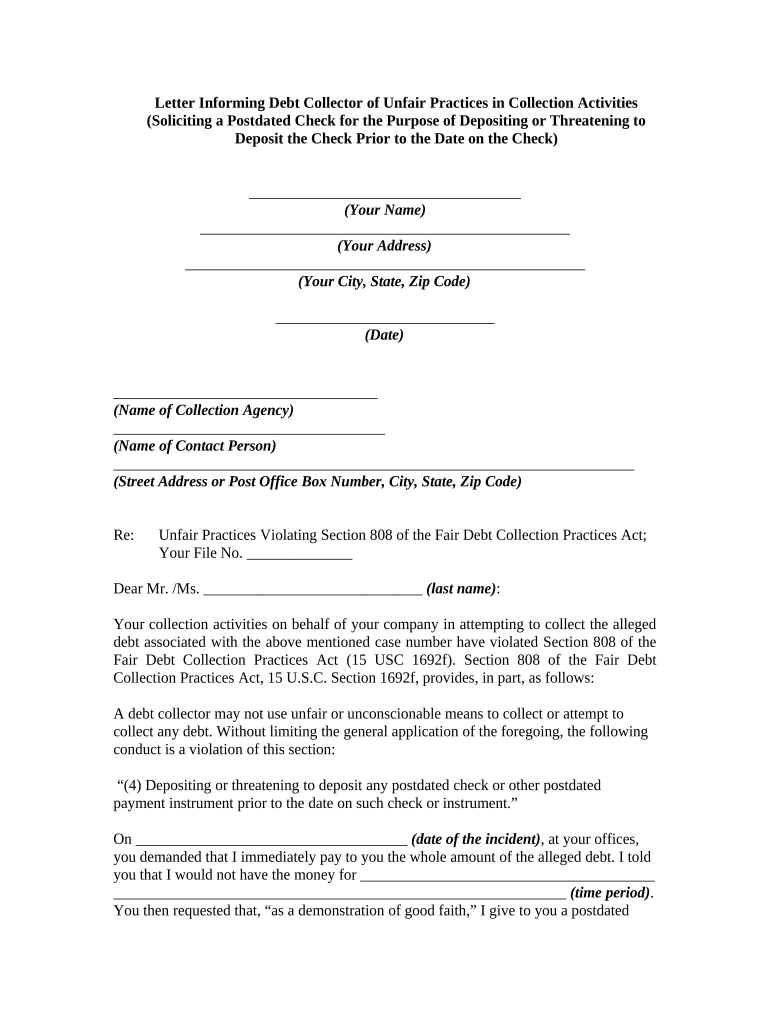
A Letter Informing Debt Collector of Unfair Practices is a written notice a consumer sends to a debt collector to describe harassment, misrepresentation, or other practices the collector used that the consumer believes violate federal or state law. The letter documents the specific conduct, requests that collection activity stop or be corrected, and asks for validation of the debt when appropriate. Use the letter to create a dated record, preserve evidence, and trigger statutory validation periods under federal law or parallel state statutes.

Why sending a clear, documented letter matters

A concise, dated letter creates a written record, can require debt validation, preserves key facts and timelines, and supports complaints to the CFPB or state attorneys general if misconduct continues.

Why sending a clear, documented letter matters

Who commonly prepares this letter

Consumers, consumer advocates, and attorneys use this letter to assert rights and collect evidence before escalating the matter.

  • Individual consumer seeking debt validation and an end to harassment.
  • Legal aid or private attorney assisting a client with unfair collection claims.
  • Consumer advocacy groups documenting patterns for regulatory complaints.

A written notice helps all parties clarify the dispute, creates an evidentiary trail, and informs appropriate next steps without immediate litigation.

Step-by-step: prepare and send the letter

Follow these sequential steps to draft, sign, and serve a defensible notice to the debt collector.

  • 01
    Identify account: Locate collector name and account number from notices or calls.
  • 02
    Document incidents: Write dates, times, what was said, and any witnesses.
  • 03
    Draft letter: Explain unfair practices and request specific remedies.
  • 04
    Send and retain proof: Mail certified or use eDelivery and keep the receipt and copy.

How the dispute and validation process typically flows

A clear process reduces confusion: serve the letter, track the collector response, escalate to regulators if necessary.

  • Send notice: Deliver by certified mail or verified eDelivery to collector.
  • Collector response: Collector must provide validation or clarify account basis when requested.
  • Track communications: Keep copies and timestamps of every interaction and response.
  • Escalate if needed: File complaints with CFPB or state regulator when violations persist.

Key elements to include in a professional notice

Make your letter precise and actionable by including six essential components that courts and regulators expect to see.

Sender details

Full legal name, mailing address, phone, and email so the collector and regulators can identify you easily and avoid mismatches.
Collector identity

Name and mailing address of the collection agency and any law firm handling the account to ensure the notice reaches the correct entity.

Account specifics

Account or reference number, original creditor name, and last known transaction date to tie the complaint to a particular debt.

Specific allegations

Clear, dated examples of the unfair practice (harassment, false statements, repeated calls), including quotes and call times when possible.

Requested action

State whether you demand debt validation, cessation of contact, correction of credit reports, or other remedies with a reasonable deadline.

Signature and proof

Signed and dated by you; include delivery proof such as certified mail receipt or eDelivery confirmation for the record.

Data elements to protect and retain

Personal identifiers: Name, SSN last four
Contact details: Address, phone, email
Account data: Account number, creditor name
Correspondence proof: Certified mail receipts
Call logs: Dates and times
Supporting docs: Billing statements, contracts

Risks of an incomplete or inaccurate letter

Lost evidence: Delayed or vague letters weaken proof.
Missed deadlines: Late notices may forfeit validation windows.
Incorrect recipient: Sending to wrong party can nullify notice.
Legal exposure: Ambiguous claims may invite counter-arguments.
Credit impact: Failure to follow up may not stop reporting.
Reduced remedies: Incomplete records limit regulator action.

Common drafting mistakes to avoid

  • Using vague language without dates or specifics makes a complaint hard to verify and less persuasive to regulators.
  • Failing to include proof of delivery — such as certified mail receipts or e-delivery logs — removes critical evidence of timely notice.
  • Claiming legal conclusions without facts (for example, asserting 'illegal harassment' without examples) weakens the letter’s credibility.
  • Omitting a clear requested remedy leaves the collector and regulators unsure what action you expect them to take.

Digital workflow checklist for preparing and sending the letter

Configure a repeatable workflow to draft, authenticate, send, and archive each notice securely and consistently.

Field Configuration
Document template Pre-filled consumer details and allegation blocks
Authentication Email plus optional SMS code for signer identity
Delivery method Certified mail or verified eDelivery
Archival policy Store signed PDF and delivery receipt

Technical considerations for e-signing and delivery

Choose tools that support verified delivery, tamper-evident signed PDFs, and secure storage to preserve evidentiary value.

  • File formats: PDF and DOCX supported
  • Integrations: CRM and document storage
  • Authentication: Email, SMS, or advanced methods

Ensure the chosen platform produces a detailed audit trail and stores signed files with encryption to meet evidentiary and privacy needs.

Key timing considerations and statutory windows

Be mindful of federal and state timelines; accurate dating of the letter influences validation obligations and complaint windows.

Request validation window:

Send within 30 days after first written notice to invoke validation rights (15 U.S.C. §1692g).

Response expectation:

Collectors typically have a short period to respond; track 30 days for validation and any follow-up.

Preserve records:

Retain delivery proof and correspondence for several years for enforcement or credit disputes.

Regulatory complaint timing:

File complaints promptly after failed resolution to improve enforcement prospects.

Statute of limitations:

Verify state-specific limitations before initiating legal claims; these vary widely by state.

Practical milestone timeline from draft to regulator

A simple four-stage milestone view helps maintain momentum and evidence when contesting unfair practices.

01

Draft and review

Compose the letter with dates, account numbers, and supporting facts.

02

Send with proof

Use certified mail or verified eDelivery and save the receipt.

03

Await response

Track a 30-day response window for debt validation or correction.

04

Escalate if needed

File complaint with CFPB or state regulator after failed resolution.

Comparison: eSignature costs and capabilities relevant to sending and storing notices

Compare baseline pricing and core capabilities for common eSignature vendors; signNow appears first per vendor ordering rules and supports the features listed.

signNow DocuSign Adobe Sign PandaDoc HelloSign
Starting Price $8/user/mo $15/user/mo $14/user/mo $19/user/mo $15/user/mo
Free Trial 7-day free trial Varies by vendor Varies by vendor Varies by vendor Varies by vendor
Bulk Send Yes Yes Yes Yes No
Audit Trail Yes Yes Yes Yes Yes
HIPAA Compliant Yes Yes Yes No No

Frequently asked questions about sending this letter

Practical answers to common questions on delivery, evidence, electronic signing, and escalation paths.


Need help? Contact support

be ready to get more
Join over 28 million airSlate SignNow users