Establishing secure connection…Loading editor…Preparing document…

Letter to Report Identity Theft of Deceased Person

This template is fully customizable. Edit the text, fill out the fields, and send it for signature. Give it a try!
Letter to Report Identity Theft of Deceased Person

What this letter is and when it’s used

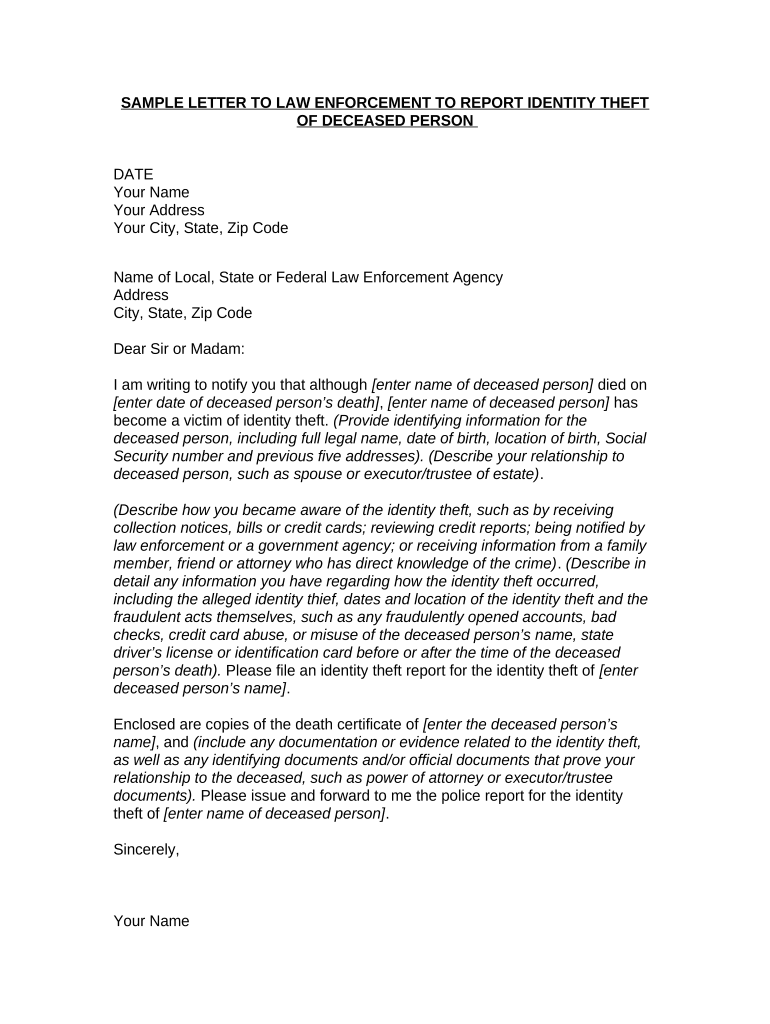
A Letter to Report Identity Theft of Deceased Person is a formal written notice used to inform financial institutions, credit bureaus, government agencies, or other organizations that a deceased individual's personal information is being misused. The letter documents the reporter's relationship to the decedent, summarizes the suspected fraudulent activity, and requests account closures, freezes, or investigatory actions. It typically accompanies supporting items such as a death certificate, proof of authority, police report, and identity documentation. Use of a clear, dated letter helps create an auditable record for recovery and dispute resolution.

Why a clear, formal letter matters

A concise, properly formatted letter establishes documented notice, triggers institution-specific fraud protocols, and supports recordkeeping for probate and creditor resolution.

Why a clear, formal letter matters

Who typically prepares and sends this letter

The sender should include documentation proving authority and identity to avoid delays or rejection by recipients.

  • Estate executors notifying banks and credit bureaus to stop unauthorized account activity and request freezes.
  • Next of kin reporting suspicious credit or benefit claims using certified copies of the death certificate.
  • Probate attorneys submitting evidence to creditors and institutions during estate administration.

Step-by-step: prepare and send the letter

Follow these sequential steps to assemble a complete report package and send it to the correct recipients.

  • 01
    Gather documents: Collect death certificate, ID, and proof of authority.
  • 02
    Describe incidents: List fraud details, dates, and affected accounts.
  • 03
    Request relief: State specific actions you want the recipient to take.
  • 04
    Send and retain: Send tracked mail or eSubmit and keep copies for records.

How to customize and complete the letter online

When using an online editor or eSignature platform, configure fields and attachments so recipients can verify authority without manual follow-up.

Field | Configuration Purpose | Notes
Full Legal Name Required text field; exact-match validation recommended
Date of Death Date picker; MM/DD/YYYY format enforced
Attach Documents PDF upload; include death certificate and authority proof
Signature Signature field with signer authentication enabled

Where to send the completed letter

Send the letter to institutions that may hold accounts or records for the decedent and to credit reporting agencies to begin dispute and freeze actions.

  • Banks: Send to fraud or estate administration department by certified mail
  • Credit Bureaus: Notify major bureaus to flag or freeze credit files
  • Government Agencies: Notify agencies (benefits, tax authorities) of suspected identity misuse
  • Service Providers: Send to insurance, utilities, and subscription services as needed

Delivery options and eSubmission considerations

Retain copies of all transmissions and confirmation receipts to support estate administration and potential litigation or creditor disputes.

  • Certified Mail: Provides delivery proof and tracking
  • Secure Upload: Use recipient portals if available
  • eSignature: Use authenticated signing and audit trail

Timing expectations and commonly required actions

Act promptly: quick notification reduces exposure and often shortens investigations. Below are practical timing milestones to guide your workflow.

Report Immediately:

Notify institutions as soon as fraud is discovered to limit damage

Police Report:

File a police report promptly if identity theft is criminal

Credit Bureaus:

Request fraud alerts or freezes right away

IRS Notification:

Inform tax authorities if tax identity theft is suspected

Record Retention:

Keep copies of all correspondence for at least three years

Key milestones from discovery to resolution

Track these numbered stages so you can measure progress and escalate when deadlines pass.

01

Discovery

Identify unauthorized accounts or transactions and collect evidence

02

Notification

Send the letter to affected institutions and credit bureaus

03

Investigation

Institutions investigate; expect requests for additional proof

04

Resolution

Accounts closed/frozen, corrections made, and replacement documents issued

Essential parts of a professional report letter

A well-structured letter makes verification easier and speeds institutional response; include these six elements clearly and in order.

Header

Date and recipient details. Use the full legal name of the institution and include a specific department (fraud, estate, compliance) when known.
Decedent Details

Full legal name, last known address, Social Security number or last four digits if available, and date of death to help match records accurately.

Reporter Identity

Your full name, relationship to decedent, contact information, and reference to proof of authority such as letters testamentary or court appointment.

Summary of Fraud

Concise chronological description of suspected fraudulent acts, including dates, account numbers, transaction amounts, and how the activity was discovered.

Requested Actions

Clear, itemized requests such as freeze file, close account, reverse transactions, remove fraudulent inquiries, or forward communications to estate counsel.

Attachments

List and attach death certificate, proof of authority, government ID, police report, and any supporting bank or credit statements.

Required information and supporting items

Decedent Name: Full legal name
Date of Death: MM/DD/YYYY
Proof of Death: Certified death certificate
Authority Proof: Letters testamentary or court appointment
Identity Proof: Government ID copy
Fraud Details: Account and transaction specifics

Consequences of an incomplete or incorrect report

Delayed Resolution: Institutions may require additional proof
Account Liability: Estate may be exposed to unauthorized debts
Credit Damage: Fraud can harm decedent credit record
Probate Complications: Creditor disputes may lengthen probate
Rejected Claims: Missing authority can result in denial
Legal Exposure: Potential litigation to resolve disputed liabilities

Common mistakes to avoid when preparing the letter

  • Failing to include certified copies of the death certificate or proof of authority, which often causes institutions to pause or refuse action.
  • Providing vague transaction descriptions without account numbers or dates, forcing the recipient to request more information and delaying remediation.
  • Using handwritten copies without legible signatures or dates; unsigned or undated letters are commonly returned or disregarded.
  • Sending only an email without documented attachments or tracked delivery; institutions often require certified mail or secure portal submissions.

Two practical examples of how the letter is used

These examples show common scenarios, the core action taken, and typical outcomes when the letter is used correctly.

Estate Bank Freeze

A personal representative discovers several debit withdrawals after the decedent’s death

  • The representative sends a detailed letter with death certificate and letters testamentary
  • The bank freezes the account, reverses unauthorized withdrawals where verified, and requests additional documentation to release funds to the estate.

Credit Report Correction

A spouse finds new credit inquiries and an open loan after the decedent’s passing

  • The spouse sends a letter plus police report and proof of death to credit bureaus
  • The bureaus place fraud alerts and remove fraudulent accounts after verification, restoring the decedent’s credit record.

Comparing eSignature costs and capabilities for submitting the letter

This vendor snapshot focuses on starting price, basic trial availability, bulk send, audit trail, HIPAA readiness, and envelope or usage caps relevant to high-volume estate workflows.

signNow DocuSign Adobe Sign PandaDoc HelloSign
Starting Price $8/user/mo $15/user/mo $14/user/mo $19/user/mo $15/user/mo
Free Trial 7-day free trial Varies Varies Varies Varies
Bulk Send Yes Yes Yes Yes Varies
Audit Trail Yes Yes Yes Yes Yes
HIPAA Compliant Yes Yes Yes No No

Frequently asked questions about preparing and submitting the letter

Answers to common questions to reduce processing delays and ensure institutions accept your report and supporting documents.


Need help? Contact support

be ready to get more
Join over 28 million airSlate SignNow users