Case caption
Include the full case caption and docket number at the top so the clerk and chambers can immediately identify the matter.
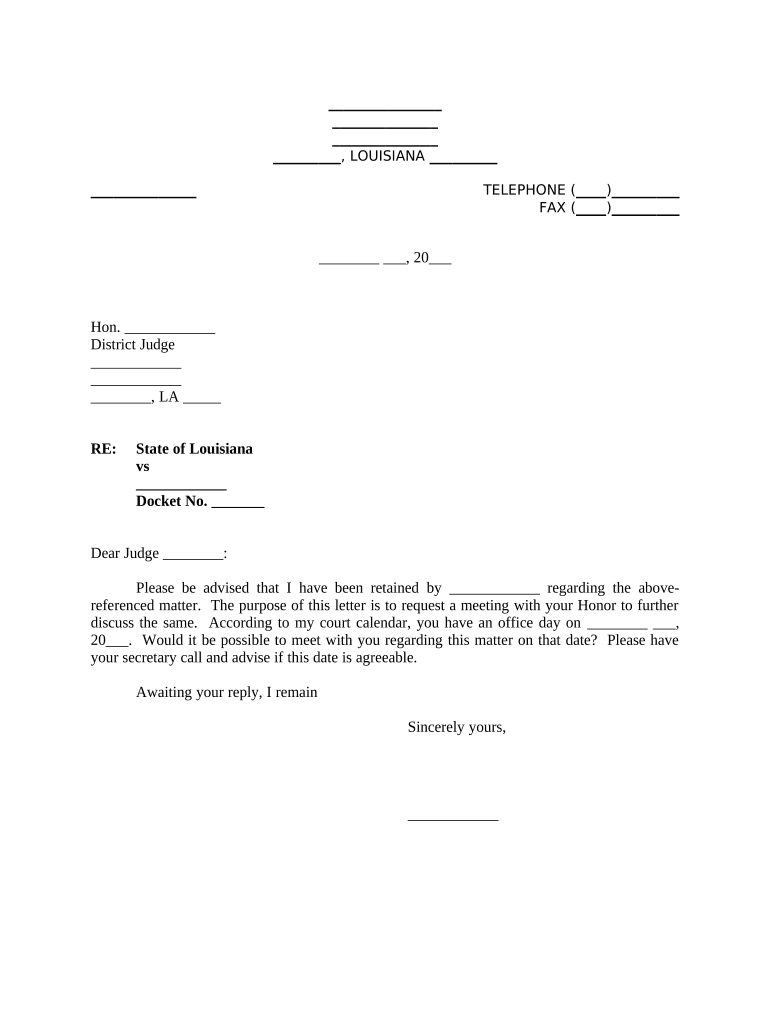
A clear, properly formatted letter clarifies the need for judicial attention, creates an official record, and speeds case management by proposing dates and agenda items in a single document.

Several courtroom participants commonly prepare a letter requesting a meeting with a judge; use this to identify who should draft or sign the request.
Confirm local rules for format, service, and filing method before sending; courts vary in whether a letter or a formal motion is required.
An attorney of record or an unrepresented party who knows the case posture should sign. Their signature attests to the facts stated, confirms service on opposing counsel, and indicates availability for proposed dates.
A clerk accepts, timestamps, and dockets the letter. Clerk endorsement or a stamped copy provides proof of filing and supports any subsequent scheduling or calendaring actions.
Include the full case caption and docket number at the top so the clerk and chambers can immediately identify the matter.
Describe the specific reason for the meeting (status, discovery dispute, settlement, scheduling) in one clear sentence to limit ambiguity.
Provide two to three mutually available dates or a date range and note any immovable conflicts to make scheduling efficient.
Attach brief exhibits or a short chronology when factual context is necessary, keeping attachments limited to what informs the scheduling decision.
Include a certificate or statement of service identifying parties served, method of service, and the date of service.
Provide the signer’s printed name, firm, bar number if applicable, email, phone, and a dated signature line.
| Field | Configuration |
|---|---|
| Document format | PDF/A for archiving and clerks; preserves formatting. |
| Authentication | Use email verification plus optional SMS code for signer attribution. |
| Attachments | Limit to necessary exhibits, compress large files before upload. |
| Retention setting | Enable audit trail retention per your records policy and applicable regulation. |
Consider the technical and compliance requirements when sending the letter electronically to the clerk or opposing counsel.
Submit at least 7–21 days before the proposed meeting date when local rules require notice.
Allow 1–3 business days for the clerk to accept and docket the letter.
Expect 3–14 days for the other side to respond unless local rule sets a shorter period.
Judge’s availability may require scheduling 2–6 weeks out for busy calendars.
Send a courteous calendar reminder 48–72 hours before the scheduled meeting.
Prepare the letter and obtain internal approvals before service.
Effect service and document the method and date.
Submit for docketing and retain stamped copy.
Receive hearing date from clerk or chambers and confirm logistics.
A firm requested a status conference to narrow discovery disputes and proposed three available dates
Plaintiff’s counsel attached a short chronology and requested a pretrial scheduling meeting
| Criteria | Letter Request | Motion | Emergency Ex Parte | Notice of Hearing |
|---|---|---|---|---|
| Purpose | informal scheduling | relief from court | immediate short-term relief | formal hearing notice |
| Formality | lower | higher | higher | higher |
| Typical response time | days to weeks | weeks | hours to days | days to weeks |
| Service requirement | standard service | formal service | immediate notice | formal service |
| signNow | DocuSign | Adobe Sign | PandaDoc | HelloSign | |
|---|---|---|---|---|---|
| Starting Price | $8/user/mo | $15/user/mo | $14/user/mo | $19/user/mo | $15/user/mo |
| Free Trial | 7-day free trial, no credit card | Varies by vendor | Varies by vendor | Varies by vendor | Varies by vendor |
| Bulk Send | Yes (Business Premium) | Yes | Yes | Yes | No |
| Audit Trail | Yes | Yes | Yes | Yes | Yes |
| HIPAA Compliant | Yes (BAA available) | Yes | Yes | No | No |