Establishing secure connection…Loading editor…Preparing document…

Letter for Order Allowing Judgment

This template is fully customizable. Edit the text, fill out the fields, and send it for signature. Give it a try!
Letter for Order Allowing Judgment

What the Letter for Order Allowing Judgment Is and When It’s Used

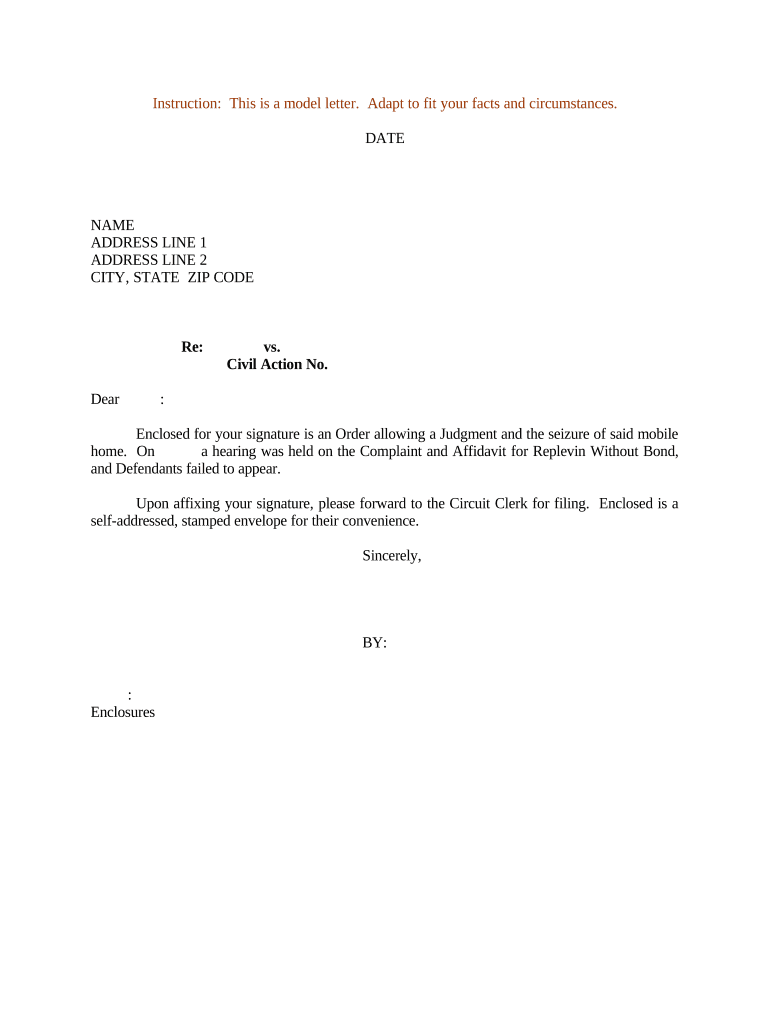
A Letter for Order Allowing Judgment is a formal cover letter addressed to a court clerk or judge accompanying a proposed order that asks the court to enter judgment for a party. It typically identifies the case caption, cites the controlling motion or stipulation, summarizes relief sought, and requests that the court sign and enter the attached order. The letter streamlines clerk review, clarifies the exact entry the moving party requests, and flags any specific processing needs such as expedited handling or entry against a defaulting defendant.

Why a Clear Letter Matters in Judgment Proceedings

A well-crafted letter reduces clerk questions, shortens entry time, and helps avoid misinterpretation that could delay judgment entry or enforcement. It provides a single-page roadmap linking the motion, supporting affidavits, and the proposed order so the court can act efficiently.

Why a Clear Letter Matters in Judgment Proceedings

Who Prepares and Relies on This Letter

Use the letter to provide context, cite controlling documents, and list attachments so the clerk can identify the correct docket entry and enter judgment promptly.

  • Creditor attorneys and collections counsel preparing judgment entry requests and writs of execution.
  • In-house legal teams submitting default judgment packages to state or federal clerks.
  • Court clerks and judicial staff who review and docket proposed orders for entry.

Typical Signatories and Responsible Parties

Creditor's Counsel

A licensed attorney representing the judgment creditor usually drafts and signs the letter, certifies compliance with local rules, and submits the proposed order with required attachments and proof of service to the clerk.

Court Clerk

The court clerk receives the letter and proposed order, verifies attachments and filings, and either enters the judgment, returns the package for corrections, or places it on the judge’s signing calendar per local practice.

Step-by-Step: Preparing and Submitting the Letter

Follow these sequential actions to prepare a complete filing packet and reduce the chance of clerk rejection or delay.

  • 01
    Draft Letter: Prepare concise letter referencing case caption, number, motion, and desired order wording.
  • 02
    Assemble Attachments: Attach proposed order, affidavits, proof of service, and any statutory required forms.
  • 03
    Sign and Date: Sign with authorized signature; include electronic signature metadata when e-submitting.
  • 04
    File or eServe: Submit via court e-filing system or deliver to clerk per local rules.

How Filing and Entry Typically Flow in Court

This simplified flow describes common processing steps from submission through judgment entry.

  • Upload or Deliver: File the letter and packet through the court's e-filing portal or in-person at the clerk's office.
  • Clerk Screening: Clerk checks docket number, attachments, signatures, and compliance with local formatting rules.
  • Judge Review: Judge or designated judicial officer reviews the proposed order and supporting papers.
  • Order Entry: Clerk enters the signed order as a docket entry and issues any judgment enforcement documents.

Configuring an Online Workflow for the Letter and Proposed Order

Set up your template and routing to match your court's filing and signature requirements for consistent, repeatable submissions.

Template Create a reusable template with fields for caption, case number, motion title, and attachment list.
Routing Order Set routing: drafter > reviewer > authorized signer > e-filing operator.
Signer Roles Assign role-based signing (attorney, client, notary) to enforce signing order.
Authentication Require email plus SMS code or higher authentication for attorney signers when available.
Auto-Reminders Enable reminders to reduce delays in signature collection.

Technical Formats and Integrations to Consider

Match your document format to the court's e-filing requirements and keep an index of all uploaded files for post-entry checks.

  • Integrations: Salesforce, NetSuite, Microsoft 365
  • File Formats: PDF, DOCX, and searchable PDFs
  • Storage: Box, Google Drive, Egnyte

Common Preparation Mistakes to Avoid

  • Using an incorrect or outdated case caption or number, which causes misfiling or clerk returns.
  • Failing to list or attach required supporting documents such as affidavits or proof of service.
  • Omitting a clear signature block with name, bar number, and date leading to questions about authorization.
  • Submitting in the wrong format or without required e-filing cover sheets, prompting clerks to reject the packet.

Practical Risks of an Incomplete or Incorrect Letter

Clerk Rejection: Filing returned
Entry Delay: Enforcement postponed
Loss of Priority: Lien or judgment priority affected
Increased Costs: Additional filing fees
Motion to Vacate: Opposing party may seek relief
Sanctions Risk: If misleading facts are submitted

Security and Compliance Considerations for eSubmission

Encryption: TLS 1.2/1.3 in transit
Data at Rest: AES-256 encryption
Regulatory: ESIGN and UETA compliance
Healthcare: HIPAA available with BAA
Audit Trail: Timestamps, IP, action log
Certifications: SOC 2 Type II, ISO 27001

Elements to Include in a Professional Letter for Order Allowing Judgment

A professional cover letter is concise, cites controlling filings, and organizes attachments so the court and opposing parties can verify the request quickly.

Case Caption

Full party names, court, and case number presented exactly as on the complaint and all related filings, enabling accurate docket matching and clerk processing.
Reference

Identify the motion or stipulation by title and docket number so the clerk can locate supporting documents without additional searches or correspondence.

Relief Requested

State the precise judgment language or monetary amount requested and any enforcement directives to avoid ambiguity in the order entered by the court.

Attachments Index

List every attached document in order and include brief descriptions (affidavit of default, declaration of damages, proof of service) to prevent missing items.

Signature Block

Provide signatory name, firm, bar number, address, phone, and signature method notation (electronic signature with audit metadata) for clerk records.

Processing Note

If expedited handling is requested, briefly explain the reason and reference any local rule or court order authorizing faster entry.

Real-World Examples of Letters and Outcomes

These two customer examples show how concise letters improved clerk processing and reduced time to entry.

Optica Ventures

Optica submitted a focused letter with a docket index

  • It attached a damages affidavit and proposed order
  • The clerk entered the order within days, reducing administrative follow-up and accelerating enforcement steps.

Martin Properties

Martin Properties used a standardized template for default judgments

  • The template listed attachments and bar numbers
  • Reusing the template cut drafting time and helped the team obtain signed orders more consistently.

Typical Timelines: Filing to Entry and Follow-up

Expect variable processing times depending on court workload, local rules, and whether expedited entry is requested.

Initial Filing:

Same day to 3 business days for e-file acceptance.

Clerk Review:

Often 3–10 business days depending on court volume and completeness.

Judge Action:

Judge may sign immediately or place on a signing calendar; timeframe varies widely.

Entry Notification:

Docket entry and notice typically issued once order is signed.

Enforcement Window:

Judgment enforcement timelines vary by state; some allow renewal or extension.

Key Milestones from Draft to Entry

Track these stages to monitor progress and schedule next steps in enforcement or appeals.

01

Drafting Complete

Letter and proposed order finalized and reviewed for accuracy and attachments.

02

Filing Submitted

Packet uploaded or delivered to clerk consistent with court e-filing rules.

03

Clerk Processing

Clerk screens for completeness and routes to judge or returns for corrections.

04

Judgment Entered

Signed order entered on the docket and enforcement documents issued as appropriate.

eSignature Vendor Comparison for Executing and Submitting Letters

Compare typical per-user starting prices and key capabilities that affect large-volume legal letter workflows; signNow is listed first per vendor ordering rules.

signNow DocuSign Adobe Sign PandaDoc HelloSign
Starting Price $8/user/mo $15/user/mo $14/user/mo $19/user/mo $15/user/mo
Free Trial 7-day free trial Varies by plan Varies by plan Varies by plan Varies by plan
Bulk Send Yes Yes Yes Yes No
Audit Trail Yes Yes Yes Yes Yes
HIPAA Compliant Yes Yes Yes No No
Envelope Cap No cap 100 envelopes/user/year Varies Varies Varies

Practical Tips for Accurate, Efficient Letter Preparation

Adopt these practices to reduce clerk follow-up and accelerate judgment entry.

Use a Template
Standardize a template with required fields and an attachments checklist to reduce drafting errors and speed repeat filings.
Verify Docket Data
Confirm the case caption and number directly from the court docket before filing to prevent misfiling.
Include Complete Attachments
Attach affidavits, calculations, and proof of service in the order listed within the letter to simplify clerk review.
Confirm Electronic Signing
If e-signing, ensure the platform captures audit metadata and that the court accepts electronic signatures for the document type.

Frequently Asked Questions About Letters for Order Allowing Judgment

Answers to typical procedural and technical questions encountered when preparing and submitting a letter and proposed order.


Need help? Contact support

be ready to get more
Join over 28 million airSlate SignNow users