Case caption
Court name, docket or case number, and caption showing the conservatee and petitioning party; used to cross-check court records and certified copies.
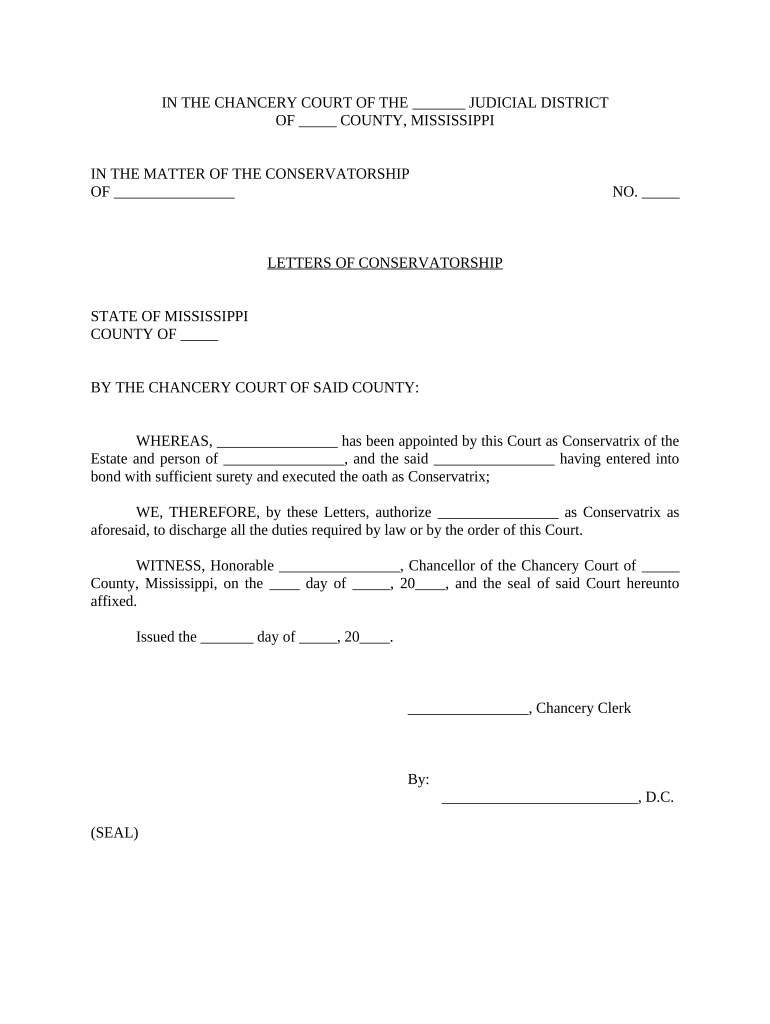
Letters provide clear, court-certified proof of a conservator’s authority, reducing administrative friction when accessing accounts, making healthcare or housing decisions, and managing property. They protect the conservator acting under court order and help institutions verify legal authority without requiring the original docket entry.

Typical parties who prepare, receive, or rely on Letters of Conservatorship Mississippi include the following.
Properly completed letters reduce delays for routine transactions and protect the conservator while complying with court-imposed limits.
Court name, docket or case number, and caption showing the conservatee and petitioning party; used to cross-check court records and certified copies.
Statement that the court appointed the named conservator, with the specific order reference and effective date, providing the primary legal basis for authority.
Conservator full legal name, mailing address, and sometimes identification details so institutions can match records reliably before releasing funds.
Explicit list of powers granted (financial, healthcare, real property, fiduciary acts) and any limitations or conditions imposed by the court.
Clerk’s signature, court seal, and issuance date or a certified copy notation that establishes the document as an official court instrument.
Any term limits, required reporting obligations, or instructions about when the conservatorship must be reexamined or closed by the court.
| Upload court order | Attach scanned signed order in PDF format for reference and certification. |
|---|---|
| Create certified copy field | Mark the document as 'Certified Copy' and include clerk seal image if available. |
| Set signer roles | Assign who signs or acknowledges receipt of the document; conservator and court clerk roles are common. |
| Authentication level | Require email or SMS code for recipient verification when you share electronically. |
| Retention settings | Enable secure storage and audit trail for compliance and recordkeeping. |
Common delivery methods include certified paper copies and secure electronic transmission to institutions.
Choose formats and authentication that meet the receiving institution’s requirements and preserve the court-certified status.
Request certified letters immediately from the clerk after the court signs the order.
Banks may take several business days to verify the certified document and update account permissions.
Allow additional time for title companies to review scope and obtain title insurance approvals.
Comply with any court-ordered inventories or periodic accountings by stated deadlines.
When conservatorship ends, obtain a court order terminating authority and provide certified notice to institutions.
Court receives petition and schedules a hearing.
Judge determines incapacity and potential conservator appointment.
Judge signs appointment order with defined authority.
Clerk issues certified letters or certified copies for third parties.
| signNow | DocuSign | Adobe Sign | PandaDoc | HelloSign | |
|---|---|---|---|---|---|
| Starting Price | $8/user/mo | $15/user/mo | $14/user/mo | $19/user/mo | $15/user/mo |
| Free Trial | 7-day trial | Varies | Varies | Varies | Varies |
| Bulk Send | Yes | Yes | Yes | Yes | No |
| Audit Trail | Yes | Yes | Yes | Yes | Yes |
| HIPAA Compliant | Yes | Yes | Yes | No | No |
A conservator obtains a certified letter after appointment and provides it to the bank to add fiduciary access to accounts.
A conservator presents the certified letter to a hospital admitting office to make care decisions for the conservatee.