Parties
Identify full legal names of releasor(s) and releasee(s), including entity type and address.
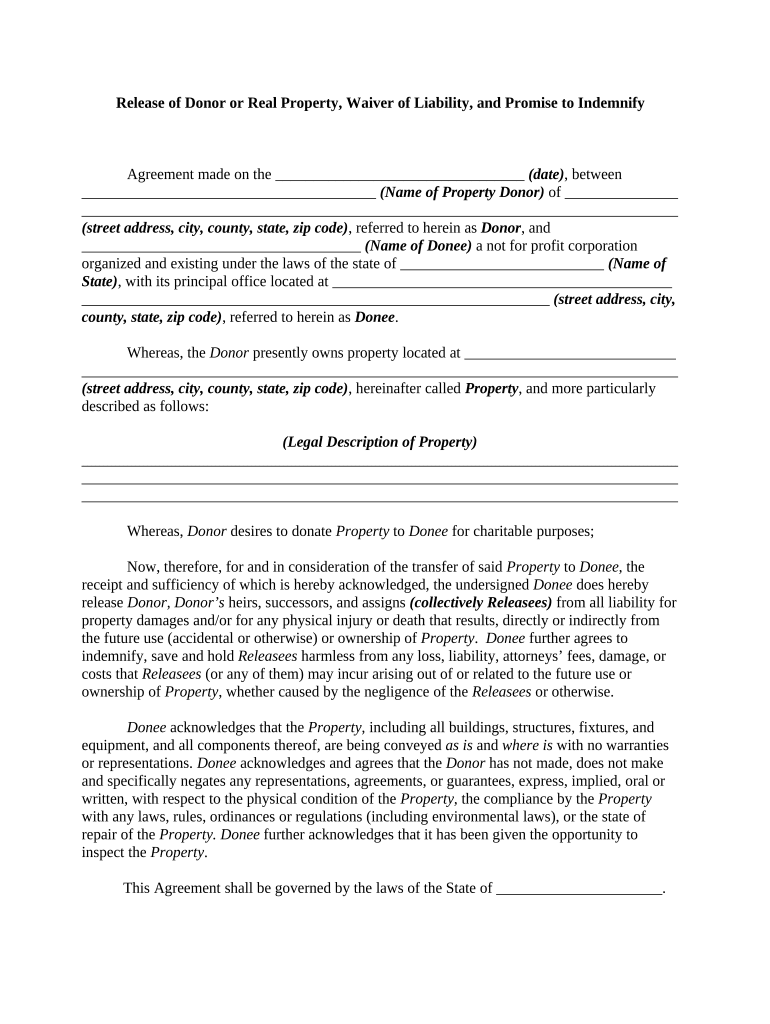
A clear waiver documents risk allocation, reduces litigation exposure, and promotes informed consent; legal validity is governed by the ESIGN Act (15 U.S.C. ch. 96) and state contract law, including UETA where adopted.

Liability waivers are used by organizations and individuals that host activities, provide services, or permit access where physical risk or professional risk exists.
Choose waiver language and execution method based on the activity, the parties’ bargaining power, and applicable state statutes to improve enforceability.
An adult competent to contract may sign to release personal claims. Minors generally cannot sign to waive future personal injury claims; parental or guardian signatures are required for minors and may have statutory limits.
An authorized agent or corporate officer can sign on behalf of an organization if the signer has authority; include printed name, title, and capacity to avoid challenges to signature validity.
Identify full legal names of releasor(s) and releasee(s), including entity type and address.
Describe the permitted activity or service in precise terms to limit ambiguity about covered risks.
List foreseeable risks and hazards so signers understand what they are releasing.
Specify claims covered (negligence, property damage) and any exceptions (gross negligence, willful misconduct) if permitted by law.
Provide printed name, signature, date, and capacity (parent, guardian, agent) with clear signature lines.
Select the governing state and include dispute resolution terms where appropriate.
| Field | Configuration |
|---|---|
| Signature Type | Visible signature with attached audit trail |
| Authentication | Email plus optional SMS or KBA for higher-risk activities |
| Retention | Store signed PDF and audit log for retention period |
| Copy Distribution | Automatically send executed copy to signer and organizer |
Choose a platform that preserves intent, attribution, and reproducible records and supports legal standards such as ESIGN and UETA.
Preserve a tamper-evident signed PDF and an audit trail containing timestamps, IP addresses, and signer authentication to support enforceability.
Date obligations and releases begin; use MM/DD/YYYY.
Set a clear deadline for execution before activity begins.
Retention period typically begins at execution date.
Complete notarization before filing or before activation if required.
Schedule periodic reviews and updates to waiver language.
Create clear language and define covered risks.
Collect signatures and confirm identity.
Provide signed copies to all parties promptly.
Store executed documents and audit logs securely.
| signNow | DocuSign | Adobe Sign | PandaDoc | HelloSign | |
|---|---|---|---|---|---|
| Starting Price | $8/user/mo | $15/user/mo | $14/user/mo | $19/user/mo | $15/user/mo |
| Free Trial | 7-day free trial | Verify | Verify | Verify | Verify |
| Bulk Send | Yes | Verify | Verify | Verify | Verify |
| Audit Trail | Yes | Yes | Yes | Yes | Yes |
| HIPAA Compliant | Yes | Verify | Verify | Verify | Verify |
| Envelope Cap | No cap | 100 envelopes/user/year | Verify | Verify | Verify |