Establishing secure connection…Loading editor…Preparing document…

New York Warranty Deed to Child Reserving Life Estate

This template is fully customizable. Edit the text, fill out the fields, and send it for signature. Give it a try!
New York Warranty Deed to Child Reserving Life Estate

What this New York warranty deed accomplishes

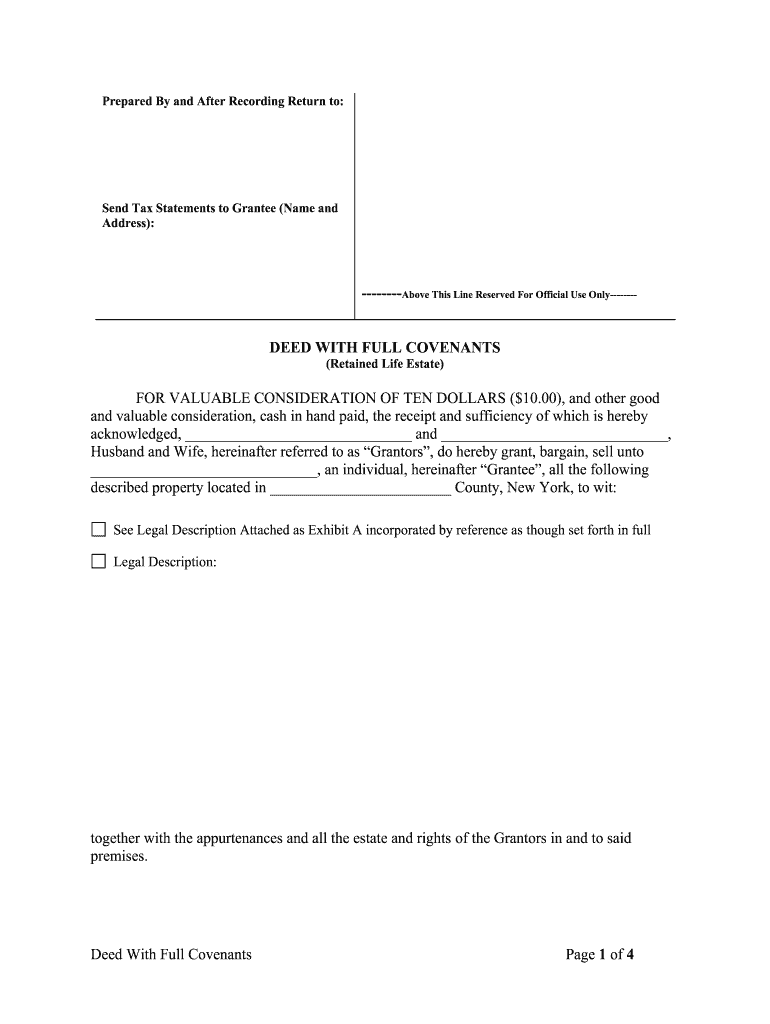
A New York Warranty Deed to Child Reserving Life Estate transfers ownership of real property to a child while the grantor retains a life estate — the right to use the property for life. This deed conveys full title subject to the retained life estate and contains warranty language promising title against defects. It is commonly used for estate planning to pass property outside probate while preserving the grantor's occupancy or income rights. In New York this deed requires proper notarization and recording in the county where the property is located.

Why people use this deed in estate planning

Using a New York Warranty Deed to Child Reserving Life Estate helps transfer title efficiently while preserving the grantor’s lifetime use and income. It can reduce probate complexity, provide warranty protections to the child, and allow controlled succession of property ownership.

Why people use this deed in estate planning

Common users and stakeholders

Typical users include private individuals, estate attorneys, and family members planning property succession in New York.

  • Parents seeking to retain lifetime occupancy while transferring remainder to a child.
  • Adult children receiving title but accepting a remainder interest subject to life estate.
  • Estate planners and attorneys preparing instruments to avoid probate and clarify succession.

Key components every deed should contain

A professional New York Warranty Deed to Child Reserving Life Estate must combine clear grant language, life estate reservation, warranty covenants, accurate legal descriptions, notarization, and recordation instructions.

Grant Language

Include explicit words of conveyance to the child, state consideration, and specify that title passes subject to the grantor's reserved life estate with warranty protections.
Life Estate Reservation

Describe the grantor's retained rights: possession, rents, profits, maintenance responsibilities, and whether rights can be transferred or terminated before death, and specify any limitations or conditions.

Warranty Covenants

State full warranty covenants where the grantor guarantees marketable title and agrees to defend against lawful claims, and include any exceptions or recorded liens on the date of conveyance.

Legal Description

Provide the exact metes and bounds or tax parcel identification used by the county; avoid abbreviations and verify against county land records before recording to prevent rejection.

Notary Acknowledgment

Include a proper New York notary acknowledgment block with signature lines and the notary’s commission details; required for recording and for title insurance acceptance.

Recording Instructions

Specify the county clerk's office where the deed must be recorded, include return-to information, and note any documentary stamp or recording tax obligations plus required filing fees.

Required information and fields at a glance

Grantor Name: Full legal name as ID
Grantee Name: Child's full legal name
Property Address: Street, city, state, ZIP
Legal Description: Metes and bounds or parcel ID
Consideration: Amount or stated consideration
Effective Date: Enter as MM/DD/YYYY format

Principal risks of errors or omissions

Invalid Conveyance: Improper wording may void transfer
Medicaid Risk: Transfer may trigger look-back penalties
Mortgage Default: Lender consent often required
Tax Consequences: Gift or capital gains issues possible
Recording Rejection: Missing notarization or description delays recordation
Probate Misunderstanding: Incorrect form may not avoid probate

Common preparation mistakes to avoid

  • Failing to reserve the life estate in precise language, including duration and powers, can create ambiguity about possession rights and lead to litigation after the grantor's death.
  • Using an incorrect legal description or relying on a street address instead of the county parcel identifier risks rejection by the county clerk and may impede title insurance issuance.
  • Not obtaining lender approval when the property has an existing mortgage can trigger acceleration clauses, accelerate debt, or be a basis for lender foreclosure actions.
  • Overlooking tax, gift, or Medicaid planning consequences during a Medicaid look-back period can trigger penalties or temporary ineligibility for benefits.

Step-by-step: preparing and recording the deed

Follow this step-by-step sequence to create, execute, and record a valid New York Warranty Deed to Child Reserving Life Estate.

  • 01
    Prepare Draft: Assemble legal description, parties, consideration, and reservation language.
  • 02
    Review with Counsel: Confirm tax, Medicaid, and mortgage impacts before signing.
  • 03
    Sign and Notarize: All grantors sign before notary; include necessary acknowledgments.
  • 04
    Record Deed: File with county clerk where the property is located and pay fees.

How to configure an online workflow for this deed

Configure an online workflow for secure completion, signing, notarization, and record-ready export of the deed.

Workflow Field Configuration and Setting How to set the field and recommended value
Identity Verification Method and Options Email link default; use SMS OTP or KBA for added assurance
Notary Mode Selection and Preferences Enable RON or include printable notary acknowledgement for in-person notarization
Document Format and Audit Trail Settings Export as PDF/A with embedded audit trail and signer certificate
Return Settings and Recording Filename Convention Specify return-to email and county recording filename format

Where to file and how the final steps flow

This outline shows where to send, how to notarize, and final recording steps for the completed deed.

  • Prepare Document: Assemble signed deed, exhibits, and required notary acknowledgments.
  • Notarization: Complete in-person or RON notarization per New York requirements.
  • Record County: File with county clerk, include documentary stamp or transfer tax payment.
  • Distribute Copies: Provide recorded copy to grantee and retain originals for the grantor.

Platform and delivery considerations for electronic workflows

Use a secure eSignature platform that supports audit trails, PDF/A export, RON capability, and integrations with cloud storage and county recording workflows.

  • File Formats: PDF, DOCX, and PDF/A supported
  • Integrations: Salesforce, NetSuite, Google Workspace, Box
  • Authentication: Email link, SMS OTP, KBA, or SSO

Timing and deadlines to keep in mind

Key timing expectations for execution, notarization, recording, and legal effects of the deed in New York.

Deed Execution and Signature Date:

Date parties sign; determines effective rights and possible look-back calculations.

Notarization Completion and Acknowledgment Date:

Complete notarization before recording to avoid county clerk rejection.

Recording and Return-to Instructions Date:

Record promptly after notarization; delays may affect tax or title matters.

Documentary Tax and Transfer Filing Deadline:

Pay any documentary transfer tax at recording per county requirements.

Medicaid Look-back and Planning Consideration:

Transfers within look-back periods can affect eligibility; consult counsel for timing.

Pricing comparison for common eSignature providers

Compare common pricing and feature criteria for popular eSignature providers; signNow appears first for reference.

signNow DocuSign Adobe Sign PandaDoc HelloSign
Starting Price $8/user/mo $15/user/mo $14/user/mo $19/user/mo $15/user/mo
Free Trial Yes, 7-day trial Varies Varies Varies Varies
Bulk Send Yes (premium tier) Varies Varies Varies Varies
Audit Trail Yes Yes Yes Yes Yes
Envelope Cap No cap 100 envelopes/user/year Varies Varies Varies

Representative users who complete or approve this deed

Estate Attorney

An estate attorney drafts deed language to reserve a life estate while conveying remainder to a child, analyzes tax and Medicaid implications, obtains lender consents, prepares notary acknowledgment, and advises on recording procedures to ensure enforceability and acceptance by title insurers.

Private Grantor

A private grantor completes this deed to transfer property to a child but retain lifetime residence and income; they coordinate with counsel and notary, verify county legal descriptions, check mortgage covenants, and keep recorded copies for tax reporting and future title proof.

Practical best practices to reduce risk

Best practices minimize risk: precise language, lender consent checks, counsel review, and careful recording prevent disputes and protect title for both grantor and child.

Use precise, recorded legal descriptions
Verify the county assessor’s metes-and-bounds or parcel ID against previous recorded instruments. Avoid using only street addresses. Accurate descriptions reduce clerk rejections and ensure consistency for title searches and insurance underwriting.
Obtain written lender consent to avoid acceleration
Review existing mortgage terms and get written lender consent if required. Failure to secure consent may trigger acceleration, breach covenants, or impair title, so document lender responses and include waivers when necessary.
Document tax and Medicaid planning analysis
Coordinate with tax counsel to evaluate gift tax, capital gains, and basis adjustments. For applicants nearing Medicaid eligibility, obtain specialist advice on look-back periods and potential penalties before transferring property.
Record promptly and retain certified copies
Record the notarized deed at the appropriate county clerk immediately after execution. Obtain certified copies, retain originals, and save electronic PDFs with audit trails for at least seven years to support title and tax inquiries.

Illustrative examples of common use cases

Real-world examples illustrate how the deed is used for family transfers, tax planning, and avoiding probate in New York.

Family Transfer

A retired New York homeowner granted a life estate to remain in the house while conveying remainder to their adult child to simplify succession and minimize probate.

  • Child receives clean title at death.
  • The family coordinated with counsel to check mortgage consent, executed the deed with a notary, recorded it at the county clerk, and retained copies for tax reporting and title insurance acceptance to prevent later disputes.

Estate Planning

An estate planner used the deed to transfer a vacation property to a child while preserving the grantor's rental income rights during life and documenting warranty covenants.

  • Avoids probate and clarifies future ownership.
  • Before recording, the planner verified tax consequences, ensured no mortgage acceleration, attached occupancy terms as an exhibit, and had the deed notarized and recorded to secure marketable title and insurability for the beneficiary.

Frequently asked questions and practical answers

Answers to frequent questions when preparing a New York Warranty Deed to Child Reserving Life Estate, including signing, notarization, recording, and legal consequences.


Need help? Contact support

be ready to get more
Join over 28 million airSlate SignNow users