Establishing secure connection…Loading editor…Preparing document…

Limited Partnership Agreement

This template is fully customizable. Edit the text, fill out the fields, and send it for signature. Give it a try!
Limited Partnership Agreement

What a Limited Partnership Agreement Is and why it matters

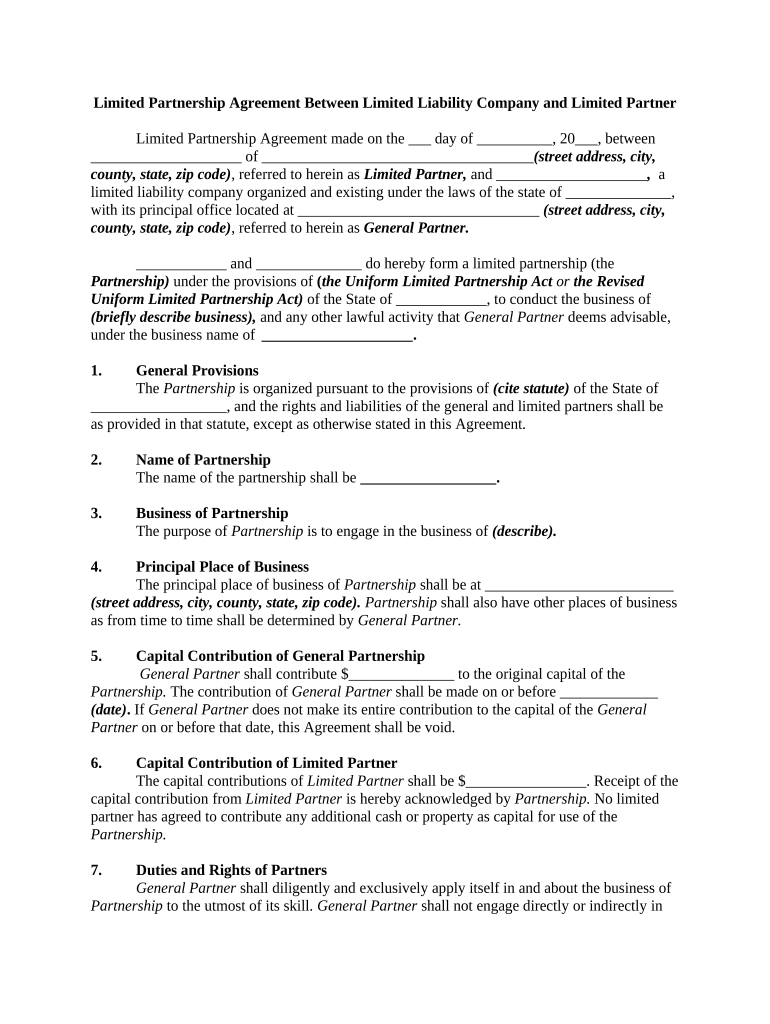
A Limited Partnership Agreement is a written contract that defines the relationship between general and limited partners in a limited partnership (LP). It establishes capital contributions, profit and loss allocation, management rights, voting procedures, transfer restrictions, dissolution mechanics, and liability allocation. The agreement governs internal affairs and complements any Certificate of Limited Partnership filed with the state. While statutes supply default rules, a tailored agreement permits partners to modify governance, financial terms, and exit procedures to reflect the business’s commercial needs and risk allocation.

Why using a formal Limited Partnership Agreement is essential

A clear Limited Partnership Agreement protects limited partners’ liability shield, documents financial commitments, reduces internal disputes, and records decision-making authority. It ensures predictable tax reporting, clarifies management duties for general partners, and serves as evidence of agreed terms if disputes arise.

Why using a formal Limited Partnership Agreement is essential

Who typically prepares and signs a Limited Partnership Agreement

The agreement is used by investors and operators who form a limited partnership to run a business or hold assets; responsibilities are split between general and limited partners.

  • Private investment groups and fund sponsors who pool capital and need governance rules and profit allocation.
  • Real estate developers using LPs to hold projects while passive investors take limited liability.
  • Professional service firms or project-based joint ventures where active managers have operational control.

Parties often use counsel to draft or review the document, and many organizations use standardized templates with custom exhibits to speed execution while preserving legal clarity.

Representative signers and their roles

General Partner

The general partner has management authority and unlimited liability under default state law; the agreement should describe duties, indemnities, and decision thresholds to limit disputes and align expectations among investors and managers.

Limited Partner

A limited partner contributes capital and enjoys limited liability if passive; the agreement must specify capital commitments, distribution priority, transfer restrictions, and information rights to preserve limited-status protections.

Essential information to include in the agreement

Parties' Names: Full legal names
Capital Contributions: Amount and form
Profit Allocation: Percentages or priorities
Management Rights: Roles and authority
Term and Dissolution: Duration and triggers
Governing Law: State selected

Step-by-step: completing and executing the agreement

Follow these sequential steps to prepare, approve, and finalize a Limited Partnership Agreement so it is enforceable and aligns with state filing requirements.

  • 01
    Draft: Prepare initial draft with key economic and governance terms.
  • 02
    Review: Have counsel and partners review terms and exhibits.
  • 03
    Sign: Obtain signatures and any required notarizations.
  • 04
    File & Distribute: File the Certificate of LP if required and provide copies to partners.

Where to file, send, and retain the signed agreement

Filing and distribution steps vary by jurisdiction and business purpose; use the route below to determine practical destinations for executed copies and public filings.

  • State Filing: File Certificate of Limited Partnership with the state Secretary of State when forming.
  • Partners: Provide executed copies to each partner and to the partnership’s records.
  • Tax Advisor: Share agreement with tax advisor for allocation and filing guidance.
  • Business Bank: Deliver copies when opening partnership bank accounts if required.

Configuring an online workflow for execution and storage

Set up a repeatable digital signing workflow to collect signatures, preserve the audit trail, and store executed agreements securely.

Field Configuration
Template Standardize a reusable agreement template
Signer Order Define execution order (general then limited partners)
Authentication Choose email, SMS code, or stronger methods
Storage Save PDF and audit trail to secure repository

Digital signing and platform considerations

Select a signing platform that supports secure authentication, tamper-evident signed PDFs, and configurable workflows.

  • File formats: PDF, DOCX supported
  • Integrations: Salesforce, NetSuite, Google Workspace
  • Security: AES-256 at rest; TLS 1.2/1.3 in transit

Ensure the platform provides a complete audit trail, optional advanced signer authentication, and secure storage to meet record retention and compliance needs.

Timing considerations and common deadlines

While the agreement itself has no universal federal filing deadline, related filings and reporting have time-sensitive requirements to plan for.

Formation Filing:

File Certificate when forming — effective on state acceptance

Tax Reporting:

Partnership tax returns due March 15 generally (Form 1065 timing varies)

Capital Contributions:

Record contribution dates for tax basis and allocation

Annual Filings:

Some states require annual reports or fees

Record Retention:

Retain executed agreement per regulatory retention rules

Key formation and lifecycle milestones

Track these numbered milestones from formation through termination to stay compliant and maintain partner protections.

01

Adopt Terms

Agree on governance, capital, and distributions.

02

File Certificate

Submit state formation documents and pay fees.

03

Execute Agreement

Collect all partner signatures and retain originals.

04

Ongoing Compliance

Meet annual reporting, tax, and recordkeeping obligations.

Common drafting and execution mistakes to avoid

  • Using vague allocation language that creates tax or distribution disputes among partners.
  • Failing to document capital calls and defaults, which causes enforcement and fairness issues.
  • Neglecting transfer restrictions or admission procedures, opening the partnership to unwanted new partners.
  • Relying on unsigned or partially executed copies rather than retaining fully executed originals.

Risks and legal consequences of an incomplete or incorrect agreement

Loss of Limited Liability: Improper structure may expose limited partners to full liability
Tax Misallocation: Incorrect allocations can trigger IRS adjustments
State Noncompliance: Missed filings may result in fines or inactive status
Enforceability Issues: Ambiguous clauses increase litigation risk
Operational Disruption: Unclear authority can stall decisions
Reputational Harm: Partner disputes can affect investor confidence

Comparing common eSignature platforms for executing partnership agreements

Basic pricing and feature availability vary by vendor and plan; signNow is listed first for parity in comparison. Confirm plan details with vendors for advanced compliance needs.

signNow DocuSign Adobe Sign PandaDoc HelloSign
Starting Price $8/user/mo $15/user/mo $14/user/mo $19/user/mo $15/user/mo
Free Trial 7-day free trial Varies Varies Varies Varies
Bulk Send Yes Yes Yes Yes No
Audit Trail Yes Yes Yes Yes Yes
HIPAA Compliant Yes Yes Yes No No

Real-world examples of executing agreements online

Organizations from venture funds to property firms use digital execution to speed closing and maintain compliance.

Optica Ventures LLC

Optica streamlined signature collection for investor documents using an online workflow, reducing delays.

  • The UI was described as simple and easy-to-use.
  • The COO said the interface is easy for the team and customers, enabling faster execution and fewer follow-ups on investor paperwork while preserving compliance.

Martin Properties

A regional real estate firm moved partnership agreements online to support remote closings.

  • Mobile signing enabled on-site partners.
  • The founder reported processing and executing all documents online with 100% compliance and built-in security, improving turnaround and client responsiveness.

Practical drafting and execution tips for clarity and enforceability

Adopt clear drafting conventions, consistent dates, and standardized exhibits to reduce ambiguity and simplify future amendments.

Use Defined Terms Consistently
Define capitalized terms in a single section and use them uniformly throughout to avoid interpretive disputes over obligations and rights.
Record Contribution Details
Document the form, valuation, and timing of noncash contributions with exhibits to preserve tax basis and capital account accuracy.
Limit General Partner Authority
Use thresholds or consent requirements for extraordinary actions to protect limited partners from unilateral decisions that increase liability.
Preserve Audit Trails
When using electronic signatures, retain a tamper-evident PDF with timestamps, IP addresses, and authentication method to support enforceability.

Frequently asked questions about Limited Partnership Agreements

Answers to common questions about validity, signatures, amendments, and recordkeeping to help avoid execution errors.


Need help? Contact support

be ready to get more
Join over 28 million airSlate SignNow users