Establishing secure connection…Loading editor…Preparing document…

Lis Pendens

This template is fully customizable. Edit the text, fill out the fields, and send it for signature. Give it a try!
Lis Pendens

What a Lis Pendens Is and when it applies

A Lis Pendens is a recorded notice placed in public land records to notify third parties that a lawsuit exists affecting title to a specific parcel of real property. It alerts prospective purchasers or lenders that the property is subject to pending litigation or claim, and it preserves potential equitable remedies by creating public notice. A properly prepared Lis Pendens typically identifies the parties, the court case or claim, a legal description of the property, and the recording office. Recording rules and the legal effect of a Lis Pendens vary by state and by the nature of the underlying claim.

Why a Lis Pendens matters to property claims

A Lis Pendens protects the claimant’s interest by warning third parties and discouraging transfers or liens that could frustrate recovery. It supports equitable remedies by placing constructive notice on the title record and can affect marketability and financing for the property while the action is pending.

Why a Lis Pendens matters to property claims

Who prepares and relies on a Lis Pendens

Typical users include property owners, claimants in quiet-title or foreclosure-related litigation, real estate attorneys, title companies, and lenders.

  • Real estate attorneys and claimants who need to preserve rights during litigation and warn third parties of claims against title.
  • Title companies and lenders who review public records to assess encumbrances and underwriting risks before issuing policies or loans.
  • Recording offices and county clerks who process and index notices for public access and chain-of-title purposes.

Because state requirements vary, practitioners and affected parties should confirm local recording rules and consult counsel before filing.

Core elements to include in a professional Lis Pendens

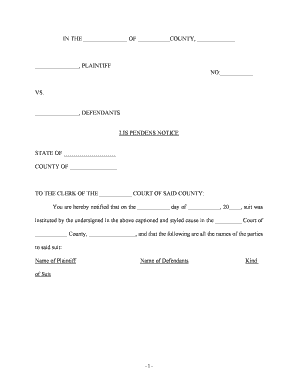
A well-drafted Lis Pendens is concise but complete: it identifies the litigation, gives an accurate legal description of the property, names the parties, and directs readers to the court case. Include contact and filing information so clerks and third parties can verify the underlying action.

Caption

Court name, case number, and filing party — aligns the notice to the underlying civil action and enables clerical verification.
Parties

Full legal names for plaintiff(s) and defendant(s) as shown in the court filing; avoid abbreviations that obscure identity.

Property Description

Complete legal description or assessor’s parcel number; street addresses alone are usually insufficient for record indexing.

Statement of Claim

A brief plain-language statement describing the nature of the claim affecting title, limited to what is necessary for notice.

Recording Details

Name of county recorder/registrar, book/page or instrument number if known, and recording date once filed.

Signer Information

Name, capacity (e.g., plaintiff or attorney), signature, and date; include notarization or verification if required by local law.

Required factual details typically collected

Court Case: Court name and case number
Claimant Name: Full legal name of party filing
Respondent Name: Full legal name of party alleged to hold interest
Property ID: Assessor parcel number
Legal Description: Metes and bounds or recorded plat
Recording County: County where property is recorded

Step-by-step: preparing and filing a Lis Pendens

Follow a consistent sequence to reduce defects: verify claimability, prepare a concise notice, confirm the legal description, obtain necessary signatures/notarization, and record with the local recorder. After recording, serve or deliver copies per local rules.

  • 01
    Verify Claim: Confirm that your cause of action supports a Lis Pendens under state law.
  • 02
    Draft Notice: Prepare a concise notice with case ID and property legal description.
  • 03
    Authenticate: Sign and notarize or verify the notice if required by the jurisdiction.
  • 04
    Record & Distribute: File at the county recorder and provide required service or copies after recording.

Where the Lis Pendens goes after it's prepared

Recording and distribution steps vary by state: after preparing the notice and securing required attestations, the document is recorded in the county land records and then distributed to affected parties or their counsel.

  • County Recorder: Primary filing office for recording and indexing the notice.
  • Court File: Keep a copy in the court record to show consistency with the complaint.
  • Opposing Parties: Serve or deliver a copy to defendants or title holders as required.
  • Title Company: Provide notice to insurers when clearing or underwriting title.

Digital workflow checklist for preparing and recording

A clear workflow ensures every step is verifiable: prepare the document, apply authentication, record, and distribute. Configure each stage for auditability and retention.

Step Configuration
Document Preparation Use a template with required fields pre-populated
Signer Authentication Choose email, SMS code, or higher assurance where needed
Recording Upload Ensure PDF/A or county-preferred format
Post-Recording Distribution Automate delivery of recorded instrument to parties

Digital signing and eSubmission considerations

Confirm whether the county recorder accepts electronic records and what authentication or format they require before e-filing or e-signing.

  • File Format: Use PDF or county-specified format for upload.
  • Authentication: Apply signer authentication per county requirements.
  • Audit Trail: Retain timestamps, IPs, and signer evidence for records.

When eSubmission is supported, use a platform that preserves an unalterable audit trail and stores a copy of the recorded instrument alongside the signing history.

Potential legal risks and penalties to avoid

Wrongful Filing: Slander of title claims may follow
Perjury Risk: False statements can trigger criminal exposure
Sanctions: Court penalties for improper use
Recording Rejection: Clerks may refuse incomplete notices
Title Clouding: Impacts sale and financing ability
Statute Limitations: May not extend underlying limitations

Common preparation errors to avoid

  • Using an incomplete or imprecise legal description that prevents proper indexing and causes recorder rejection or ambiguous title notice.
  • Mismatching party names between the Lis Pendens and court pleadings, which can result in clerical errors or challenges to notice validity.
  • Failing to notarize or verify the notice where the jurisdiction requires it, leading to rejection or ineffective notice.
  • Neglecting to serve or deliver required copies after recording, which can create procedural defenses for affected parties.

Practical tips for accurate and efficient filing

Adopt consistent templates and verification steps to reduce rejections. Where available, use electronic workflows that preserve a tamper-evident audit trail.

Use exact recorded legal descriptions
Copy the deed or recorded plat description verbatim to avoid ambiguity. Where possible, include assessor parcel numbers to aid recorder indexing and title searches.
Confirm local recorder formatting
Check the county recorder’s submission standards (margins, font, required cover sheet) before filing to prevent administrative rejection and delays.
Retain proof of service and recording
Keep certified copies and recorded instrument images alongside signed audit trails to demonstrate notice and support enforcement if needed.
Coordinate with counsel before filing
Have an attorney confirm that your underlying claim warrants a Lis Pendens and that filing it complies with state law and ethical obligations.

Timelines to expect when filing and processing

Timing depends on the county recorder and any statutory service requirements; plan for immediate recording followed by administrative processing and possible court challenges.

Recording Effectiveness:

Notice typically becomes effective upon recording with the county office.

Clerical Processing:

Recorder indexing can take 1–10 business days depending on county workload.

Service Deadlines:

State rules may require service or mailing within a short period after recording.

Challenge Window:

Opposing parties often move to expunge or dissolve a Lis Pendens early in the litigation.

Removal or Release:

Lis Pendens is removed upon settlement, dismissal, or court order; administrative releases vary by county.

Comparing eSignature vendor basics for Lis Pendens workflows

When choosing an eSignature provider for documents related to Lis Pendens and recording, compare price model, bulk capabilities, audit trail, and HIPAA/enterprise compliance. signNow appears first for comparison.

signNow DocuSign Adobe Sign PandaDoc HelloSign
Starting Price $8/user/mo $15/user/mo $14/user/mo $19/user/mo $15/user/mo
Free Trial 7-day free trial Varies by plan Varies by plan Varies by plan Varies by plan
Bulk Send Yes (Business Premium) Varies by plan Varies by plan Varies by plan Varies by plan
Audit Trail Yes Yes Yes Yes Yes
HIPAA Compliant Yes Yes Yes No No
Envelope Cap No cap 100 envelopes/user/year Varies by plan Varies by plan Varies by plan

Common questions about Lis Pendens — answers and next steps

Below are frequently encountered questions about Lis Pendens preparation, recording, and e-signature use, with concise guidance for practical next steps.


Need help? Contact support

be ready to get more
Join over 28 million airSlate SignNow users