Establishing secure connection…Loading editor…Preparing document…

Louisiana Affidavit of Death and Heirship

This template is fully customizable. Edit the text, fill out the fields, and send it for signature. Give it a try!
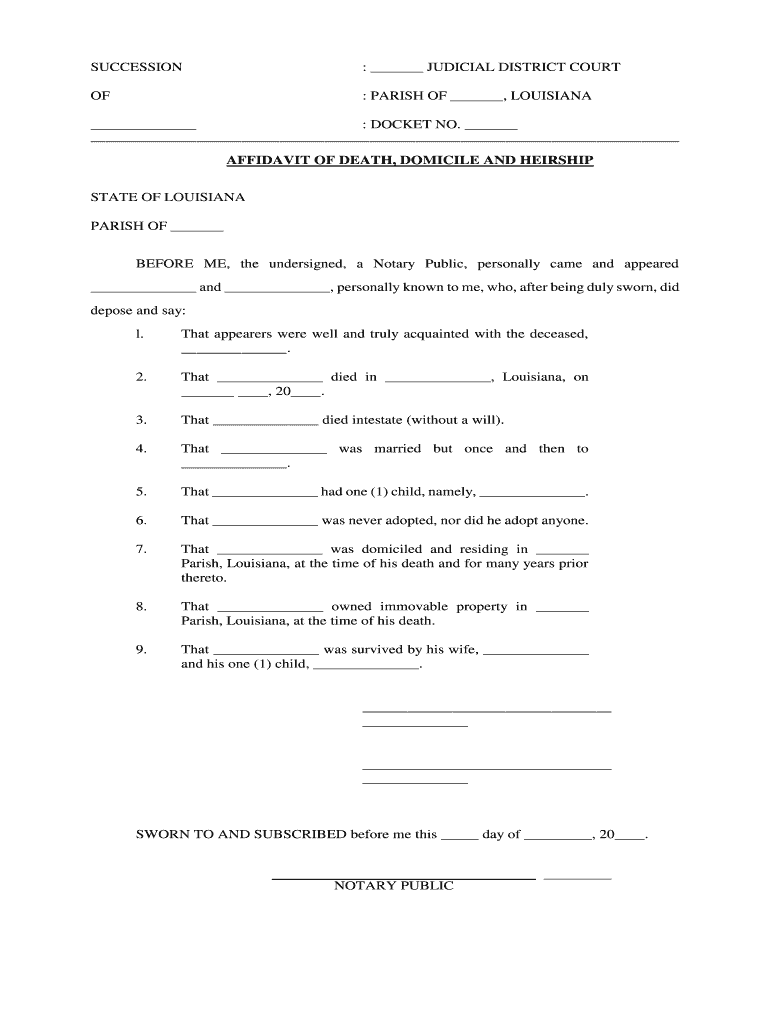
Louisiana Affidavit of Death and Heirship

What the Louisiana Affidavit of Death and Heirship Is

The Louisiana Affidavit of Death and Heirship is a sworn statement prepared to identify a decedent, list lawful heirs, and describe property or accounts for transfer without formal succession proceedings when permitted by law. It is typically completed by a person with direct knowledge of the family relationships and the decedent’s assets, signed under oath, and notarized or authenticated according to Louisiana notarial rules. The affidavit is commonly used by banks, title companies, and registrars to clear title or release assets when the estate qualifies for a simplified transfer procedure.

Why this affidavit matters and when it applies

The affidavit provides an expedited, cost-effective method to document heirs and permit transfers when formal probate is unnecessary. Electronic execution may be acceptable under federal ESIGN (15 U.S.C. ch. 96) and state UETA rules, but notarization and witness requirements are governed by state notary law and Louisiana civil-law practice.

Why this affidavit matters and when it applies

Who commonly prepares and relies on this affidavit

Typical users prepare and submit the affidavit to institutions and registrars to clear title or release funds without opening full succession.

  • Heirs and family members who need to claim personal property or small estate proceeds with minimal court involvement.
  • Financial institutions and title companies that require legal evidence of heirship before releasing accounts, vehicles, or transferring titles.
  • Estate attorneys or notaries who draft, review, and authenticate the affidavit for legal sufficiency and compliance.

When prepared correctly the affidavit reduces administrative delay; when requirements are unclear, professionals or the receiving institution can specify additional documentation.

Core elements to include in a professional affidavit

A complete affidavit of death and heirship organizes the decedent’s identity, family relationships, the affiant’s statement, and supporting attachments to give receiving parties clear legal context.

Decedent details

Full legal name, date of death, last domicile, and any aliases; these facts anchor identity and jurisdiction.
Affiant statement

A sworn declaration by the person with personal knowledge describing their relationship and basis for knowledge.

List of heirs

Names, relationships, and contact details for each heir; note adoption, predeceased heirs, and per stirpes allocations as applicable.

Property description

Clear description of accounts, vehicles, or immovables affected, including account numbers, VINs, or parcel IDs where available.

Notarial block

Notary acknowledgement or remote notarization statement consistent with Louisiana notary law and any RON requirements.

Attachments

Supporting documents such as death certificate, marriage certificate, birth records, or prior wills to verify relationships.

Step-by-step: preparing and submitting the affidavit

Follow these core steps to complete and deliver an affidavit that receiving parties can accept without court action.

  • 01
    Gather records: Collect death certificate, IDs, and heir documentation.
  • 02
    Draft affidavit: Populate fields and describe property clearly.
  • 03
    Notarize: Sign before a notary or use authorized RON processes.
  • 04
    Submit: Provide the affidavit and attachments to institutions or recorders.

How electronic completion and submission typically works

Electronic workflows let you prepare, sign, and send an affidavit while preserving an audit trail; follow institutional acceptance rules for notarization and witnesses.

  • Prepare PDF: Convert template to a fillable PDF.
  • Add fields: Place name, date, and signature fields for signers.
  • Authenticate signer: Use email, SMS, or stronger methods if required.
  • Deliver executed copy: Send final PDF and certificate of completion to recipients.

Typical digital workflow settings for an affidavit

A consistent digital setup reduces errors: configure required fields, signer order, and authentication before sending for signature.

Field Configuration
Required fields Full name, date, decedent address
Signer order Affiant then witness/notary as applicable
Authentication Email plus SMS or ID verification
Attachments Death certificate and identity documents

Technical considerations for eSigning and eNotarization

Ensure the platform supports secure signature capture, required authentication, and formats accepted by banks and registrars.

  • File formats: PDF and DOCX supported
  • Integrations: CRM and storage connectors
  • Authentication: Email, SMS, or KBA

Verify the receiving institution’s acceptance policy for electronic affidavits and whether a remote online notarization (RON) session or recorded audio-video is required by state law.

Timing considerations and typical processing expectations

While there is no single federal deadline, prepare and present the affidavit promptly to avoid delays with institutions and to meet any state-specific filing expectations.

When to prepare:

Prepare as soon as you have an official death certificate.

Notarization timing:

Obtain notarization before submitting to banks or title companies.

Recording timing:

Record or deliver within parish recording timeframes if transferring immovable property.

Institution review:

Expect review periods; banks may request additional verification.

Probate alternative:

Use affidavit when institution acceptance replaces formal succession.

Common preparation mistakes to avoid

  • Listing incorrect heir names or misspellings that prevent institutions from matching records to beneficiaries.
  • Failing to attach a certified death certificate or required identity documents, which often causes rejection.
  • Omitting clear property identifiers such as account numbers, VINs, or parcel IDs leading to ambiguous transfers.
  • Using an improper notarial format or skipping required witness attestations under state law.

Security and compliance considerations for electronic affidavits

Encryption: TLS 1.2/1.3; AES-256 at rest
Audit Trail: Timestamped signer actions recorded
Certifications: SOC 2 Type II, ISO 27001
HIPAA Support: BAA available when needed
ESIGN / UETA: Compliant for electronic signatures
21 CFR Part 11: Supported for regulated records

Potential consequences of incorrect or incomplete affidavits

Rejection by institutions: May block transfers
Title delays: Property stays uncleared
Legal disputes: Heirship can be contested
Tax exposure: Reporting errors or delays
Notarial invalidity: Improper notarization risks voiding document
Additional costs: Attorney or court fees

Real-world examples of affidavit use

These brief examples show how organizations and property owners use affidavits to clear title or release assets without full probate.

Tim Martin — Martin Properties

Tim used an executed affidavit to retitle a small rental property after a tenant-owner passed.

  • The affidavit included notarized heir statements and a death certificate.
  • The property was transferred without opening succession, reducing administrative time and professional fees while meeting the title company's acceptance requirements.

Brian Fitzgibbons — Optica Ventures LLC

Brian prepared an affidavit to transfer several business-related movable assets after a shareholder died.

  • The affidavit listed heirs and asset details.
  • Banks and partners accepted the affidavit with certified attachments, enabling a quick operational transition and restoring account access.

Selected eSignature vendor comparison for affidavit workflows

Pricing and feature availability can influence workflow design for notarization and signature collection. The table lists starting prices and selected capabilities for common vendors.

signNow DocuSign Adobe Sign PandaDoc HelloSign
Starting Price $8/user/mo $15/user/mo $14/user/mo $19/user/mo $15/user/mo
Free Trial 7-day free trial Varies by plan Varies by plan Varies by plan Varies by plan
Bulk Send Yes Yes Yes Yes Yes
Audit Trail Yes Yes Yes Yes Yes
HIPAA Compliant Yes Yes Yes No No
Envelope Cap No cap 100 envelopes/user/year Varies by plan Varies by plan Varies by plan

Frequently asked questions about affidavits and electronic execution

Practical answers to common uncertainties about acceptance, notarization, and corrections for the Louisiana Affidavit of Death and Heirship.


Need help? Contact support

be ready to get more
Join over 28 million airSlate SignNow users