Establishing secure connection…Loading editor…Preparing document…

Louisiana Answer to Interrogatories

This template is fully customizable. Edit the text, fill out the fields, and send it for signature. Give it a try!
Louisiana Answer to Interrogatories

What the Louisiana Answer to Interrogatories Is

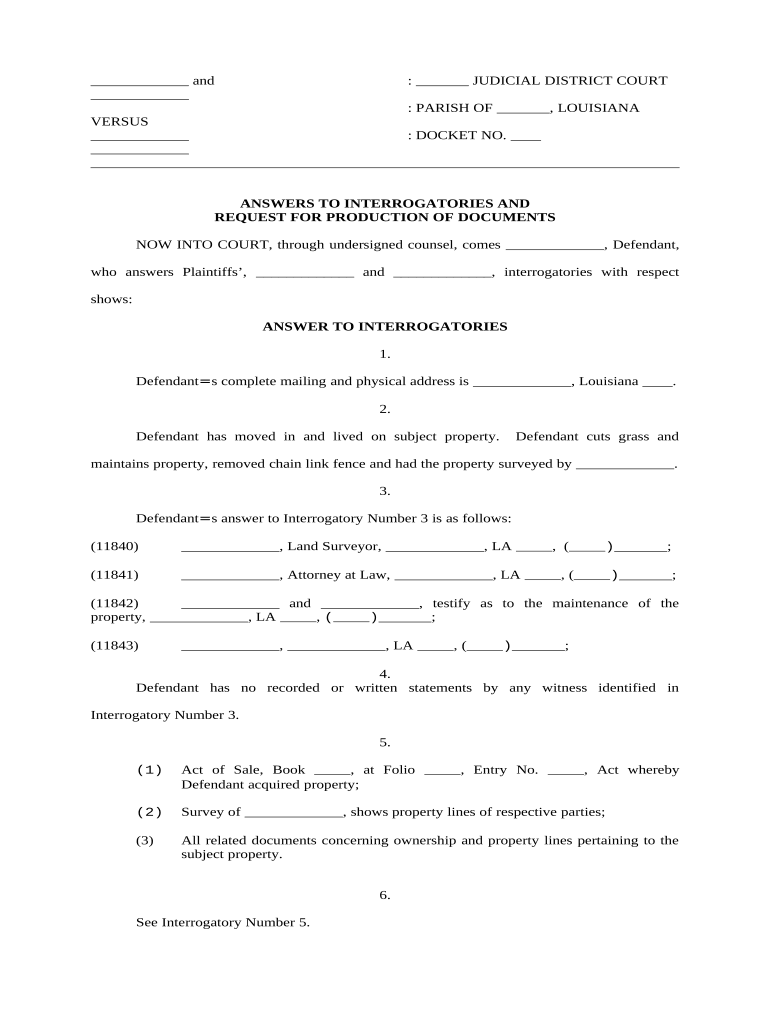
A Louisiana Answer to Interrogatories is a written response provided by a party in civil litigation to a set of written questions (interrogatories) served by an opposing party. In federal cases interrogatory practice is governed by Federal Rule of Civil Procedure 33; state-court practice follows the Louisiana Code of Civil Procedure and local rules. Answers should directly address each numbered interrogatory, assert any timely objections, and, when required, be verified under oath. Electronic delivery and signing are generally permitted under ESIGN (15 U.S.C. §7001) and applicable state e-signature laws, subject to court rules and exceptions for certain filings.

Why Accurate Answers Matter for Your Case

Timely, complete answers narrow issues, preserve evidence, and reduce motion practice. Proper responses protect credibility, limit surprise at trial, and create a clear record for any disputes over discovery or sanctions.

Why Accurate Answers Matter for Your Case

Who Prepares and Uses These Answers

Parties to litigation and their counsel are the primary users of answers to interrogatories.

  • Plaintiffs and defendants preparing factual responses and objections for discovery.
  • Attorneys drafting verified answers and coordinating supporting documents and privilege logs.
  • Corporate records custodians supplying business records and authentication for documentary responses.

Core Components of a Professional Louisiana Answer to Interrogatories

A complete answer combines case identification, numbered responses tied to each interrogatory, clear objections when warranted, references to supporting documents, and proper verification or signature block.

Caption & Case Number

Place the court name, docket number, and party caption at the top so the response is affixed to the correct matter and accepted by the clerk.
Reference to Interrogatory

Repeat each interrogatory number or text briefly before the corresponding answer so reviewers can match responses to requests without cross-referencing other documents.

Direct Responses

Answer each interrogatory fully and clearly; when a question requires factual statements, provide concise narrative answers and identify relevant custodians or dates.

Proper Objections

State specific, timely objections (e.g., privilege, overbroad, burdensome) with a concise legal basis rather than boilerplate language to preserve the objection on the record.

Document References

If documents support a response, identify them by Bates range or exhibit label and indicate whether copies are produced or available on request.

Verification / Signature

Include a signed verification or affidavit where required, dated and signed by the responding party or an authorized representative, and identify the signer’s role and authority.

Step-by-Step: Preparing Your Answers

Follow an organized, documented workflow to gather facts, verify accuracy, and serve responses within the required timeframe.

  • 01
    Review Requests: Carefully read each interrogatory and note reasonable scope or privilege issues.
  • 02
    Collect Evidence: Locate documents and custodians and compile factual inputs for each question.
  • 03
    Draft Responses: Write direct answers, cite supporting documents, and draft specific objections where appropriate.
  • 04
    Verify and Serve: Have the signer verify under oath, then serve opposing counsel and file if required.

Where to File and How to Serve Answers

Determine whether filing with the court clerk is required and serve the opposing party according to court rules and local procedures.

  • Serve Opposing Counsel: Deliver answers by permitted service method (email, e-service, hand delivery) per local rules.
  • File with Clerk: File with the court only if local rules require or if the court ordered filing.
  • E-Filing Systems: Use the court’s e-filing portal where available and follow docketing requirements.
  • Retain Proof: Keep certificates of service, e-file receipts, and timestamped delivery records.

Configuring an Online Workflow for Responses

Set up a digital workflow that maps responsibilities, places signature fields, and preserves an audit trail for service and verification.

Field Configuration
Signer Authentication Email plus access code or stronger MFA
Signature Placement Add signature and date fields in verification block
Document Versioning Enable automatic version history and audit trail
Service Tracking Capture delivery timestamps and recipient confirmations

Digital Signing and eSubmission Considerations

Verify that your chosen platform supports required file types, authentication, and an audit trail acceptable to the court and opposing counsel.

  • File formats: PDF, DOCX, PDF/A
  • Integrations: E-filing and case management
  • Authentication: Email, SMS code, KBA

Typical Deadlines for Responding

Timely response is essential; federal and local rules set fixed periods and extensions may require agreement or court approval.

Federal Rule Deadline:

30 days to answer after service (FRCP 33(b)(2)).

Service with Complaint:

If served with the complaint, timing may be linked to answer deadlines — check applicable rules.

State Court Timing:

Louisiana state deadlines vary by local rule; consult the court or Code of Civil Procedure.

Extensions:

Parties may agree to extend by written stipulation or seek court approval.

Motion Practice:

Missed deadlines can trigger motions to compel or sanctions under discovery rules.

Key Milestones in the Interrogatory Timeline

Track milestone dates from service through potential motion practice to preserve rights and comply with court orders.

01

Interrogatories Served

Opposing party serves numbered questions and sets the initial countdown.

02

Internal Review

Collect facts, documents, and identify privilege issues before drafting answers.

03

Serve Responses

Serve signed answers within the applicable deadline and retain proof of service.

04

Motion to Compel

If answers are insufficient, the propounding party may move to compel under discovery rules.

Common Preparation Mistakes to Avoid

  • Providing incomplete or evasive answers that fail to comply with the interrogatory’s scope and invite motions to compel.
  • Using boilerplate objections without a specific factual or legal basis, which courts often reject as insufficient.
  • Failing to verify answers under oath or omitting the verifying party’s authority when an agent signs on behalf of a corporation.
  • Neglecting to produce or identify supporting documents and Bates numbers, causing disputes about the completeness of production.

Consequences of Noncompliance

Court Sanctions: Attorney's fees and costs
Struck Pleadings: Defenses or filings may be struck
Adverse Inference: Court may draw unfavorable inference
Default Judgment: Extreme noncompliance can lead to default
Contempt: Potential contempt proceedings
Fee Shifting: Recoverable costs paid to requester

How Others Use Digital Answers in Practice

Real organizations use e-signature platforms and digital workflows to manage responses, preserve audit trails, and coordinate cross-functional input efficiently.

Optica Ventures (COO)

Their team centralized discovery intake to speed responses and reduce errors.

  • The interface simplified internal review.
  • The result was quicker turnaround and consistent formatting, making it easier to produce verified responses and supporting documents for opposing counsel.

Martin Properties (Founder)

Managed property litigation discovery across locations using a shared template.

  • Mobile signing enabled field managers to verify facts quickly.
  • Centralized templates and secure signing reduced back-and-forth, preserved audit logs, and helped the company meet court-ordered deadlines.

E-signature Pricing and Feature Comparison

Compare common pricing and feature criteria for e-signature vendors that are often used to prepare and sign discovery responses and verifications.

signNow DocuSign Adobe Sign PandaDoc HelloSign
Starting Price $8/user/mo $15/user/mo $14/user/mo $19/user/mo $15/user/mo
Free Trial 7-day free trial Varies Varies Varies Varies
Bulk Send Yes Yes Yes Yes No
Audit Trail Yes Yes Yes Yes Yes
HIPAA Compliant Yes Yes Yes No No

Frequently Asked Questions About Louisiana Answers to Interrogatories

Common procedural and technical questions arise when preparing, signing, and serving answers; the following clarifies routine points and next steps.


Need help? Contact support

be ready to get more
Join over 28 million airSlate SignNow users