Establishing secure connection…Loading editor…Preparing document…

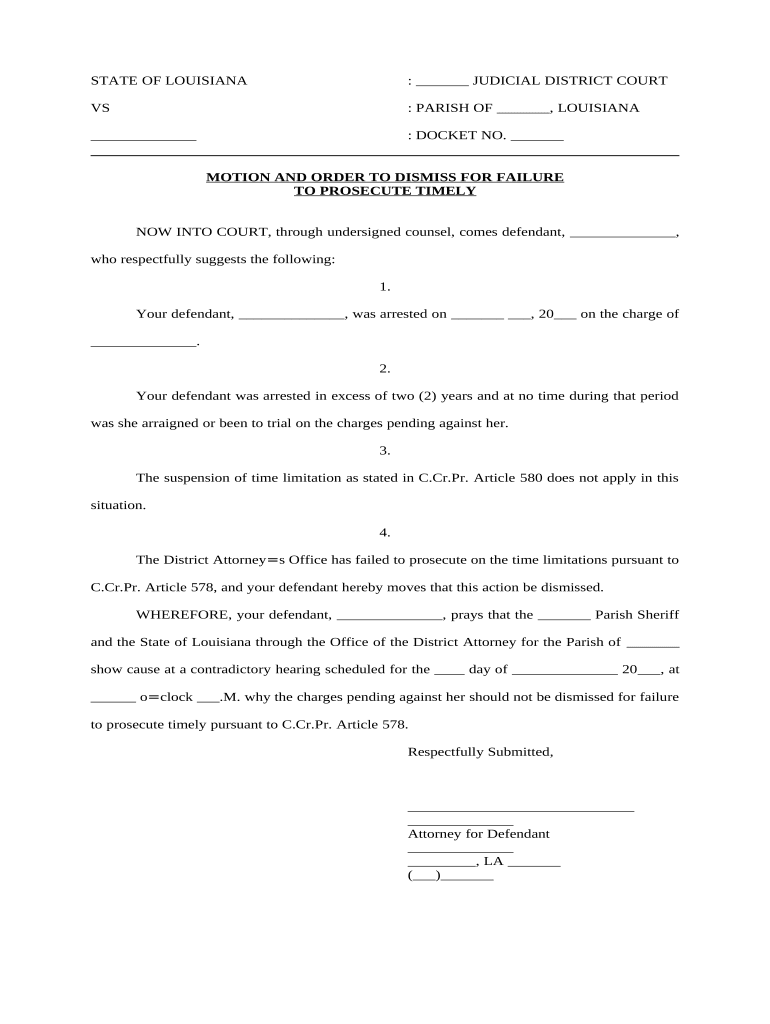
Louisiana Motion and Order to Dismiss for Failure to Prosecute Timely

This template is fully customizable. Edit the text, fill out the fields, and send it for signature. Give it a try!
Louisiana Motion and Order to Dismiss for Failure to Prosecute Timely

What this Louisiana Motion and Order to Dismiss for Failure to Prosecute Timely does

The Louisiana Motion and Order to Dismiss for Failure to Prosecute Timely is a court filing used to request dismissal of a civil action when a party has not advanced the case within the timeframes required by procedural rules or local court orders. The motion explains the basis for dismissal, cites the applicable rule or local practice, and requests the court enter an order dismissing the case, with or without prejudice. The accompanying proposed order provides the judge with language to grant the requested relief and conclude the matter administratively.

Why a properly drafted motion matters

A clear, procedurally correct motion protects your right to timely disposition and can avoid unnecessary hearings. It documents the basis for dismissal, supplies required notice and proof of service, and gives the court an enforceable order that resolves stale claims while preserving court resources.

Why a properly drafted motion matters

Who typically prepares and files this motion

Proper service, a concise factual recitation, and a proposed order increase the likelihood the court will act without delay.

  • Civil defense counsel handling inactive matters and docket management
  • Plaintiffs or defendants who need a formal disposition for case closure
  • Court administrators tracking inactive files and calendar congestion

Step-by-step: preparing and filing the motion

Follow these core steps to prepare a motion that complies with Louisiana court practice and reduces the chance of denial.

  • 01
    Draft motion: State facts, cite rule, and request dismissal.
  • 02
    Attach evidence: Include docket history and any notices of inactivity.
  • 03
    Prepare order: Provide proposed order language for the judge.
  • 04
    Serve parties: File proof of service before or with the motion.

How to set up an electronic workflow for this motion

Configure your online document before sending so routing, signing, and filing occur smoothly and the court receives a clean PDF and proposed order.

Field Configuration
Case Caption Auto-fill from template metadata to match court filings.
Signature Block Place attorney signature and date fields for counsel.
Proposed Order Upload Attach as separate file for judicial review.
Certificate of Service Field Make signer-entered; include service method and date.

Electronic filing and service: the basic flow

A typical eSubmission includes document preparation, signer authentication, distribution to opposing counsel, and filing with the court's electronic filing system.

  • Prepare: Complete form fields and attach supporting exhibits.
  • Authenticate: Use email or stronger authentication for signer attribution.
  • Serve: Send copies to opposing counsel per local rules.
  • File: Submit to court e-filing portal and retain filing receipt.

Technical considerations for eSubmission and eSigning

Verify local court e-filing rules and confirm the final signed PDF includes an audit trail or certificate for recordkeeping.

  • File formats: PDF and DOCX are commonly accepted by e-filing systems.
  • Authentication: Email links, SMS codes, or stronger MFA help attribute signatures.
  • Integrations: Connectors to case management and cloud storage speed workflows.

Typical timing and hearing expectations

Local rules govern service, response, and hearing scheduling; counsel should check the parish's practice and the court's motion calendar for exact timing.

Service and Filing Window:

File motion and serve parties per local rule; response windows vary by court.

Response Deadline:

Opposing party typically has 7–21 days to answer or oppose, depending on local procedure.

Hearing Scheduling:

Clerks schedule hearings per calendar availability; expect 14–90 day ranges in many districts.

Proposed Order Timing:

Provide proposed order at filing to expedite judge's disposition.

Effect of Order:

A signed order closes the case; note any terms for costs or reinstatement.

Key milestones from filing to final dismissal

Track these numbered stages to monitor the motion lifecycle and next required actions.

01

File Motion

Prepare motion with facts, rule citation, and proposed order.

02

Serve Parties

Deliver copies using court-approved service methods and record them.

03

Opposition Period

Allow time for responses or objections per local rule.

04

Court Disposition

Judge signs order granting or denying dismissal; file entry of judgment.

Security and compliance considerations for electronic handling

Encryption in transit: TLS 1.2/1.3 encryption
Encryption at rest: AES-256 data encryption
Regulatory standards: ESIGN and UETA compliance
Healthcare compliance: HIPAA available with BAA
Audit and logs: Detailed audit trails retained
Certifications: SOC 2 Type II and ISO 27001

Common preparation errors to avoid

  • Failing to list the correct case number or caption, which can result in a rejected or misfiled document and delay resolution.
  • Neglecting to attach the docket history or proof of inactivity, leaving the court without the necessary factual basis for dismissal.
  • Insufficient or improper service on opposing parties, causing the court to find improper notice and deny the motion.
  • Submitting a proposed order with ambiguous language, which can prevent the judge from entering clear, enforceable relief.

Potential consequences of incorrect or incomplete filings

Dismissal outcome: Case dismissed; relief outcome depends on order type
Cost exposure: Court may award costs or attorneys' fees
Refile complexity: Refiling may be limited or impractical
Appeal risk: Improper procedure can produce reversible error
Delay: Clerical defects cause processing delays
Record problems: Missing proof of service undermines motion validity

Real-world examples of moving documents electronically

These brief examples show how organizations used eSignature and digital workflows to finalize legal documents and administrative orders.

Martin Properties

Property manager shifted to online document execution to close administrative matters faster.

  • Streamlined signature collection and record retention.
  • The firm reported fewer in-person meetings and consistent compliance when distributing standardized motions and proposed orders electronically.

Fertility Centers of Illinois

Medical provider digitized consent and administrative forms to reduce processing time.

  • Improved signature attribution and audit trails.
  • The organization maintained secure, HIPAA-aware workflows while reducing paper handling and improving turnaround on routine filings.

Practical tips for accurate and efficient completion

Follow these best practices to reduce objections, avoid clerical rejections, and speed court acceptance of dismissal motions.

Verify the caption
Double-check party names, counsel names, and the docket number against the original complaint and the clerk's records before filing.
Include docket history
Attach a concise chronology of filings, hearings, and service attempts to demonstrate the inactivity that justifies dismissal.
Provide a clear proposed order
Offer precise language for the judge that addresses disposition, costs, and whether the dismissal is with or without prejudice.
Confirm service and filing method
Document the service method and file the motion through the court's accepted channel to preserve proof of notice.

Frequently asked questions and troubleshooting

Answers to common procedural and technical questions about filing a Louisiana Motion and Order to Dismiss for Failure to Prosecute Timely.


Need help? Contact support

Comparing eSignature vendor pricing and key features for motion workflows

Select a vendor based on price, required compliance features, and envelope or usage limits. signNow appears first for direct comparison of core pricing and capabilities.

signNow DocuSign Adobe Sign PandaDoc HelloSign
Starting Price $8/user/mo $15/user/mo $14/user/mo $19/user/mo $15/user/mo
Free Trial 7-day free trial Varies Varies Varies Varies
Bulk Send Yes Yes Yes Yes No
Audit Trail Yes Yes Yes Yes Yes
HIPAA Compliant Yes Yes Yes No No
be ready to get more
Join over 28 million airSlate SignNow users