Establishing secure connection…Loading editor…Preparing document…

Louisiana Emancipation

This template is fully customizable. Edit the text, fill out the fields, and send it for signature. Give it a try!
Louisiana Emancipation

What Louisiana Emancipation Means and When it Applies

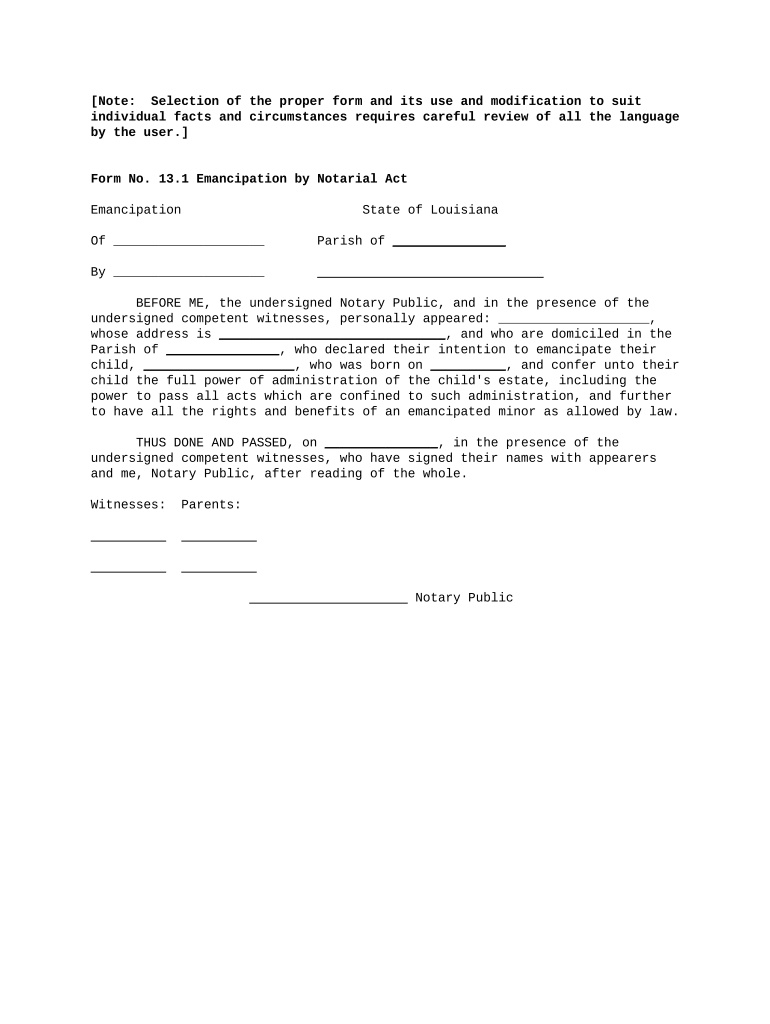
Louisiana emancipation refers to the legal process by which a minor seeks recognition as independent from parental control or guardianship under Louisiana law. The procedure typically involves filing a petition with the relevant parish court and supplying documentation that the minor is capable of managing personal, financial, and contractual affairs. Emancipation may affect the minor's ability to enter contracts, obtain employment, consent to medical care, or manage educational and housing matters; exact effects and eligibility standards vary by jurisdiction and by the court’s discretion.

Why Preparing a Proper Emancipation Petition Matters

A professionally drafted petition clarifies the minor’s legal status, reduces the chance of procedural rejection, and shortens court review time.

Why Preparing a Proper Emancipation Petition Matters

Who Typically Files or Reviews an Emancipation Petition

Multiple parties interact with an emancipation filing: the minor petitioner, parents or guardians, attorneys, and the parish clerk of court.

  • Minor petitioners who seek legal independence and must show stable income, housing, or school arrangements.
  • Parents or guardians who must be notified and may need to appear or file responses with the court.
  • Attorneys, school officials, or social workers who may prepare or certify supporting statements and documentation.

Step-by-step: Preparing and Filing an Emancipation Petition

Follow these basic procedural steps; local parish courts may require additional forms or different timelines.

  • 01
    1. Gather evidence: Collect income, housing, school, and identification documents to show maturity and independence.
  • 02
    2. Draft petition: Prepare a clear petition stating relief sought, factual basis, and proposed effective date.
  • 03
    3. File with court: Submit the petition to the parish clerk and pay applicable filing fees or request fee waiver.
  • 04
    4. Attend hearing: Appear at the scheduled hearing with witnesses or affidavits to support the petition.

How to Configure an Online Emancipation Packet

Set up a digital workflow to collect signatures, upload attachments, and route the petition to the parish clerk and counsel.

Field Configuration
Petitioner Signature Required; date stamp; signer authentication via email or SMS
Parent/Guardian Signature Conditional if parent consents; include witness field where required
Attachments Upload Allow multiple PDF uploads; enforce file size and naming conventions
Clerk Routing One-step routing to parish clerk with audit trail and delivery receipt

Typical Online Filing Flow

A streamlined digital workflow speeds collection of signatures and evidence while preserving an audit trail for the court file.

  • Prepare Packet: Assemble petition, affidavits, and attachments into a single PDF package.
  • Place Fields: Add signature, date, and attachment fields where required for each signer.
  • Send to Signers: Distribute signing invitations via email or secure link for parents and petitioner.
  • Receive Completed File: Download final signed PDF and the certificate of completion for court submission.

Technical Considerations for eSubmission and Document Handling

Use a platform that supports common file formats, preserves an audit trail, and integrates with cloud storage.

  • File Formats: PDF, DOCX supported
  • Integrations: Salesforce, NetSuite, Google Workspace
  • Security: AES-256 at rest

Confirm the parish clerk accepts electronic submissions or prepare printed copies where e-filing is not available.

Comparing eSignature Vendors for Emancipation Packets

Vendor pricing and capabilities vary; signNow is listed first for straightforward eSignature and document workflow needs.

signNow DocuSign Adobe Sign PandaDoc HelloSign
Starting Price $8/user/mo $15/user/mo $14/user/mo $19/user/mo $15/user/mo
Free Trial 7-day free trial No No Yes, limited Yes, limited
Bulk Send Yes Yes Yes Yes No
Audit Trail Yes Yes Yes Yes Yes
HIPAA Compliant Yes Yes Yes No No

Risks and Potential Consequences of an Incorrect Petition

Dismissal or Delay: Incomplete or inaccurate petitions may be dismissed or continued, delaying relief and increasing costs
Loss of Credibility: Conflicting statements or missing exhibits undermine testimony and reduce the chance of a favorable finding
Perjury Risk: False sworn statements can expose signers to perjury charges under state law
Custody Complications: Improper filings can complicate ongoing guardianship, child support, or custody proceedings
Administrative Fines: Failure to follow filing or service rules can trigger fees or require refiling
Recordkeeping Failures: Poor retention may impede appeals or future legal needs

Common Pitfalls to Avoid When Preparing the Petition

  • Omitting required attachments like proof of income or residence leads to continuances and requests for supplemental evidence.
  • Using inconsistent names or dates across documents causes identity verification issues and clerk rejections.
  • Failing to serve parents or guardians properly results in jurisdictional defects and potential dismissal.
  • Relying on unsigned affidavits or informal statements weakens evidentiary weight at the hearing.

Essential Components of a Complete Louisiana Emancipation Packet

A professionally organized petition groups statutory claims, factual support, and administrative information to aid the judge’s review.

Petition Header

Caption and parties: include the court name, parish, case number space, petitioner name, and defendant notice fields formatted to the clerk’s requirements.
Statement of Facts

A clear, chronological narrative explaining the minor’s reasons for emancipation, financial independence, living arrangements, and proof of maturity.

Affidavits

Signed sworn statements from employers, landlords, teachers, or social workers that corroborate income, housing, school attendance, or other claims.

Exhibits

Supporting documents such as pay stubs, lease agreements, school records, ID copies, and any relevant medical or counseling records.

Proposed Order

A draft court order reflecting the relief requested, effective date, and any limitations to assist the judge with a clean decree.

Service and Proof

Certificates of service, return receipts, or notarized acknowledgements demonstrating that required parties were properly notified.

Representative Use Cases and Typical Outcomes

Two practical scenarios illustrate how documentation and evidence affect court outcomes and timelines.

Case Study 1

A 17-year-old employed full-time files a petition with pay stubs and a lease

  • Judge weighs maturity and stability
  • The petition proceeds to hearing quickly when documentation is complete, reducing continuances and legal expense.

Case Study 2

A minor petitions with school records but no stable housing proof

  • Court requests supplemental affidavits
  • Additional evidence of residence and financial independence helps the court issue a narrow, conditional emancipation order.

Practical Tips for Accurate, Efficient Petition Preparation

Follow local rules, organize exhibits clearly, and use digital workflows to collect signatures and keep an audit trail.

Follow Parish Filing Rules
Review the parish clerk’s local rules before filing. Each clerk may have different cover page formats, fee amounts, or required blank spaces on pleadings.
Label Exhibits Consistently
Number and tab exhibits in the order cited in the petition to help the judge and clerk locate supporting material quickly during review.
Preserve Audit Trails
Use an eSignature platform that records timestamps, IP addresses, and completion certificates to prove when and by whom documents were signed.
Prepare Witness Summaries
Provide short witness summaries listing expected testimony topics to streamline the hearing and make testimony more admissible.

Typical Timeline Expectations and Court Deadlines

Court calendars and local rules determine exact deadlines; the following are common milestones to plan around.

Filing Date:

Petition filed and fees paid; clerk assigns a case number and sets initial processing.

Service Deadline:

Required parties must be served within the timeframe the court sets after filing.

Hearing Date:

The court schedules a hearing date; wait times vary by parish from weeks to months.

Order Entry:

If granted, the court issues a signed order with the effective emancipation date.

Appeal Period:

Parties normally have a statutory short period to appeal or request reconsideration per local appellate rules.

Frequently Asked Questions About Louisiana Emancipation

Answers address common procedural and evidentiary concerns to reduce filing errors and improve readiness for hearing.


Need help? Contact support

be ready to get more
Join over 28 million airSlate SignNow users