Establishing secure connection…Loading editor…Preparing document…

Louisiana Declinatory Exception of Lack of Jurisdiction

This template is fully customizable. Edit the text, fill out the fields, and send it for signature. Give it a try!
Louisiana Declinatory Exception of Lack of Jurisdiction

What the Louisiana Declinatory Exception of Lack of Jurisdiction Is

The Louisiana Declinatory Exception of Lack of Jurisdiction is a procedural pleading used in Louisiana civil cases to contest a court’s authority to hear a matter. It asserts that the court lacks either personal jurisdiction over a party or subject-matter jurisdiction over the dispute, and it must be raised at an early stage to preserve the defense. The exception identifies the specific jurisdictional defect, cites the factual basis, and asks the court to decline jurisdiction or transfer the case. It is distinct from dilatory exceptions and must follow Louisiana procedural form and timing.

Why Filing a Declinatory Exception Matters

Filing this exception preserves the right to contest jurisdiction, prevents default or forfeiture of the defense, and can remove a case from an inappropriate forum early in litigation.

Why Filing a Declinatory Exception Matters

Who Typically Prepares and Files This Exception

Parties defending or disputing venue often need to file this exception quickly.

  • Defense counsel preparing early responsive pleadings to preserve procedural defenses.
  • In-house legal teams avoiding litigation in an unfavorable forum or venue.
  • Pro se litigants who recognize that the court lacks authority over them.

Who Signs and Submits the Exception

Defense Attorney

A licensed lawyer representing the defendant usually drafts and signs the exception, certifying legal grounds and factual support and ensuring compliance with Louisiana Code of Civil Procedure timing and form requirements.

Pro Se Litigant

A self-represented party may prepare and sign the exception but must strictly follow procedural deadlines; courts often apply waiver rules if the exception is not timely asserted.

Step-by-Step: Preparing and Filing the Exception

Follow these sequential steps to prepare, verify, and file a declinatory exception in Louisiana civil proceedings.

  • 01
    Identify Grounds: Determine whether personal or subject-matter jurisdiction is disputed.
  • 02
    Gather Facts: Assemble dates, contacts, and forum connections supporting the claim.
  • 03
    Draft Exception: Draft concise allegations and a clear prayer for relief.
  • 04
    File on Time: File and serve the exception before the responsive pleading deadline.

Essential Parts of a Professional Exception

A complete exception includes structured components that courts expect; including each part increases clarity and the chance the court will consider the jurisdictional challenge on its merits.

Caption

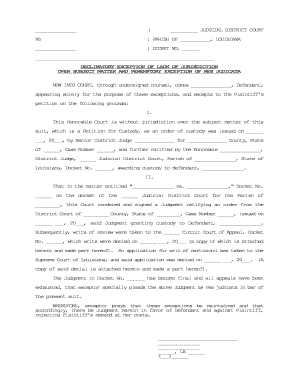
Full court caption showing parish, court division, docket number, and party names so the pleading is correctly identified and matched to the original file.
Statement of Jurisdiction

A clear statement whether the objection is to personal jurisdiction or subject-matter jurisdiction, specifying statutory or constitutional grounds.

Factual Allegations

Concise factual paragraphs that explain why the court lacks authority, including dates, locations, and relevant contractual or residency details.

Legal Argument

Citation to controlling Louisiana authority and brief reasoning applying law to facts; avoid extensive unrelated argumentation.

Prayer

Explicitly state the relief requested: dismissal, declinatory ruling, or transfer to a proper forum with any alternative relief.

Verification

Signed declaration or affidavit verifying facts where required, including signature, printed name, and date for authenticity and record.

Digital Workflow: Document Setup and Routing

Configure the filing workflow to ensure required fields, signatures, and service obligations are satisfied before court submission.

Field Action
Upload Document Attach final PDF for signing and filing
Signature Field Place signature and date fields for counsel or party
Service Copies Add recipient emails for opposing counsel and court clerk
Audit Trail Enable audit logs and timestamping

How Filing and Service Typically Flow

A standard sequence ensures the exception is filed, served, and preserved in the court record with supporting proof of service.

  • Prepare Pleading: Draft, verify, and convert to court-ready PDF
  • Sign and Date: Counsel or party signs with date and bar number
  • File with Clerk: Submit to court clerk per local electronic filing rules
  • Serve Opposing Party: Serve promptly and retain proof of service

Technical Checklist for eFiling and eSigning

Confirm platform compatibility, signer authentication, and court e-filing requirements before finalizing the document.

  • File Formats: PDF or PDF/A required
  • Integrations: Connect with court e-filing or document storage
  • Authentication: Use email, SMS, or advanced signer verification

Essential Filing Details to Include

Court Name: Parish and division
Case Number: Docket identifier
Parties: Full legal names
Date Filed: MM/DD/YYYY format
Grounds Asserted: Personal or subject-matter
Relief Sought: Dismissal or declinatory relief

Supporting Documents and Download Options

Collect related records and save multiple file formats to support the exception and preserve an accessible record for court and counsel.

Supporting Affidavits

Attach sworn statements or declarations that corroborate jurisdictional facts; include exhibits such as contracts, service records, or residency proof to strengthen the factual record.

Proof of Service

Include the certificate of service showing method and date served on opposing counsel; courts require this to confirm timely notice of the exception and proper service.

Exhibits

Attach contracts, correspondence, or transactional records cited in the pleading and label exhibits clearly (Exhibit A, Exhibit B) to aid judicial review.

Download Formats

Save completed documents as PDF/A for court filing and as DOCX for internal edits; export audit trail and signature certificates to preserve electronic evidence.

Timing: Key Deadlines and Filing Expectations

Timely assertion of a declinatory exception is critical; missing the window can forfeit the right to challenge jurisdiction.

Initial Responsive Deadline:

File before or with introductory answer

Service Deadline:

Serve opposing counsel promptly after filing

Hearing Scheduling:

Request an early hearing on jurisdictional issues

Amendment Window:

Amend only with court permission

Appeal Timing:

Preserve record for possible interlocutory appeal

Practical Tips for Accurate and Efficient Completion

Follow these proven practices to reduce risk of waiver, improve clarity, and expedite court review.

Be Concise and Specific
Limit factual paragraphs to jurisdictional facts only; lengthy unrelated arguments distract the court and dilute the core challenge.
Attach Supporting Evidence
Include key exhibits such as contracts, service records, and residency proofs; label and reference exhibits in the pleading for easy judicial review.
Preserve Proof of Service
Serve and file certificates of service immediately and retain copies; courts frequently deny relief absent proper service proof.
Confirm Local Rules
Check parish or division local rules for specific formatting, filing method, and hearing request procedures before submission.

Common Preparation Pitfalls to Avoid

  • Missing the procedural deadline and thereby waiving the jurisdictional defense is a frequent and often dispositive error.
  • Overly broad factual recitations that fail to directly connect facts to the jurisdictional defect weaken the exception’s persuasive force.
  • Failure to attach or properly cite exhibits leaves the court without evidence to rule in favor of the exception.
  • Using incorrect party names or case captions can cause misfiling or rejection by the clerk and delay the process.

Consequences of an Incorrect or Untimely Exception

Waiver Risk: Late filing waives jurisdiction defense
Default Exposure: Unchallenged jurisdiction can lead to default judgment
Sanctions: Frivolous jurisdiction claims risk sanctions
Evidence Loss: Missing exhibits weakens argument
Appeal Limitations: Preservation failures limit appellate relief
Increased Costs: Late or flawed filings increase attorney fees

eSignature Platform Comparison for Preparing and Signing Pleadings

Standard platform features and pricing can affect document preparation and signature workflows; the table compares typical starting prices and key capabilities across vendors.

signNow DocuSign Adobe Sign PandaDoc HelloSign
Starting Price $8/user/mo $15/user/mo $14/user/mo $19/user/mo $15/user/mo
Free Trial 7-day free trial Yes Yes Yes Yes
Bulk Send Yes Yes Yes Yes No
Audit Trail Yes Yes Yes Yes Yes
HIPAA Compliant Yes Yes Yes No No

Frequently Asked Questions About Filing and Validity

Answers to common questions about timing, e-signatures, notarization, and correcting errors when asserting a declinatory exception.


Need help? Contact support

be ready to get more
Join over 28 million airSlate SignNow users