Establishing secure connection…Loading editor…Preparing document…

Louisiana Petition for Garnishment

This template is fully customizable. Edit the text, fill out the fields, and send it for signature. Give it a try!
Louisiana Petition for Garnishment

What the Louisiana Petition for Garnishment Is and When it’s Used

A Louisiana Petition for Garnishment is a court filing creditors or their attorneys use to seek payment by attaching a debtor’s property or funds held by a third party (the garnishee). The petition asks a civil court to order the garnishee — for example, an employer or bank — to hold or turn over funds to satisfy a judgment. Garnishment procedures in Louisiana follow state civil procedure and local court rules; forms typically request identifying information for creditor, debtor, garnishee, the underlying judgment, amounts sought, and any claimed exemptions.

Why a Proper Petition Matters

A correctly prepared petition protects your right to recover judgment amounts while reducing the risk of dismissal, delay, or sanctions. Clear identification of parties, accurate amounts, and correct service ensure the court and garnishee can respond and limits grounds for objection.

Why a Proper Petition Matters

Who Commonly Prepares and Uses This Petition

Typical users include creditors, collection attorneys, and court clerks who process garnishment matters.

  • Creditor representatives and collection attorneys seeking to enforce money judgments against debtor assets.
  • Garnishees such as banks or employers who must respond, freeze, or remit funds.
  • Court clerks and process servers who handle filing, service, and returned process.

Step-by-Step: Completing and Submitting the Petition

Follow this sequence to prepare, serve, and file a garnishment petition with minimal errors.

  • 01
    Prepare: Gather judgment, debtor, and garnishee details; compute balance and exemptions.
  • 02
    Complete Form: Fill each field accurately and attach supporting judgment and service documents.
  • 03
    File with Clerk: Submit petition to the appropriate parish court clerk following local filing rules.
  • 04
    Serve Garnishee: Arrange service per local rules and obtain proof of service for the court record.

How to Customize an Online Workflow for This Petition

Configure an e-filing or e-sign workflow to match local court and service requirements before sending to signers or garnishees.

Field Configuration
Signature Type Allow typed or drawn signatures; require signer name and date fields.
Auth Level Use email + SMS code for attorney or court clerk verification.
Attachments Require upload of judgment, writs, and proof of service as mandatory documents.
Routing Set order: creditor → clerk (if required) → garnishee. Capture audit trail at each step.

Digital Signing and eSubmission Considerations

Ensure your chosen platform supports required authentication, audit trails, and document formats for court submission.

  • File Formats: PDF and Word DOCX are commonly accepted; preserve original PDF/A where courts request archival format.
  • Authentication: Use multi-factor authentication for attorney or creditor signers when possible to strengthen attribution.
  • Audit Trail: Capture IP, timestamp, and signer email to support admissibility and record retention.

Where to File and How Notices Are Routed

A garnishment petition is typically filed in the court that issued the judgment or where enforcement is proper; routing varies by parish.

  • Court Clerk: File the petition with the appropriate parish civil clerk following local fee rules.
  • Process Server: Arrange service on the garnishee per Louisiana rules; obtain proof of service.
  • Garnishee Response: Garnishee may be required to answer or freeze funds; local rules set response timing.
  • Court Order: If the court grants relief, the clerk issues an order directing remittance to the creditor.

Typical Timelines and What to Expect

Processing times for garnishment petitions vary widely; plan for clerk review, service, and possible garnishee responses when scheduling collection steps.

Clerk Processing:

Often 1–4 weeks depending on local caseload and filing method.

Service Window:

Service on garnishee typically occurs immediately after filing; proof of service must be returned promptly.

Garnishee Answer:

Many jurisdictions allow 15–30 days for the garnishee to respond or object.

Court Hearing:

If contested, a hearing may be scheduled within several weeks to months.

Remittance Timing:

After court order, garnishee remits funds per the order; timing depends on payroll cycles or bank processing.

Key Milestones in a Garnishment Proceeding

Track these sequential stages from filing through remittance to ensure compliance and timely enforcement.

01

File Petition

Clerk accepts and docket assigns a case number; filing triggers service steps.

02

Serve Garnishee

Deliver petition and obtain proof of service under local rules.

03

Garnishee Response

Garnishee answers, asserts exemptions, or freezes funds per applicable law.

04

Court Order and Remittance

If granted, court issues order directing garnishee to remit funds to creditor.

eSignature Vendor Pricing Snapshot for Filing and Managing Garnishment Documents

Compare common vendor entry-level pricing and feature indicators relevant to secure signing, audit trails, and HIPAA or courtroom admissibility concerns.

signNow DocuSign Adobe Sign PandaDoc HelloSign
Starting Price $8/user/mo $15/user/mo $14/user/mo $19/user/mo $15/user/mo
Free Trial 7-day free trial, no card Varies by plan Varies by plan Varies by plan Varies by plan
Bulk Send Yes (Premium) Yes Yes Yes Varies
Audit Trail Yes Yes Yes Yes Yes
HIPAA Compliant Yes Yes Yes Varies Varies
Envelope Cap No cap 100 envelopes/user/year Varies Varies Varies

Required Information and Key Data Elements

Creditor Details: Full legal name
Debtor Details: Full legal name
Garnishee Details: Name and contact
Judgment Reference: Court and number
Amount Claimed: Exact dollar total
Signature: Authorized signer

Penalties and Risks of an Incorrect Petition

Dismissal Risk: Case dismissal or delay
Sanctions: Court fines or sanctions
Liability: Liability for wrongful garnishment
Returned Service: Service defects require re-filing
Fee Loss: Nonrefundable filing fees
Appeals: Additional litigation costs

Common Preparation Errors to Avoid

  • Using an incorrect or incomplete debtor name that leads to improper service and potential dismissal of the garnishment action.
  • Failing to include the judgment number, issuance date, or court of record, causing clerk delays and requests for supplemental filings.
  • Omitting garnishee contact details or serving the wrong party such as a payroll administrator rather than the employer’s registered agent.
  • Neglecting to compute interest or to list statutory exemptions, which may result in contested claims or reduced recovery.

Core Components of a Professional Louisiana Petition for Garnishment

A complete petition combines identifying information, supporting judgments, statutory statements, and court-ready signature and service sections.

Caption

Court caption and case number clearly identify the filing court and link the garnishment petition to the underlying judgment and docket entry.
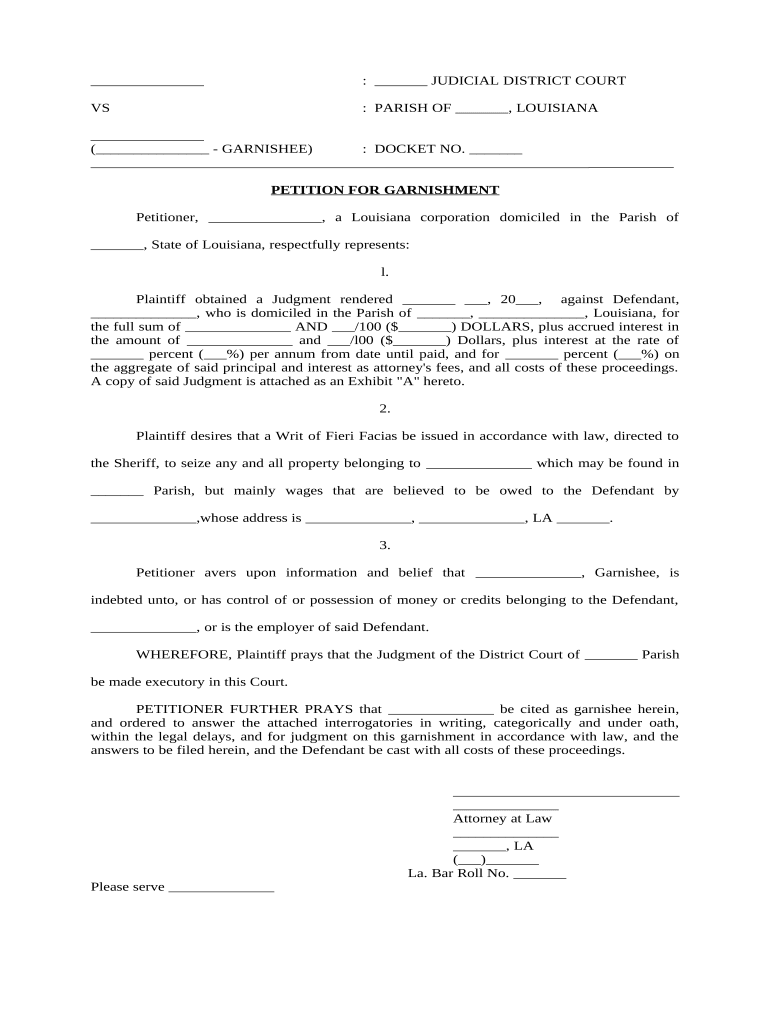
Party Details

Clear identification of creditor, debtor, and garnishee with mailing addresses and contact information enables proper service and court communication.

Judgment Attachment

Attach a certified or docketed copy of the judgment showing amount due, date, and any post-judgment interest calculations required by the court.

Amount Statement

A precise calculation of the amount sought, including principal, interest to the stated date, and itemized costs to support the remittance request.

Exemptions

State and federal exemptions must be listed or referenced, and the petition should request a hearing if exempted funds are at issue.

Service and Proof

Provide space for proof of service, notary acknowledgment (if required), and any certification the clerk requires for garnishee notification.

Real-World Use Scenarios

Two typical scenarios illustrate how a garnishment petition is used and processed in practice.

Small Creditor Collection

A local vendor obtains a judgment and files a petition to garnish the debtor’s bank account

  • The garnishee freezes the account pending court review
  • After serving proof of the judgment and complying with clerk instructions, the vendor receives remitted funds to satisfy the debt, less allowable fees.

Payroll Garnishment for Child Support

A state agency submits a garnishment petition to collect arrears

  • Employer receives proper notice and begins withholding per the court order
  • Payroll withholdings are sent to the agency on its regular remittance schedule until the obligation is satisfied.

Practical Tips for Accurate and Efficient Petition Preparation

Adopt these practices to reduce errors, speed processing, and preserve enforceability.

Verify Identity
Confirm the debtor’s full legal name and any business or trade names against the judgment and public records. Mismatched names lead to service defects and can delay or invalidate enforcement efforts; cross-check with debtor addresses and social security or EIN information where permitted by law.
Attach Certified Judgment
Attach a certified or docket-stamped copy of the underlying judgment to the petition. Courts often require documentary proof of the debt before issuing garnishment relief; an uncertified copy can cause the clerk to reject or hold the filing for supplemental documentation.
Document Service
Use a professional process server or follow local sheriff procedures and obtain proof of service. Maintain a copy of the return of service in the file because courts routinely request evidence before entering garnishment orders or adjudicating exemptions.
Use Secure eSign and Audit Trails
When preparing documents electronically, employ an eSignature provider that preserves an audit trail with time stamps and signer attribution. Proper audit records support admissibility and help resolve disputes about intent or execution, particularly when filings are contested.

How to Download, Save, and Share the Petition

Export and archive petitions in formats that meet court and retention requirements while preserving signatures and metadata.

PDF/A Export

Save a signed, flattened PDF/A copy for long-term archival; this preserves appearance and prevents future alteration while retaining embedded metadata when the platform supports PDF/A.

Editable DOCX

Keep an editable DOCX master with form fields for internal use or subsequent amendments; preserve a read-only signed PDF for submissions.

Certificate of Completion

Download the eSignature provider’s certificate or audit trail that records timestamp, IP, and signer authentication details for court admissibility.

Secure Storage

Store final signed documents in encrypted cloud storage or court eFiling accounts with access logs and role-based permissions to prevent unauthorized access.

Who Signs and Certifies the Petition

Creditor Representative, Collections Officer

A collections officer or authorized creditor representative signs to certify the accuracy of amounts and facts. The signer should be prepared to attest to the source of the debt and attach documentation showing the judgment and amounts due.

Attorney of Record, Counsel

An attorney listed on the case signs filings and provides bar number and contact information. Counsel handles service procedures, objections, and court hearings that may be necessary to enforce or defend against garnishment.

Frequently Asked Questions About the Louisiana Petition for Garnishment

Answers to common questions about validity, service, exemptions, and digital signatures for garnishment petitions in Louisiana.


Need help? Contact support

be ready to get more
Join over 28 million airSlate SignNow users