Establishing secure connection…Loading editor…Preparing document…

Louisiana Hardship License Application

This template is fully customizable. Edit the text, fill out the fields, and send it for signature. Give it a try!
Louisiana Hardship License Application

What the Louisiana Hardship License Application Is

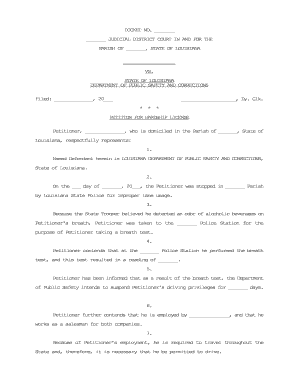
The Louisiana Hardship License Application is the written request a suspended driver submits to seek limited driving privileges when full driving privileges are suspended or revoked. Typical approvals allow travel for work, medical treatment, education, or court-ordered activities while restrictions and conditions apply. The application collects personal details, suspension history, and documentation proving the need for limited travel; it may trigger a hearing, fee assessment, or proof-of-insurance verification before a conditional license is issued.

Why a Hardship Application Matters

A correctly completed application can preserve employment, enable medical access, and reduce legal exposure by formally requesting court or DMV-authorized limited driving. The application also documents the applicant's circumstances for administrative review and helps ensure any granted privileges include clear restrictions and monitoring conditions.

Why a Hardship Application Matters

Who Typically Submits or Reviews This Application

Several parties interact with the hardship application during review and after issuance.

  • Individuals under driver license suspension who need limited travel for employment, healthcare, or family needs.
  • Attorneys or legal representatives who file on behalf of clients and prepare supporting affidavits or court filings.
  • DMV/OMV staff and hearing officers who evaluate eligibility, verify documentation, and set conditions of any limited license.

Each participant has distinct responsibilities: applicants supply accurate evidence, representatives craft legal support, and agency staff enforce statutory criteria and monitoring requirements.

Primary Roles Involved

Applicant

A driver whose license is suspended or revoked. The applicant must provide full legal name, current address, driver license number, suspension details, and supporting documents such as employer letters or medical records; inaccurate information can delay or invalidate the request.

Agency Official

A Louisiana OMV or parish hearing officer who reviews the file, confirms statutory eligibility, and issues conditions. Officials verify identity, inspect attachments, and may require in-person hearings or additional documentation before granting a limited driving privilege.

Key Parts of a Professional Hardship License Application

A complete application is structured to present identity, suspension details, the claimed hardship, and supporting evidence clearly so reviewers can assess need and impose appropriate conditions.

Applicant Information

Full legal name, date of birth, current mailing and physical address, and driver license number to tie the request to the suspended record.
Suspension Details

Exact suspension or revocation date, underlying violation or reason, and any prior hardship requests or outcomes.

Hardship Statement

Concise explanation of why limited driving is necessary (work, medical, education, family care), including specific locations, times, and frequency.

Supporting Documents

Employer letters, medical records, proof of enrollment, court orders, or other agency correspondence that substantiate the claimed need.

Conditions Requested

Proposed travel restrictions (routes, hours, vehicle) and consent to monitoring or SR-22 insurance when required by statute.

Signature and Attestation

Applicant signature, date, and any notarization or witness information required by the issuing authority.

Step-by-Step: Submitting the Application

Follow these core steps to prepare and submit a complete Louisiana Hardship License Application.

  • 01
    Gather documents: Collect ID, suspension notice, employer/medical letters, and insurance proof.
  • 02
    Complete form: Fill fields precisely using MM/DD/YYYY and legal name formatting.
  • 03
    Attach support: Include scanned or original documentation as required by the agency.
  • 04
    File and pay: Submit to the designated office and pay application or hearing fees.

Completing and Routing an Online Hardship Application

Online filing improves tracking and preserves a digital audit trail when configured with required fields and verification steps.

Form Fields Full name | DOB | DL# | Suspension date | Hardship reason
Conditional Fields Show employer or medical fields only when that hardship type is selected
Signature Type Allow typed, drawn, or uploaded signatures with timestamped audit trail
Authentication Use email confirmation or SMS code for basic signer verification
Notifications Auto-notify applicant and agency reviewers after submission

Digital Submission: Platform and Integration Considerations

Electronic filing reduces paper handling but requires specific platform support for secure uploads and signer verification.

  • File Format: PDF, DOCX, or scanned images accepted
  • Integrations: Common integrations: Salesforce, NetSuite, Microsoft 365
  • Authentication: Email, SMS, or stronger KBA/MFA when needed

Choose a platform that preserves an audit trail, supports conditional fields, and integrates with storage or case-management systems for retention and review.

Where to File the Louisiana Hardship License Application

Filing paths vary; verify the correct agency or office before submission to avoid delays.

  • State OMV: Louisiana Office of Motor Vehicles processes many license actions and may accept applications or direct you to hearings.
  • Parish Court: Some hardship requests require a parish or municipal court hearing depending on the underlying violation.
  • Hearing Office: Schedule or attend an administrative hearing if required by the suspension notice.
  • Mail or In-Person: Submit documents by mail, in person, or through the agency's online portal if offered.

Typical Deadlines and Processing Expectations

Deadlines and timing differ by case and parish. Confirm local rules at the agency before filing to ensure timely submission and hearing scheduling.

Application Window:

Submit as soon as practicable after suspension to minimize disruption.

Hearing Scheduling:

Hearing may be scheduled by the agency; timing varies by docket and locality.

Document Deadlines:

Provide outstanding evidence by any agency-set date to avoid denial.

Fee Payment:

Pay required filing or hearing fees when directed to complete processing.

License Effective Date:

If approved, the conditional license will state effective and expiration dates and any travel restrictions.

Key Milestones from Filing to Decision

Track these stages to monitor progress and comply with any agency requests during review.

01

Preparation

Assemble application package and supporting documentation for submission.

02

Submission

File the application via the designated office or online portal.

03

Review

Agency or hearing official examines evidence and may request clarifications.

04

Decision

Approval, conditional issuance, or denial is communicated in writing with next steps.

Common File Preparation Mistakes

  • Incomplete supporting evidence such as unsigned employer letters or redacted medical records that prevent verification.
  • Mismatched identity details between documents and DMV records, including different name spellings or outdated addresses.
  • Missing notarization or failing to sign in the presence of a notary when the form requires notarized attestation.
  • Submitting poor-quality scans or incompatible file formats that agency systems cannot process reliably.

Consequences of an Incorrect or Fraudulent Application

Application Denial: Incomplete or inaccurate submissions can result in denial.
License Revocation: Fraudulent claims may lead to expanded suspension or revocation.
Fines and Fees: Failure to comply can trigger fines or additional administrative costs.
Criminal Charges: False statements on sworn forms may expose the applicant to criminal liability.
Insurance Impact: Conditional licensing may require SR-22; noncompliance affects coverage.
Employment Risk: Unresolved suspensions can jeopardize job duties dependent on driving.

Required Information Typically Collected

Full Name: Applicant's legal name
Date of Birth: MM/DD/YYYY
Driver License: State and license number
Suspension Details: Date and reason
Supporting Contacts: Employer or medical provider info
Signature: Signed and dated attestation

eSignature Pricing Snapshot for High-Volume Hardship Application Workflows

When choosing an eSignature vendor for batch processing or integration, consider starting price, trial availability, bulk-send capability, audit trails, HIPAA support, and any envelope or session caps.

signNow DocuSign Adobe Sign PandaDoc HelloSign
Starting Price $8/user/mo $15/user/mo $14/user/mo $19/user/mo $15/user/mo
Free Trial Yes, 7-day trial Varies Varies Varies Varies
Bulk Send Yes Yes Yes Yes No
Audit Trail Yes Yes Yes Yes Yes
HIPAA Compliant Yes Yes Yes No No

Real-World Application Examples

Two typical scenarios show how the form supports continued mobility while protecting public safety and legal process.

Commuter for Employment

An applicant provides employer letter confirming essential travel

  • Employer verifies driving hours and route
  • The agency issues restricted hours-only travel for work with SR-22 insurance and periodic review.

Medical Necessity Travel

A patient documents recurring treatments with physician letters

  • Medical provider details frequency and locations
  • The reviewing officer grants travel limited to treatment locations, requires proof of appointments, and sets an expiration date.

Practical Tips for Accurate and Efficient Completion

Adopt these practices to reduce back-and-forth and expedite decisions.

Use Verified Identity Documents
Attach legible government ID scans and ensure the name and birthdate match DMV records. Discrepancies are one of the most common causes of processing delays; correct them before submission.
Provide Clear Supporting Evidence
Include dated letters on employer or provider letterhead with contact details. Vague statements or missing contact data force agencies to request follow-up and extend review time.
Follow Local Submission Rules
Confirm whether your parish requires in-person hearing, notarization, or electronic filing. Complying with local procedural rules prevents unnecessary rejection for format or routing errors.
Keep Copies and Audit Trails
Retain digital copies and any eSignature audit logs showing timestamps and signer authentication. These records support appeals and prove submission timing if disputes arise.

Frequently Asked Questions About the Louisiana Hardship License Application

Answers to common questions about eligibility, documentation, electronic signing, and next steps to help applicants avoid delays.


Need help? Contact support

be ready to get more
Join over 28 million airSlate SignNow users