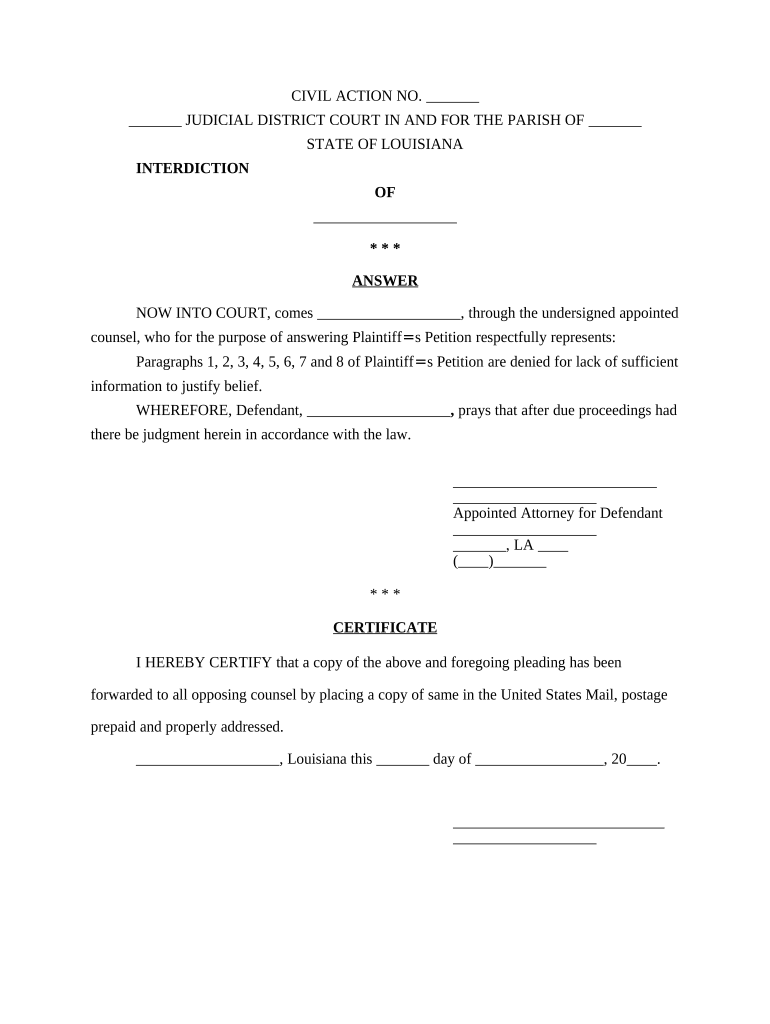
Louisiana Interdiction
What a Louisiana Interdiction Is and When It Applies
Why Understanding the Interdiction Process Matters
Clear, compliant petitions protect vulnerable adults, reduce delays, and ensure the court can authorize appropriate protective measures.
Who Typically Prepares or Files an Interdiction Petition
These petitions are commonly prepared by family members, attorneys, and public guardians seeking court protection for an incapacitated adult.
- Adult family members (spouse, adult child) filing to protect a relative's health and finances through court supervision.
- Private attorneys who represent petitioners, draft pleadings, and present evidence at the interdiction hearing.
- Public or court-appointed guardians and social services agencies acting for adults with no available family representative.
In many cases the petitioner consults an attorney to confirm standing, compile medical proof, and handle court procedures.
Typical Petitioners and Their Roles
Adult Child, Petitioner
A grown child files when an elderly parent shows progressive cognitive decline and cannot manage bills or medical decisions. The petitioner gathers medical evaluations, financial records, and a list of interested persons for court service, and may request limited or plenary interdiction depending on assessed incapacity.
Private Attorney
An attorney prepares the petition, ensures compliance with local civil procedure, obtains expert medical affidavits, attends the hearing, and presents evidence to the judge. Counsel also advises on post-judgment duties, inventory, and reporting obligations for a curator or guardian.
Step-by-Step: Filing a Louisiana Interdiction Petition
-
01Prepare petition: Draft petition with facts, parties, and requested relief.
-
02Collect evidence: Attach medical reports, financial documents, and witness statements.
-
03File with court: Submit petition to the parish clerk and pay applicable fees.
-
04Attend hearing: Present evidence; judge issues order if interdiction is warranted.
Digital Workflow Settings for Online Completion
| Field | Configuration |
|---|---|
| Document Template | Use a court-format petition PDF with fillable fields. |
| Notifications | Email notifications to petitioner, attorney, and interested parties. |
| Authentication | Use email plus SMS code or ID verification for signers. |
| Retention | Archive signed PDF/A with audit trail for required retention period. |
How to File, Serve, and Track a Petition
-
File Petition: Submit to parish clerk per local rules.
-
Serve Respondent: Arrange personal service or authorized substituted service.
-
Confirm Service: File proof of service with the court.
-
Track Hearing: Watch docket and prepare testimony or exhibits.
Technical Considerations for eFiling and eSigning
Ensure your electronic platform supports secure signing, audit trails, and the output formats required by the court clerk.
- Supported Formats: PDF, PDF/A and Word DOCX accepted
- Signer Authentication: Email link, SMS code, ID check
- Integrations: Common integrations include Salesforce and NetSuite
Check local clerk eFiling rules before submitting electronically and retain certified copies plus an audit trail for the record.
Typical Timeline Considerations and Local Deadlines
Filing Promptly:
File as soon as incapacity evidence is available.
Service Timing:
Service deadlines depend on local civil procedure rules.
Hearing Scheduling:
Hearing may be set within weeks to months depending on workload.
Temporary Orders:
Courts can issue interim protective orders quickly if immediate risk exists.
Post-Judgment Duties:
Curator reports and inventories follow schedules set by the court.
Key Milestones from Filing to Post-Judgment Supervision
Intake & Evaluation
Gather medical reports, finances, and names of interested parties.
Petition Filed
Clerk accepts petition and assigns a docket number.
Court Hearing
Judge evaluates evidence and hears testimony.
Judgment & Orders
If granted, court appoints curator and issues protective orders.
Common Mistakes to Avoid When Preparing a Petition
- Incomplete medical evidence: missing clear clinical findings or unsigned reports delays or weakens the petition.
- Incorrect names or addresses: mismatched identity details cause service failures and jurisdictional objections.
- Improper service: failing to follow local rules for personal or substituted service can invalidate proceedings.
- Scope errors: asking for broader interdiction than evidence supports increases risk of denial or appeal.
Consequences of Errors or Improper Interdiction Practice
Comparing eSignature Options for Interdiction Documents
| signNow | DocuSign | Adobe Sign | PandaDoc | HelloSign | |
|---|---|---|---|---|---|
| Starting Price | $8/user/mo | $15/user/mo | $14/user/mo | $19/user/mo | $15/user/mo |
| Free Trial | 7-day free trial | Varies | Varies | Varies | Varies |
| Bulk Send | Yes | Yes | Yes | Yes | Varies |
| Audit Trail | Yes | Yes | Yes | Yes | Yes |
| HIPAA Compliant | Yes | Yes | Yes | No | No |
Practical Tips for Accurate, Efficient Petition Preparation
Frequently Asked Questions About Louisiana Interdiction
-
What is interdiction in Louisiana?
Interdiction is a court process to determine that an adult lacks capacity and to appoint a curator or guardian. Proceedings require a petition, supporting medical evidence, notice to interested parties, and a judicial hearing before a final order is entered.
-
Who can file a petition?
Close family members, healthcare providers with standing, public guardianship agencies, or attorneys acting for interested parties typically may file. Standing rules vary by parish; check local procedure for who qualifies as a petitioner.
-
What evidence is required?
Courts generally require contemporaneous medical or psychological assessments, factual incidents demonstrating incapacity, and sometimes witness affidavits. The stronger and more specific the evidence, the more likely the court can fashion an appropriate limited or plenary order.
-
Can the petition be signed electronically?
Electronic signatures are legally recognized under ESIGN and UETA for most documents. Confirm the local court clerk accepts eFiled or eSigned petitions and that the signature method meets any clerk authentication requirements.
-
How can an interdiction be changed or revoked?
A respondent or interested person can petition the court to modify or terminate interdiction by showing changed circumstances or restored capacity; procedures are set by statute and local rule.
-
Where do I get local forms and instructions?
Obtain court-specific petition forms, filing instructions, and fee schedules from the parish clerk of court. Clerks can confirm filing method, acceptable formats, and service requirements.