Establishing secure connection…Loading editor…Preparing document…

Louisiana Interrogatories

This template is fully customizable. Edit the text, fill out the fields, and send it for signature. Give it a try!
Louisiana Interrogatories

What Louisiana Interrogatories Are and when they apply

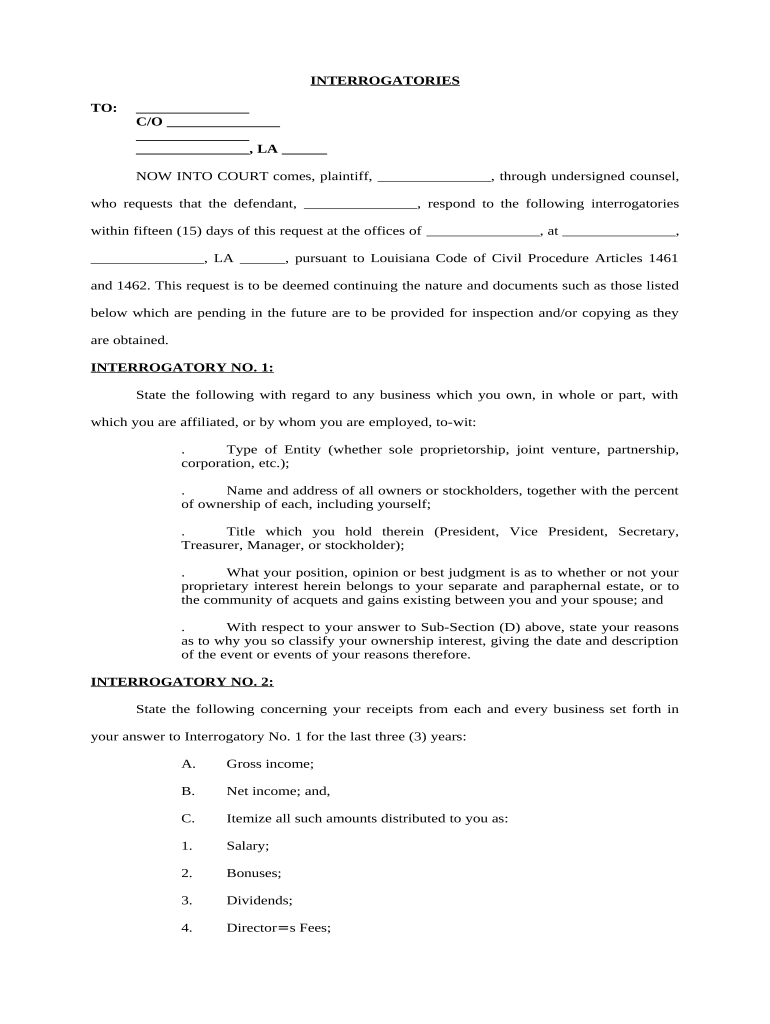
Louisiana Interrogatories are written questions used in civil discovery to obtain facts, identify witnesses, and narrow disputed issues before trial. Served by one party on another, interrogatories require written answers or objections under oath and are governed by state procedural rules and applicable local court orders. They form part of a litigation record that can shape depositions, motions, and settlement negotiations. Proper drafting, timely service, and verified responses help preserve evidence and reduce surprises at trial while ensuring compliance with discovery limits and confidentiality protections.

Why carefully prepared interrogatories matter

Clear interrogatories streamline fact-gathering, limit disputes, and create an admissible written record. They guide depositions and reduce discovery costs by focusing inquiry on legally relevant information.

Why carefully prepared interrogatories matter

Primary users and typical roles

Use trained counsel or experienced court clerks to confirm local procedural limits and timing before serving or answering interrogatories.

  • Plaintiff’s counsel seeking facts, damages detail, and witness identities.
  • Defense counsel testing liability theories and requesting admissions or documents.
  • In-house or corporate counsel responding to commercial litigation or regulatory disputes.

Core parts of a professional set of interrogatories

A professional set of Louisiana Interrogatories is organized, numbered, and accompanied by clear instructions and a verification. Each component supports enforceability and efficient response handling.

Case Caption

Full court caption with case number, parties, court name and division. Accurate captioning ensures service and filing are properly attributed.
Instructions

Defines terms, sets response format, and states objection protocol. Clear instructions reduce ambiguity and minimize boilerplate objections.

Definitions

Precise definitions narrow scope for terms like 'document', 'identify', and named entities to avoid disputes over interpretation.

Interrogatory Text

Numbered, discrete questions phrased to elicit specific facts, dates, or documents. Avoid compound or ambiguous phrasing that invites objections.

Verification

A sworn statement by the responding party or authorized representative attesting to truthfulness of answers under penalty of perjury.

Certificate of Service

Shows how and when the interrogatories were served. Courts require proof of service for enforceability and motion practice.

Step-by-step: drafting, serving, and responding

Follow a consistent sequence to prepare, serve, and manage interrogatories to reduce disputes and avoid procedural sanctions.

  • 01
    Draft: Formulate clear, narrowly tailored questions.
  • 02
    Serve: Deliver according to local rules and record proof of service.
  • 03
    Respond: Answer or object under oath within the applicable deadline.
  • 04
    Enforce: Move to compel if responses are incomplete or evasive.

How to set up an online interrogatory workflow

Configure a digital workflow to draft, collect, and store interrogatories with clear versions and signer verification.

Document upload Upload final PDF or DOCX to your eSignature platform.
Field placement Insert numbered question fields and designated response blocks.
Signer roles Assign respondent and attorney roles for signature order.
Authentication Enable email, SMS code, or higher authentication as required.
Retention Set automatic retention and export policies for audit trail.

Where to send and how service typically works

Service and filing methods vary by jurisdiction; follow local civil rules and the court’s e-filing and service procedures when serving interrogatories.

  • Opposing Counsel: Serve direct to counsel by permitted methods under local rule.
  • Self-Represented Parties: Serve the opposing party at listed address or email if allowed.
  • E-Service: Use court-authorized e-service systems when local rules permit.
  • Certificate: File or retain a certificate of service showing date and method.

Common timelines and response expectations

Deadlines depend on federal, state, or local rules; many jurisdictions set a 30-day response period absent extension, but verify the controlling rule before relying on any timeline.

Response Deadline:

Often 30 days from service, subject to local variations and court orders.

Motion to Compel:

File promptly after meet-and-confer if responses are incomplete or evasive.

Extension by Agreement:

Parties may extend deadlines by written agreement before expiration.

Supplementation:

Duty to supplement answers if new responsive information arises.

Filing Requirements:

File certificates or proof of service per court e-filing rules.

Common mistakes to avoid when preparing or answering

  • Using vague or compound questions that invite boilerplate objections and delay responses.
  • Failing to verify answers under oath or omitting a corporate representative verification where required.
  • Missing the service or filing deadline without a written extension or court approval.
  • Overlooking confidentiality or privilege designations when producing related documents.

Consequences of inadequate answers or procedural missteps

Motion Sanctions: Court may impose monetary sanctions or attorney fees.
Waiver of Objections: Late or untimely objections can be deemed waived.
Adverse Inference: Court may permit negative inference or strike evidence.
Compelled Answers: Court can order supplemental answers or production.
Default Risk: Repeated noncompliance can support default judgment arguments.
Privacy Exposure: Improper production may breach confidentiality or privilege.

How interrogatories shape different litigation scenarios

Two short examples illustrate how focused questions reveal key facts and streamline case handling.

Personal Injury

A plaintiff uses interrogatories to establish medical treatment chronology and providers.

  • Targeted questions elicit providers and billing details.
  • Thorough answers help counsel plan depositions, secure records, and quantify damages while limiting surprise testimony at trial.

Commercial Contract Dispute

A defendant serves interrogatories to identify decision-makers and document exchanges.

  • Requests for communications and contract versions.
  • Precise responses expose contract interpretations and timeline, enabling focused motion practice or a narrower, quicker settlement discussion.

Who signs or verifies interrogatory answers

Plaintiff’s Attorney

An attorney often prepares or certifies answers on behalf of an individual client and ensures responses comply with procedural rules and privilege assertions while coordinating document production.

Corporate Representative

A designated corporate officer or records custodian verifies corporate answers under oath, stating knowledge of company facts and document searches supporting the responses.

Security and compliance checkpoints for electronic interrogatories

Encryption: TLS 1.2/1.3
Data at rest: AES-256 encryption
Audit trail: IP, timestamp, action log
HIPAA support: BAA available
Access control: Role-based permissions
Certifications: SOC 2 Type II

Digital signing, storage, and integration considerations

Ensure the chosen solution can produce court-ready audit reports and that you retain signed copies and service certificates to support motions or appeals.

  • File Formats: PDF, DOCX
  • Integrations: Salesforce | NetSuite | Google Workspace
  • Security Standards: AES-256 | TLS 1.2/1.3

eSignature pricing and capability comparison relevant to discovery workflows

The table below compares common plan-level features and compliance attributes across leading eSignature providers; signNow appears first per vendor ordering rules.

signNow DocuSign Adobe Sign PandaDoc HelloSign
Starting Price $8/user/mo $15/user/mo $14/user/mo $19/user/mo $15/user/mo
Free Trial 7-day free trial Varies by vendor Varies by vendor Varies by vendor Varies by vendor
Bulk Send Yes Yes Yes Yes No
Audit Trail Yes Yes Yes Yes Yes
HIPAA Compliant Yes Yes Yes No No

Frequently asked questions about Louisiana Interrogatories

Answers to common questions cover electronic service, timing, objections, verification, and correcting responses to reduce risk and improve compliance.


Need help? Contact support

be ready to get more
Join over 28 million airSlate SignNow users