Establishing secure connection…Loading editor…Preparing document…

Louisiana Partition

This template is fully customizable. Edit the text, fill out the fields, and send it for signature. Give it a try!
Louisiana Partition

What a Louisiana Partition Is and when it applies

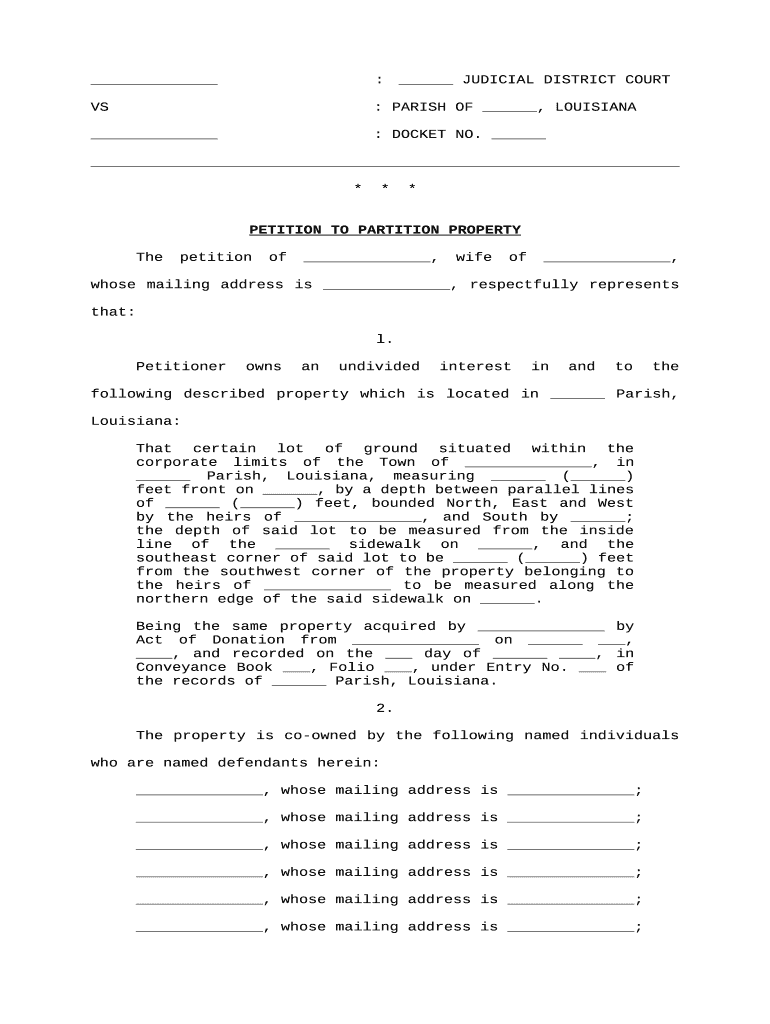
A Louisiana Partition is a legal process used to divide or otherwise end co-ownership in immovable property located in Louisiana. It can be achieved by a judicial partition action in civil court or, where all co-owners consent, by an extrajudicial notarial act that restructures ownership or orders a sale. The procedure identifies the property, the co-owners’ shares, and the method of division or sale, and results in recorded instruments that update title records and permit distribution of proceeds or reallocation of ownership interests.

Why a Partition matters for co‑owners and title clarity

A partition clarifies ownership, resolves disputes among co‑owners, and converts joint or undivided interests into discrete, marketable title or sale proceeds. It prevents long‑term clouded title and creates a formal record for subsequent transactions.

Why a Partition matters for co‑owners and title clarity

Who typically prepares or signs a Louisiana Partition

The partition is used by property co‑owners, attorneys, notaries, and real estate professionals when dividing immovable property or converting shared interests to separate titles or sale proceeds.

  • Co‑owners and heirs seeking to divide property or liquidate shared real estate interests.
  • Real estate attorneys or civil‑law notaries drafting or supervising partition instruments.
  • Title companies and recordation clerks processing the act or court judgment for public records.

In many cases a notary or attorney will prepare the partition; co‑owners must review and sign to ensure consent and accurate recording.

Essential elements of a professional Louisiana Partition document

A complete partition document combines precise property description, clear ownership shares, agreed division method, consideration, signatory blocks, and recordation instructions to ensure enforceability and title clarity.

Property Description

Provide a full legal description (lot, block, subdivision, metes and bounds) and parish parcel/assessor ID to avoid ambiguity in recording and title search.
Ownership Shares

State each party's name and fractional interest or percentage share before partition to establish entitlement to portions or proceeds.

Division Method

Specify whether the partition is by physical division, by sale with proceeds split, or by allotment and cash adjustment among co‑owners.

Consideration

Document monetary payments, credits, or other consideration used to equalize shares, and detail payment terms and security if applicable.

Notarial/Authentication

Include notary acknowledgment or notarization block, and identify witnesses if required by Louisiana practice for a valid notarial act.

Recording Instructions

Specify the parish clerk/recorder office for filing, the party responsible for recordation costs, and any required indexing information.

Data and security considerations for partition records

Encryption: TLS 1.2/1.3 in transit
At Rest: AES‑256 encryption at rest
Audit Trail: Detailed signing metadata
Regulatory Standards: ESIGN and UETA compliant
Health Data: HIPAA BAA available when needed
Certifications: SOC 2 Type II and ISO 27001

Key legal risks and consequences of a flawed partition

Title defects: Unrecorded acts impair marketability
Litigation: Disputes may trigger partition suits
Tax exposure: Unreported proceeds may cause tax issues
Recording delays: Prior interests could gain priority
Incorrect notarial act: May result in invalid conveyance
Missing signatures: Can void the instrument

Common preparation errors to avoid

  • Using an informal property description that differs from the deed record, creating ambiguity at recording and triggering title objections.
  • Failing to obtain all required consents or signatures, which can allow disgruntled co‑owners to challenge the partition in court.
  • Neglecting to allocate closing costs or recording fees in writing, causing disputes over who pays expenses after execution.
  • Omitting a clear mechanism for equalizing differing acreages or values, which results in post‑closing claims or litigation.

Step‑by‑step: preparing and executing a Louisiana Partition

Follow a clear sequence from preparatory title work through signing, notarization, and parish recording to finalize partition transactions.

  • 01
    Title Search: Confirm current title, liens, and encumbrances.
  • 02
    Draft Act: Prepare partition instrument or settlement agreement.
  • 03
    Sign & Notarize: All parties sign before a notary as required.
  • 04
    Record Act: File with parish recorder to perfect title.

Where to file, send, and record a partition in Louisiana

A finalized partition instrument or judgment should be recorded in the parish where the immovable property is located; additional notices may be sent to title insurers and lienholders.

  • Parish Recorder: Record deed or judgment in property parish
  • Title Company: Deliver copy for title update
  • Tax Authorities: Notify parish assessor if appropriate
  • Lienholders: Send recorded documents to clear encumbrances

Digital signing and file formats for partition instruments

Use secure, tamper‑evident document formats and eSignature workflows that preserve an audit trail and produce recordable PDF/A or PDF output.

  • File Formats: PDF, PDF/A, DOCX supported
  • Integrations: Salesforce, NetSuite, Google Workspace
  • Authentication: Email, SMS code, advanced options

Key milestones from agreement to recorded title

A typical partition timeline moves from pre‑execution review to recording and distribution of proceeds in four primary stages.

01

Pre‑Execution Review

Title search, lien clearance, and valuation tasks completed

02

Execution and Notarization

All parties sign and the instrument is notarized per local requirements

03

Recordation

File the act or judgment in the parish recorder’s office to perfect title

04

Distribution

Allocate parcels or disburse sale proceeds and update title records

Timing considerations and retention for electronic notarization

When using remote or electronic notarization, confirm retention rules and recording acceptance to avoid delays or rejection.

RON Recordings:

Audio‑video often retained 5–10 years per state rules

Immediate Recording:

Record promptly after execution to protect priority

Tax Filings:

Report proceeds on tax returns per IRS timing rules

Notary Journal:

Notary must keep journal entries as required

Clerk Processing:

Parish recorder timelines vary by office workload

Real examples of digital workflows used for property documents

Organizations used compliant eSignature tools to manage real estate documents, demonstrating practical benefits for partition and conveyance workflows.

Tim Martin — Martin Properties

We process and execute documents online with full compliance and security

  • Used digital signing for remote closings and partition documents
  • This reduced turnaround and allowed property divisions to complete without in‑person meetings while preserving audit trails and title readiness.

Brian Fitzgibbons — Optica Ventures LLC

The interface is simple for our team and customers

  • Adopted eSignature for real estate documents including partitions
  • As a result, we improved execution speed, reduced paper handling, and maintained consistent records for recording and title updates.

Practical tips to prepare a clean Louisiana Partition

Follow these recommended practices to minimize disputes, ensure recordability, and protect co‑owner interests during partition.

Confirm Title First
Order a current title report to identify liens and encumbrances. Clear or address liens before execution or explicitly allocate responsibility for payoff in the instrument.
Use Exact Descriptions
Copy the deed’s legal description and parish parcel ID verbatim to avoid indexing or title examiner rejections; ambiguous descriptions delay recording.
Document Consideration
Spell out monetary adjustments, promissory terms, and escrow arrangements to avoid later disputes and to permit clear reporting of taxable events.
Plan for Recordation
Identify who will record the instrument, pay fees, and distribute recorded copies to title insurers and taxing authorities to finalize the transaction promptly.

How a partition compares with other property resolution options

Compare partition actions with consensual sale or transfer options to determine the appropriate process based on consent, speed, and court involvement.

Criteria Partition Action Consensual Sale
Court Involvement often yes usually no
Notary Required
Typical Timeline weeks–months days–weeks
Purpose divide ownership convert to single owner sale

Recommended digital workflow settings for partition documents

Configure your electronic workflow to match signing order, authentication needs, and required fields before sending the partition instrument for signature.

Field Configuration
Authentication Email + SMS code or advanced signer verification
Signing Order Set to sequential when signatures require notarization
Required Fields Property description, shares, dates, and notary block
File Formats Use PDF/A for archiving and recorder compatibility

eSignature vendor comparison for handling partition documents

Vendor pricing and capabilities vary; below is a concise comparison showing starting prices, trial availability, bulk send, audit trails, HIPAA compliance, and envelope limits.

signNow DocuSign Adobe Sign PandaDoc HelloSign
Starting Price $8/user/mo $15/user/mo $14/user/mo $19/user/mo $15/user/mo
Free Trial 7‑day free trial Yes, varies Yes, varies Yes, varies Yes, varies
Bulk Send Yes (plan limits) Yes Yes Yes No
Audit Trail Yes Yes Yes Yes Yes
HIPAA Compliant Yes Yes Yes No No

Frequently asked questions about Louisiana Partition documents

Answers to common questions about execution, recording, notarization, and electronic signing for partitions in Louisiana.


Need help? Contact support

be ready to get more
Join over 28 million airSlate SignNow users