Establishing secure connection…Loading editor…Preparing document…

Petition for Writ of Mandamus

This template is fully customizable. Edit the text, fill out the fields, and send it for signature. Give it a try!
Petition for Writ of Mandamus

What a Petition for Writ of Mandamus Is

A Petition for Writ of Mandamus is a legal pleading filed in a court asking a judge to order a government official, administrative agency, or lower court to perform a mandatory duty required by law. It is an extraordinary remedy used when no adequate alternative remedy exists and when the petitioner can show a clear legal right, a corresponding duty by the respondent, and lack of any other adequate remedy. The petition frames the factual record, cites statutory or constitutional sources, and requests issuance of the writ directing specific action.

Why a Mandamus Petition Matters

A Petition for Writ of Mandamus clarifies legal obligations, secures court-ordered performance of non-discretionary duties, and preserves the petitioner’s rights when administrative remedies are exhausted or ineffective and creates a record for appellate review.

Why a Mandamus Petition Matters

Who Typically Files a Mandamus Petition

Typical users who file a Petition for Writ of Mandamus include litigants and attorneys when government action is at issue.

  • Private individuals challenging administrative delays or refusals to act under statutes or regulations.
  • Corporations or nonprofits seeking compelled agency action affecting licenses or permits.
  • Public-interest groups and state actors enforcing statutory duties or procedural compliance.

Key Components to Include in a Professional Petition

Core elements of a professional Petition for Writ of Mandamus clarify the claim, identify duties, and attach the administrative record.

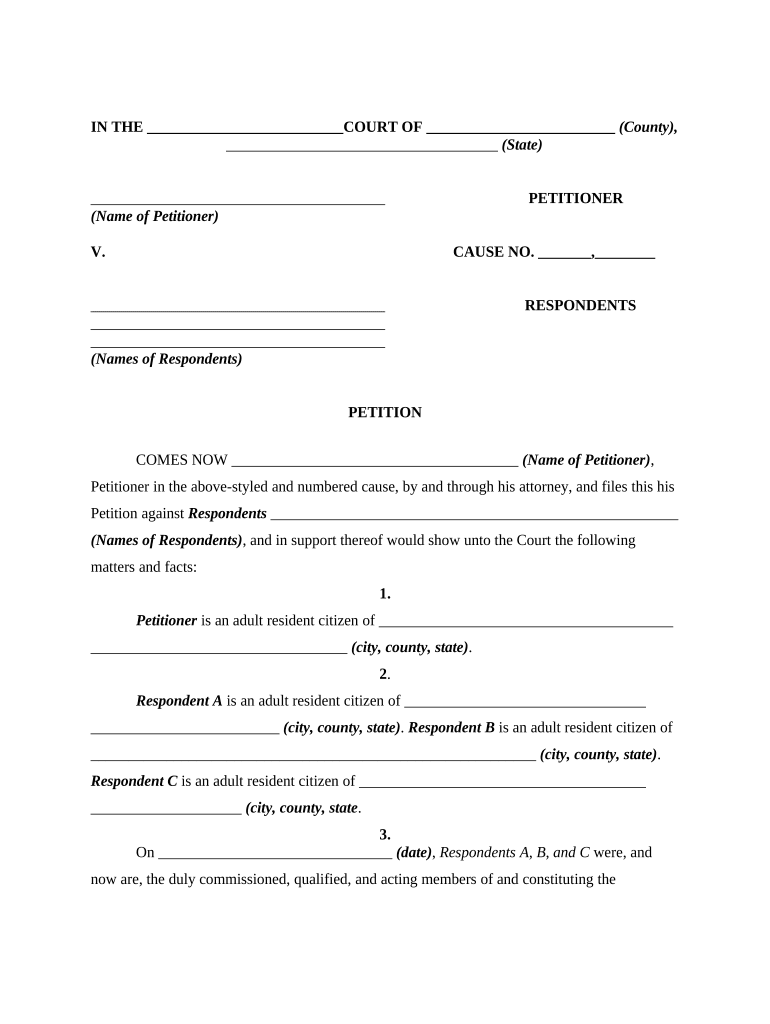
Caption

State court caption or federal court heading identifying parties, case number if any, court name, and precise designation of petitioner and respondent to ensure proper jurisdictional record.
Statement of Facts

Concise chronicle of relevant events with dates, agency actions, communications, and attempts to obtain relief; include exhibits references and specific statutory or regulatory provisions the respondent failed to apply or follow.

Legal Claim

Identify the legal duty allegedly owed by the respondent, cite governing statutes, regulations, constitutional provisions, and present argument showing duty is ministerial, not discretionary, as required for mandamus relief.

Administrative Record

Attach or reference the complete administrative record, include agency decisions, correspondence, notices, and appeal filings; explain gaps and certify record authenticity to enable judicial review without supplemental fact-finding.

Request for Relief

Specify the writ sought, the precise action the court should order, any preliminary relief or stay requested, and the form of judgment or decree the petitioner requests.

Verification

Include a sworn verification or declaration under penalty of perjury attesting to the truth of factual statements, signed by petitioner or authorized representative with date and contact information.

Step-by-Step Filing Checklist

Follow this step-by-step process to prepare and file a Petition for Writ of Mandamus with clarity and procedural compliance.

  • 01
    Gather Record: Collect agency files, correspondence, and administrative decisions.
  • 02
    Draft Petition: Draft facts, legal claims, and prayer for relief.
  • 03
    Verify & Sign: Prepare verification and obtain required signatures.
  • 04
    File & Serve: File with court and serve respondents per rules.

Practical Filing and Post-Filing Workflow

Overview of practical filing steps, routing, and immediate post-filing actions courts typically perform after a mandamus petition is submitted.

  • Clerk Review: Clerk checks caption, filing fee, and signature.
  • Service: Respondent served according to civil procedure rules.
  • Response: Court sets briefing schedule or requests record.
  • Hearing: Court may schedule oral argument or deny on papers.

Digital Filing and eSubmission Considerations

Use digital tools for secure eFiling, eService, and record assembly; ensure platform meets court e-filing rules.

  • Document Formats: PDF/A preferred; include OCR text.
  • Integrations: Connect to case management or storage.
  • Authentication: Support multi-factor signer verification.

Penalties and Risks of Incorrect or Incomplete Petitions

Dismissal Risk: Failure to state duty.
Standing Issues: Lack of petitioner standing.
Exhaustion Failure: Court may dismiss for non-exhaustion.
Service Defect: Improper service voids relief.
Timeliness: Statute of limitations bars claim.
Sanctions: Frivolous filings risk fees.

Common Preparation Mistakes to Avoid

  • Failing to name the correct legal respondent, such as naming agency staff instead of the agency head, often results in dismissal for misjoinder or improper party.
  • Submitting an incomplete administrative record or failing to attach essential exhibits forces the court to request supplementation, prolonging resolution and increasing costs.
  • Neglecting to show exhaustion of available administrative remedies frequently leads courts to dismiss mandamus petitions as premature under procedural doctrines.
  • Using vague or overly broad requests for relief, rather than precise ministerial directives, undermines the argument that mandamus is an appropriate remedy.

Practical Tips to Improve Petition Quality

Adopt these best practices to strengthen the petition and minimize procedural rejection or delay risks.

Confirm Proper Jurisdiction and Venue
Verify statutory authority for mandamus in the chosen court, check federal statutes such as 28 U.S.C. §1361 for federal actions, and ensure venue aligns with respondent’s official duty location to prevent transfer or dismissal.
Fully Exhaust Administrative Remedies First
Document all administrative appeals, deadlines, and agency communications demonstrating that no adequate remedy remains; courts often require clear proof of exhaustion before considering mandamus relief, and attach supporting exhibits with timeline.
Prepare a Complete Administrative Record
Assemble and Bates-stamp exhibits, provide an index and certificates of authenticity where possible, and highlight administrative findings or omissions that demonstrate agency failure to perform required duties in sequenced chronology.
Use Precise Prayer for Relief Language
Draft a narrowly tailored requested order specifying actions, deadlines, and measurable performance criteria; avoid open-ended directives to improve enforceability and to increase likelihood the court will grant the writ or enter sanctions.

Timing and Deadline Considerations

Key timing considerations for mandamus petitions include statutes of limitations, exhaustion deadlines, and expedited briefing or emergency relief procedures.

Statute of Limitations:

Depends on underlying claim; check applicable federal or state statutes.

Exhaustion Deadline:

File after exhausting administrative remedies or upon final agency action.

Emergency Relief:

Seek temporary orders when irreparable harm is imminent.

Service Timing:

Serve respondents promptly per local civil procedure rules.

Briefing Schedules:

Court may set accelerated deadlines for filings and responses.

eSignature Provider Comparison for Filing and Service Workflows

Comparison of common eSignature providers and features relevant when filing and serving a Petition for Writ of Mandamus.

signNow DocuSign Adobe Sign PandaDoc HelloSign
Starting Price $8/user/mo $15/user/mo $14/user/mo $19/user/mo $15/user/mo
Free Trial Yes, 7-day trial Varies by plan Varies by plan Varies by plan Varies by plan
Bulk Send Yes Yes Yes Yes No
Audit Trail Yes Yes Yes Yes Yes
HIPAA Compliant Yes Yes Yes No No

Frequently Asked Questions and Troubleshooting

Answers to common procedural and technical questions about preparing, signing, and filing a Petition for Writ of Mandamus.


Need help? Contact support

be ready to get more
Join over 28 million airSlate SignNow users