Establishing secure connection…Loading editor…Preparing document…

Metal Detecting Agreement

This template is fully customizable. Edit the text, fill out the fields, and send it for signature. Give it a try!
Metal Detecting Agreement

What a Metal Detecting Agreement Covers

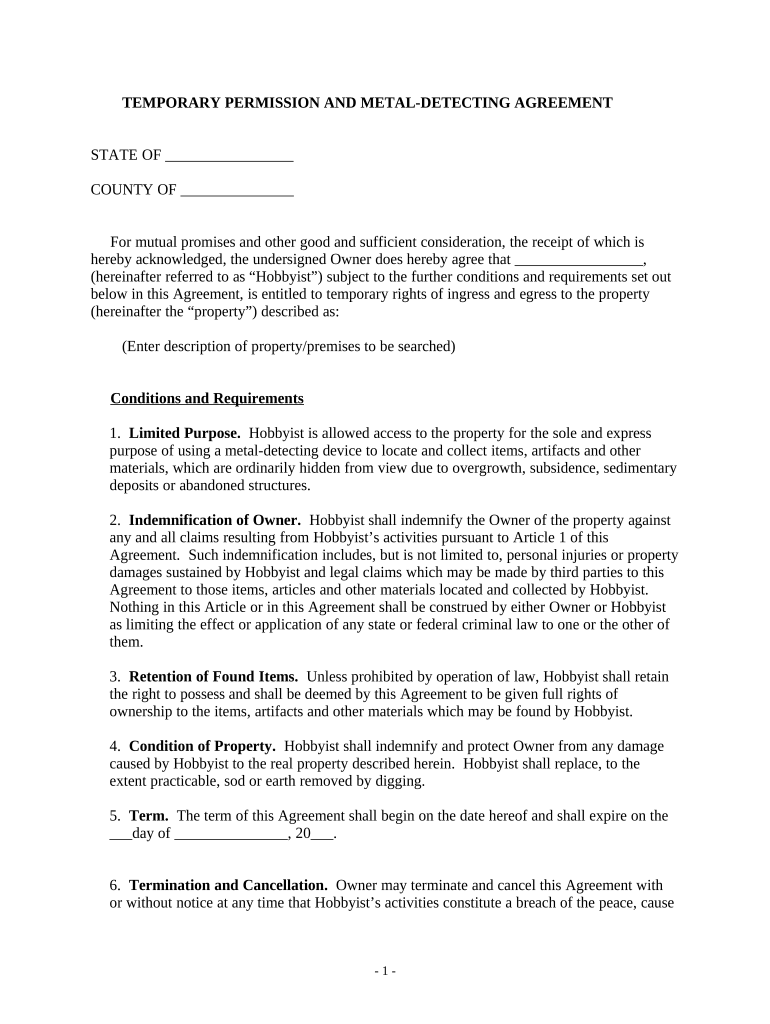
A Metal Detecting Agreement is a written contract that records permission, scope, and conditions for metal detecting on defined land. It specifies the landowner and detectorist, permitted areas and hours, artifact handling and reporting, liability allocation, and any fees or consideration exchanged. The agreement protects property rights, clarifies responsibilities for discovered items, and establishes dispute resolution and governing law to reduce ambiguity before field activity begins.

Why you should use a Metal Detecting Agreement

A clear agreement reduces disputes, protects property rights, and defines artifact custody and reporting procedures. It also allocates liability and clarifies whether removal, sale, or donations of finds are allowed, giving both parties predictable legal and practical outcomes.

Why you should use a Metal Detecting Agreement

Common users and roles for this agreement

Typical parties include private landowners, hobbyist detectorists, land managers, and commercial recovery operators seeking written permission.

  • Private landowners granting access under specific terms and restrictions.
  • Recreational detectorists documenting permission, reporting obligations, and liability limits.
  • Commercial recovery services defining compensation, artifact ownership, and compliance terms.

Who can sign and why their role matters

Owner / Landowner

The person or entity with legal title or authority to permit access. Their signature confirms consent, defines permitted areas, and binds property-related conditions; mismatched authority can render the agreement unenforceable.

Detectorist / Permittee

The individual or company receiving permission who agrees to follow site rules, reporting procedures, and liability terms. Their signature demonstrates acceptance of obligations and allows attribution of discovered items or damages.

Core clauses to include in a professional agreement

Include provisions that clearly allocate rights, duties, and remedies so the relationship is predictable and enforceable.

Permission scope

Describe permitted areas, dates, and hours. Be precise about boundaries and whether permission is revocable at will or fixed-term to avoid disputes.
Artifact ownership

State whether finds become the landowner's property, the detectorist's, or subject to split/escrow. Include procedures for culturally sensitive or archaeological items.

Reporting and handling

Require immediate reporting of significant or regulated finds and specify chain-of-custody, temporary storage, and contacts for authorities when necessary.

Compensation

Detail any fees, percentage splits, or barter arrangements. Specify payment timing and taxes, and whether finder’s fees apply to valuable discoveries.

Liability and insurance

Allocate responsibility for injury, property damage, and legal claims. Require proof of insurance where appropriate and indemnity language to protect owners.

Termination and remedies

Define causes for termination, required notices, and remedies for breach, including return of finds, damages, or injunctive relief.

Step-by-step: preparing and executing the agreement

Follow these steps to create, review, and finalize a valid Metal Detecting Agreement.

  • 01
    Draft terms: Define scope, ownership, reporting, and insurance requirements.
  • 02
    Map and attach: Include a clear site map and any relevant permits or land records.
  • 03
    Review and revise: Have both parties and counsel review for clarity and legality.
  • 04
    Sign and retain: Obtain signatures, notarize if required, and store the original securely.

Typical execution and record flow

Understand the usual lifecycle from permission request to signed agreement and post-activity reporting.

  • Request access: Detectorist requests permission and proposes dates.
  • Negotiate terms: Parties agree on scope, compensation, and reporting.
  • Sign document: Both parties sign; notarize if state or landowner requires.
  • Field activity: Detecting occurs; finds are reported per agreement.

Configuring an online agreement workflow

Set up the digital workflow so fields, signatures, and notifications are completed in the correct order.

Field Configuration
Signature Order Set landowner first, detectorist second to confirm permission is prior to activity.
Required Fields Make property description, effective date, and signature blocks mandatory.
Notifications Enable email alerts on completion and for any declined signatures.
Attachments Allow site maps and permit PDFs to be uploaded and locked after signing.

Digital signing and platform considerations

Choose a platform that supports secure e-signatures, audit trails, and optional advanced authentication for higher-risk sites.

  • File formats: PDF, DOCX supported
  • Authentication: Email or SMS code
  • Integrations: CRM and cloud storage

E-signature vendor comparison for executing agreements

A basic comparison of common e-signature providers and features useful when sending Metal Detecting Agreements; signNow appears first per vendor listing requirements.

signNow DocuSign Adobe Sign PandaDoc HelloSign
Starting Price $8/user/mo $15/user/mo $14/user/mo $19/user/mo $15/user/mo
Free Trial 7-day free trial Varies by vendor Varies by vendor Varies by vendor Varies by vendor
Bulk Send Yes Yes Yes Yes Yes
Audit Trail Yes Yes Yes Yes Yes
HIPAA Compliant Yes Yes Yes No No

Common preparation mistakes to avoid

  • Vague property descriptions leading to boundary disputes and consent challenges.
  • Failing to state artifact ownership, causing post-discovery conflicts over valuable finds.
  • Omitting insurance or indemnity clauses and exposing owners to third-party claims.
  • Using unsigned or improperly witnessed documents that courts may deem unenforceable.

Key risks and legal consequences

Unenforceable Terms: Ambiguous language risks invalidation
Civil Liability: Injury or property damage exposure
Criminal Prosecution: Illegal removal of protected artifacts
Permit Violations: Fines from land manager or agency
Insurance Gaps: Claims denied without proof of coverage
Notarization Errors: Improper notarization can void signatures

Practical tips for a clear, enforceable agreement

Adopt straightforward language, attach maps, and confirm authority to sign to minimize disputes and administrative friction.

Use clear maps
Attach a labeled site map showing permitted areas, access routes, and off-limits zones. This visual attachment reduces ambiguity and is easily referenced in the field or in a dispute.
Define finds process
Specify reporting timelines, temporary custody, and disposition rules for significant or regulated finds. Include contact details for local archaeological or land management authorities.
Verify authority
Confirm the signer is the legal owner or authorized representative. For corporate or trust-owned land, require proof of authority or a board resolution.
Document insurance
Require evidence of liability insurance when appropriate, and describe minimum coverage levels and indemnity obligations to protect the owner.

Frequently asked questions about Metal Detecting Agreements

Answers to common execution, enforcement, and compliance questions to help both landowners and detectorists manage risk and recordkeeping.


Need help? Contact support

be ready to get more
Join over 28 million airSlate SignNow users