Establishing secure connection…Loading editor…Preparing document…

Mississippi Involuntary Commitment

This template is fully customizable. Edit the text, fill out the fields, and send it for signature. Give it a try!
Mississippi Involuntary Commitment

What the Mississippi Involuntary Commitment Is

The Mississippi Involuntary Commitment is a court-initiated legal process used to seek court-ordered evaluation, temporary hospitalization, or long-term commitment for an adult who appears to have a mental illness and poses a substantial risk of harm to self or others or is gravely disabled. The procedure typically starts with a petition or affidavit from a physician, licensed mental health professional, concerned family member, or public official and requires judicial review. Protections include notice, an opportunity for a hearing, and statutory standards that the court must apply before ordering involuntary treatment or confinement. Local procedures vary by county and circuit court.

Why this form matters for safety and due process

The involuntary commitment process balances an individual’s liberty with community safety and access to care: it enables evaluation and treatment for those who cannot or will not seek help while requiring judicial oversight and procedural protections to prevent arbitrary detention.

Why this form matters for safety and due process

Who typically files or completes this petition

Several parties may prepare or submit a commitment petition depending on urgency and local rules.

  • Family members or caregivers seeking emergency evaluation for a loved one.
  • Physicians or licensed mental health professionals certifying clinical findings and imminent risk.
  • County officials, law enforcement, or public guardians initiating public-need petitions.

Each filing party should confirm county-specific forms, required affidavits, and service rules with the local circuit clerk before submission.

Key roles and authorities

Petitioner

A petitioner may be a family member, physician, or public official who files the petition and presents evidence at hearing. The petitioner is responsible for providing accurate identifying information and any required medical affidavits.

Court Officer

A judge issues emergency or final orders after hearing statutory findings. Court clerks accept filings, set hearings, and manage service and case records for the circuit court.

Essential information the petition must include

Respondent name: Full legal name
Date of birth: MM/DD/YYYY format
Address: Street, city, state, ZIP
Clinical findings: Physician's concise summary
Requested relief: Emergency evaluation or commitment
Signatures: Petitioner and certifying clinician

Legal risks of errors or omissions

Procedural dismissal: Missing elements can lead to court rejection
Wrongful detention: Improper orders risk civil liability
Evidence exclusion: Defective process may bar evidence
HIPAA violations: Unauthorized disclosures can trigger penalties
Appeal exposure: Orders may be appealed for due process errors
Court sanctions: False affidavits can lead to sanctions

Common preparation mistakes to avoid

  • Incomplete medical affidavits that lack current clinical observations and specific dangerous behaviors delay hearings and may result in dismissal.
  • Wrong filing venue or incorrect case caption frequently causes the clerk to return the petition and postpone evaluation.
  • Failing to serve the respondent or notify next of kin per local rules leads to continuances or reversal.
  • Using inconsistent identifiers (different spellings or DOB) causes administrative confusion and can invalidate service.

Step-by-step: preparing and submitting the petition

Follow a consistent sequence: collect clinical evidence, complete required forms, file with circuit court, and arrange service and hearing.

  • 01
    Prepare documentation: Gather medical notes, observations, and contact details.
  • 02
    Complete petition: Enter full identifiers and precise behavior descriptions.
  • 03
    File with court: Submit to local circuit clerk per county requirements.
  • 04
    Arrange hearing: Ensure timely service and confirm hearing date.

Where the petition goes and what follows

After filing, the court evaluates the petition, may order an emergency hold or evaluation, and schedules a hearing where evidence is tested before an order is entered.

  • File petition: Circuit clerk accepts petition and assigns case number.
  • Emergency evaluation: Court may authorize immediate evaluation or short hold.
  • Court hearing: Judge hears testimony and reviews medical affidavits.
  • Disposition: Judge issues release, treatment order, or commitment.

Core components of a professional commitment petition

A complete petition combines identifying data, current clinical evidence, legal pleadings, and documentation of procedural steps so the court can make required statutory findings.

Petition Form

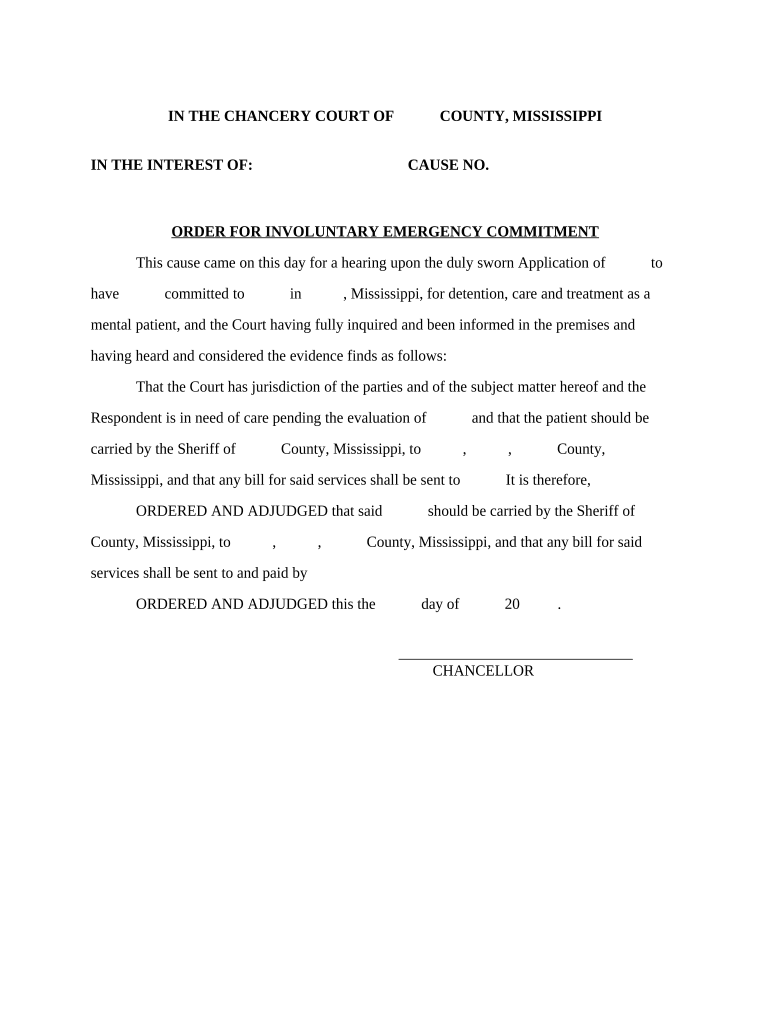
Clear caption, respondent and petitioner details, concise statement of facts and requested relief for court review and docketing.
Medical Certificate

Signed clinical attestation describing symptoms, dangerous behaviors, current treatment, and basis for involuntary evaluation or commitment.

Affidavit of Witness

Firsthand observations describing specific conduct demonstrating danger or inability to care for self.

Order Template

Proposed temporary or final order that implements statutory criteria and specifies duration and conditions of commitment.

Service Instructions

Proof of notice to respondent and any required next-of-kin or public guardian per local rules.

Hearing Record

Transcript or minutes documenting testimony, findings, and judicial rationale for the order.

Online workflow checklist for completing the form

When using e-filing or an e-sign platform, configure fields and authentication to match court and privacy requirements before sending.

Field mapping Map name, DOB, and address to fixed fields for consistency
Authentication Use strong signer verification for clinicians and petitioners
Document format PDF/A preferred for court filing and long-term storage
Service method Set up e-service or upload for clerk's e-filing portal
Retention rules Enable secure archiving per HIPAA and court rules

Technical considerations for digital completion and filing

Confirm file types, signer authentication, and integration options before submitting electronically.

  • File Formats: PDF, DOCX accepted by some courts
  • Integrations: Connectors to e-filing portals and EHRs
  • Authentication: Email, SMS, or stronger methods available

Work with the circuit clerk and, where applicable, the receiving health provider to ensure chosen formats and authentication meet local filing and privacy expectations.

Common timing expectations and immediate steps

Timing is outcome-critical: emergency evaluations and hearing scheduling often follow expedited timelines, but exact deadlines depend on local rules.

Emergency evaluation timeframe:

Often 24–72 hours for clinical assessment

Initial hearing scheduling:

Usually set within days to weeks depending on court calendar

Temporary order duration:

Court specifies duration (varies by statute)

Service deadlines:

Service must follow local process before hearing

Appeal windows:

Appeal periods vary; consult county rules

Practical tips for accurate and efficient completion

Follow these best practices to reduce delays and protect rights while ensuring the petition is legally sufficient.

Confirm local form
Use the circuit court’s prescribed petition form when available. Courts may reject nonconforming documents or require reformatting; using the official form reduces processing friction and helps ensure statutory elements are present.
Document recent behavior
Include specific dates, locations, and witnesses for observable conduct. Detailed contemporaneous observations strengthen the factual basis for emergency orders and assist the judge in making required findings.
Coordinate with clinicians
Ensure the certifying physician or licensed mental health professional completes the medical certificate with dated evaluations. Timely clinical input is often decisive for temporary emergency orders and admissible at hearing.
Protect privacy
Limit PHI to material facts and use secure transmission channels. Improper disclosure can create HIPAA issues and complicate procedural steps; use secure e-filing and storage where permitted.

Practical examples of how petitions are used

These example scenarios illustrate common pathways for initiating an involuntary commitment.

Family-Initiated Emergency

A family reports escalating threats and inability to care for self over two weeks

  • Physician documents imminent risk in a dated certificate
  • The family files an urgent petition with the circuit court; the court orders a short-term evaluation and schedules a hearing to determine further treatment needs and potential commitment.

Clinician-Initiated Hold

An ER psychiatrist documents suicidal behavior and admits for evaluation

  • Hospital completes the medical certification and requests emergency detention
  • The clinician or hospital works with the county to file the petition and the court reviews the medical evidence at the earliest available hearing to determine continuance or release.

eSignature vendor overview for completing and routing commitment paperwork

Comparing core pricing and capabilities can help organizations choose a platform that meets HIPAA, audit, and bulk-processing needs without assuming any vendor is preselected.

signNow DocuSign Adobe Sign PandaDoc HelloSign
Starting Price $8/user/mo $15/user/mo $14/user/mo $19/user/mo $15/user/mo
Free Trial 7-day free trial Varies by plan Varies by plan Varies by plan Varies by plan
Bulk Send Yes (Business Premium) Yes Yes Yes Limited
Audit Trail Yes Yes Yes Yes Yes
HIPAA Compliant Yes (BAA) Yes (BAA) Yes (BAA) No No
Envelope Cap No cap 100 envelopes/user/year Varies Varies Varies

Frequently asked questions about Mississippi involuntary commitment

Answers to common issues when preparing or filing a commitment petition in Mississippi or when using digital tools to support the process.


Need help? Contact support

be ready to get more
Join over 28 million airSlate SignNow users