Establishing secure connection…Loading editor…Preparing document…

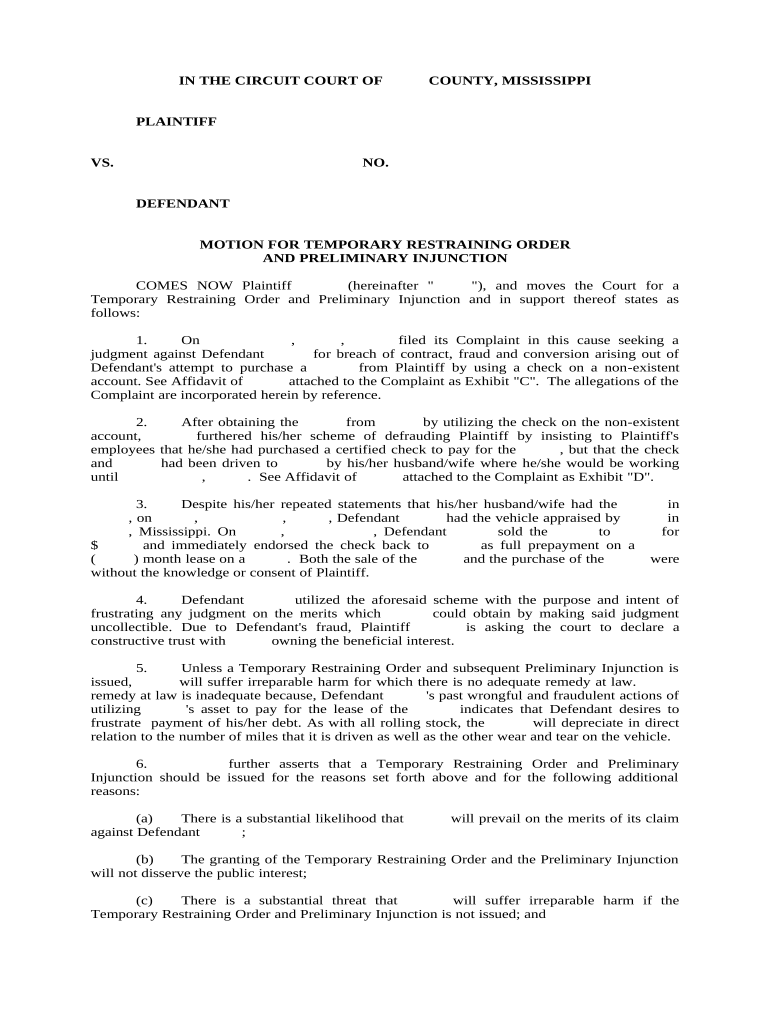
Mississippi Restraining Order Form

This template is fully customizable. Edit the text, fill out the fields, and send it for signature. Give it a try!
Mississippi Restraining Order Form

What the Mississippi Restraining Order Form Is

The Mississippi Restraining Order Form is a courtroom document used to request judicial protection from harassment, threats, stalking, domestic violence, or other behavior that causes fear of harm. Petitioners complete the form to describe incidents, list parties, and request temporary or longer-term relief such as emergency protective orders, no-contact directives, or custody and support provisions when applicable. The court uses the information to schedule hearings, assess immediate safety needs, and determine whether to issue an ex parte emergency order before a full hearing. Requirements and procedures vary by county and by the type of protection sought.

Why the Form Matters for Protection and Court Process

Filing a properly completed restraining order form sets the formal record of alleged abuse or threats, starts judicial review, and creates the paper trail necessary for emergency relief and law enforcement enforcement.

Why the Form Matters for Protection and Court Process

Who Typically Prepares and Files This Form

Court clerks, judges, and law enforcement use the information to schedule hearings, evaluate emergency relief, and enforce any issued order.

  • Self-represented petitioners preparing factual incident narratives and personal contact details.
  • Domestic violence advocates assisting with form completion and safety planning.
  • Private attorneys or public defenders filing motions and representing petitioners in hearings.

Step-by-step: Completing the Form

Follow a clear sequence: identify parties, describe incidents, request specific relief, sign, and file with the appropriate court.

  • 01
    Identify Parties: Enter full legal names and contact information for petitioner and respondent.
  • 02
    Describe Incidents: Provide concise dates, locations, and factual descriptions of alleged conduct.
  • 03
    Specify Relief: Check boxes for temporary orders, no-contact, stay-away, or custody provisions requested.
  • 04
    File & Serve: Sign the petition, submit to the court clerk, and arrange service on the respondent per court rules.

Typical filing and court processing flow

A typical process moves from petition filing to possible ex parte relief, service of process, a full hearing, and final order entry.

  • File Petition: Submit the completed form to the court clerk in the relevant county.
  • Emergency Review: Judge may grant temporary ex parte relief if immediate danger is shown.
  • Service on Respondent: Clerk or sheriff serves the respondent with the petition and hearing notice.
  • Full Hearing: Court holds a contested hearing and decides whether to issue a longer-term order.

Digital preparation and submission considerations

Confirm local court rules for e-filing, signature acceptance, and required supporting documents before relying on electronic submission.

  • File Format: PDF is the most widely accepted format for court filings.
  • eSignature: Electronic signatures follow ESIGN/UETA standards when permitted by court rule.
  • Attachment Types: Include exhibits as attached PDFs; label each exhibit clearly.

Privacy and security for sensitive court forms

Encryption: TLS 1.2/1.3 in transit and AES-256 at rest
Access Controls: Role-based access and audit logs for document access
BAA Availability: Business Associate Agreement available for HIPAA-sensitive workflows
Audit Trail: Comprehensive signing and access history for evidentiary use
Certifications: SOC 2 Type II and ISO 27001 compliance available
ADA Support: WCAG 2.0 Level AA accessibility support

Consequences and risks of errors or false statements

Perjury Risk: False sworn statements may expose the petitioner to criminal perjury charges
Service Failures: Incorrect respondent details can prevent lawful service and delay hearings
Order Enforcement: Vague requests can limit enforceable remedies by police or court
Dismissal: Incomplete or inconsistent evidence may lead to dismissal at hearing
Privacy Exposure: Improperly filed personal data can create safety risks if not redacted
Legal Costs: Errors can increase attorney fees and procedural expenses

Practical tips for accurate and efficient completion

Follow clear drafting, keep factual chronology, and coordinate with local victim services or counsel to ensure timely and enforceable filings.

Be Factual and Specific
List dates, times, places, and witnesses rather than emotional characterizations; specifics strengthen the judge’s ability to assess risk.
Keep Copies
Retain signed originals, filed stamped copies, and proof of service; these support enforcement and future legal needs.
Coordinate Service
Arrange timely service through sheriff, process server, or court channels and obtain written proof of service.
Seek Local Guidance
Contact the court clerk or a local domestic violence advocate to confirm filing practices and fee waiver options.

Real-world examples and platform experiences

Organizations that manage high volumes of legal paperwork use electronic workflows to accelerate filings and improve tracking of signed orders.

Optica Ventures — Operational Efficiency

Their team streamlined signature steps for legal documents

  • Reduced turnaround on notarizations
  • The interface is simple and easy-to-use for our team; more importantly, it is just as easy for our customers.

Martin Properties — Compliance and Mobility

Handled document execution remotely during urgent timelines

  • Maintained compliance and security
  • I can process and execute all of these documents online with 100% compliance and built-in security.

eSignature vendor comparison for filing and serving court forms

Compare common pricing and feature criteria across popular eSignature vendors; signNow is listed first per vendor ordering guidance.

signNow DocuSign Adobe Sign PandaDoc HelloSign
Starting Price $8/user/mo $15/user/mo $14/user/mo $19/user/mo $15/user/mo
Free Trial 7-day free trial No No Yes, limited Yes, limited
Bulk Send Yes Yes Yes Yes No
Audit Trail Yes Yes Yes Yes Yes
HIPAA Compliant Yes Yes Yes No No
Envelope Cap No cap 100 envelopes/user/year Varies by plan Varies by plan Varies by plan

Common questions about completing and filing the form

Answers to typical procedural and technical questions encountered when preparing and submitting a restraining order petition.


Need help? Contact support

be ready to get more
Join over 28 million airSlate SignNow users