Establishing secure connection…Loading editor…Preparing document…

Minnesota Divorce Answer

This template is fully customizable. Edit the text, fill out the fields, and send it for signature. Give it a try!
Minnesota Divorce Answer

What a Minnesota Divorce Answer Is and when it matters

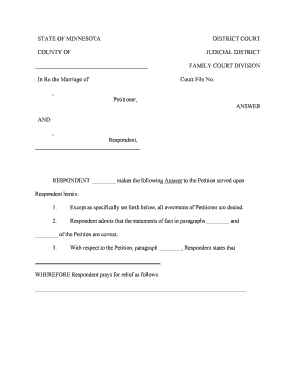
A Minnesota Divorce Answer is the formal written response a respondent files in district court after being served with a Petition for Dissolution of Marriage. The Answer admits or denies allegations, raises affirmative defenses, and can include counterclaims or a demand for relief on custody, property division, spousal maintenance, and other issues. Filing a timely Answer preserves procedural rights, allows the respondent to participate in hearings, and prevents entry of a default judgment. Local court rules and the petition’s instructions determine the filing method and any supporting documents required.

Why filing a proper Answer matters

Filing a complete Minnesota Divorce Answer preserves your legal rights, frames the issues for the court, and documents your position on custody, finances, and relief sought. It prevents default judgments and starts the formal discovery and resolution process.

Why filing a proper Answer matters

Who typically prepares and files a Minnesota Divorce Answer

The Answer is prepared by the person served (the respondent), their attorney, or a self-represented litigant following court rules and service requirements.

  • Respondent preparing a factual and legal response to the petition and asserting any defenses or counterclaims.
  • Family law attorneys drafting a structured Answer, adding counterclaims, and planning next steps for hearings or settlement.
  • Self-represented litigants using court forms or templates to respond when they do not retain counsel.

Parties file and serve the Answer according to district court procedures so the case moves forward without default.

Key parties who sign or authorize the Answer

Respondent

The individual served with the Petition. The respondent signs the Answer under penalty of perjury if required and is responsible for factual accuracy and timely filing to avoid default consequences.

Attorney

Licensed counsel of record signs the filing when retained, certifies service, and ensures procedural compliance, including e-filing, scheduling hearings, and advising on affirmative defenses or counterclaims.

Essential identifying details for the Answer

Case Caption: Names as in petition
Case Number: Court-assigned docket number
Respondent Info: Full legal name, address
Filing Date: MM/DD/YYYY
Service Method: How petition was served
Signature: Signed and dated

Consequences of failing to file or filing incorrectly

Default Judgment: Court may grant petitioner's requests
Loss of Rights: No chance to contest orders
Adverse Custody Orders: Temporary custody may be set
Unfavorable Financial Orders: Support or division decided without input
Sanctions: Court may impose fees or costs
Late Amendments: Higher standards to modify pleadings

Common preparation errors to avoid

  • Using the wrong case caption or failing to include the court and docket number, which can result in rejection or misfiling.
  • Missing the deadline to file an Answer after service, creating a risk of default judgment and loss of procedural protections.
  • Filing a generic denial without addressing specific allegations or raising affirmative defenses, which weakens legal positions.
  • Failing to serve the petitioner or their counsel properly after filing, which violates service rules and may delay proceedings.

Step-by-step: preparing and filing your Answer

Follow a clear sequence: confirm service details, draft a point-by-point response, add defenses or counterclaims, then file and serve according to court rules.

  • 01
    Confirm Service: Check the date and method of service
  • 02
    Draft Answer: Respond to each numbered paragraph
  • 03
    Add Defenses: State affirmative defenses clearly
  • 04
    File and Serve: E-file or deliver to court and serve parties

How filing and service usually proceed

A typical workflow starts with preparing the Answer, continues with filing at the district court (electronically or in person), and concludes with serving the opposing party and documenting proof of service.

  • Prepare Documents: Complete the Answer and attachments
  • File with Court: E-file or submit paper copies
  • Serve Opposing Party: Deliver per Minnesota service rules
  • File Proof of Service: Record how and when served

What to include in a professional Minnesota Divorce Answer

A well-structured Answer organizes the case caption, numbered responses, defenses, and any alternative relief while conforming to local formatting and signature requirements.

Case Caption

Use the exact caption from the Petition, include court, county, and docket number so the filing is correctly associated with the pending case.
Paragraph Responses

Respond to each numbered allegation in the Petition with admission, denial, or lack of information, avoiding blanket denials that obscure specific factual issues.

Affirmative Defenses

List any applicable defenses (for example, statute of limitations, jurisdictional objections) in numbered format to preserve legal arguments for later proceedings.

Counterclaims / Relief

Include specific requests for relief or counterclaims such as custody proposals, spousal maintenance, or property division to place your positions before the court.

Parenting and Support

When children are involved, outline temporary custody, visitation proposals, and request financial disclosure needed for support calculations.

Exhibits and Disclosures

Attach relevant financial statements, declarations, or proposed parenting plans and note any required statutory disclosures under Minnesota law.

Practical tips for accuracy and efficiency

Adopt consistent formatting, verify identifiers, and document each step to reduce objections and processing delays.

Use exact names
Enter all party names exactly as shown on the Petition; typographical differences can cause administrative issues or misidentification in court records.
Answer point-by-point
Address each numbered allegation directly, using admission, denial, or a statement of lack of knowledge to preserve clarity and avoid ambiguity.
Preserve evidence
Attach key financial records or declarations as exhibits and label them clearly to streamline discovery and support your factual assertions.
Consult rules
Review Minnesota district court local rules for formatting, page limits, and e-filing requirements before submission to avoid rejection.

Timing and deadlines to watch for

Deadlines for answering and related procedural steps vary by service method and local rules; confirm timing with the clerk’s office or counsel.

Service Date:

Date petitioner served you; triggers response timing

Answer Deadline:

Respond within the period allowed by court rules; verify with clerk

Default Risk:

Failure to respond may permit default judgment

Temporary Orders:

Hearings on temporary relief may be scheduled quickly

Financial Disclosures:

Provide sworn disclosures when requested by rule or order

Key milestones in the early case timeline

A concise sequence helps track obligations and prepares you for hearings, discovery, and settlement discussions.

01

Petition Filed

Petitioner files and case is opened at the court clerk

02

Service Completed

Respondent is served and the response clock starts

03

Answer Filed

Respondent files the Answer to preserve defenses

04

Initial Hearings

Court may set temporary orders or conferences

How a Minnesota Divorce Answer compares to related family filings

This high-level comparison highlights differences in filing mechanics and formalities between an Answer and other family law filings.

Feature Minnesota Divorce Answer Other Family Filings
Notarization sometimes required
E-filing common common
Court Fee varies by county varies by filing
Respond Within varies by service method varies by document

Typical eSignature vendor pricing and capabilities relevant to filing and serving an Answer

Comparing common vendor pricing and select capabilities can help organizations choose an eSignature provider for document execution; signNow is listed first per platform comparisons.

signNow DocuSign Adobe Sign PandaDoc HelloSign
Starting Price $8/user/mo $15/user/mo $14/user/mo $19/user/mo $15/user/mo
Free Trial 7-day free trial Verify with vendor Verify with vendor Verify with vendor Verify with vendor
Bulk Send Yes Yes Yes Yes No
Audit Trail Yes Yes Yes Yes Yes
HIPAA Compliant Yes Yes Yes No No

Configuring an electronic workflow for an Answer

Set up e-filing and signing workflows that match court requirements, including signer authentication and document retention settings.

Field Configuration
Service Method E-file or paper per court rules
Signer Authentication Email or SMS code recommended
Notifications Notify opposing counsel and parties
Retention Save PDF plus audit trail

Technical considerations for e-signing and e-filing

Ensure the platform supports court-acceptable file types, audit trails, and the authentication level required by your jurisdiction.

  • File Formats: PDF, DOCX supported
  • Integrations: Works with Google Workspace and NetSuite
  • Authentication: Email, SMS, or advanced methods

Choose a solution that produces tamper-evident signed PDFs and preserves audit logs; verify the court’s accepted submission method before e-filing or presenting documents at hearings.

Common questions about filing a Minnesota Divorce Answer

Answers to typical procedural and technical questions to help respondents avoid delays or default outcomes.


Need help? Contact support

be ready to get more
Join over 28 million airSlate SignNow users