Establishing secure connection…Loading editor…Preparing document…

Motion and Order to Refix Louisiana

This template is fully customizable. Edit the text, fill out the fields, and send it for signature. Give it a try!
Motion and Order to Refix Louisiana

What the Motion and Order to Refix Louisiana Is and When it Applies

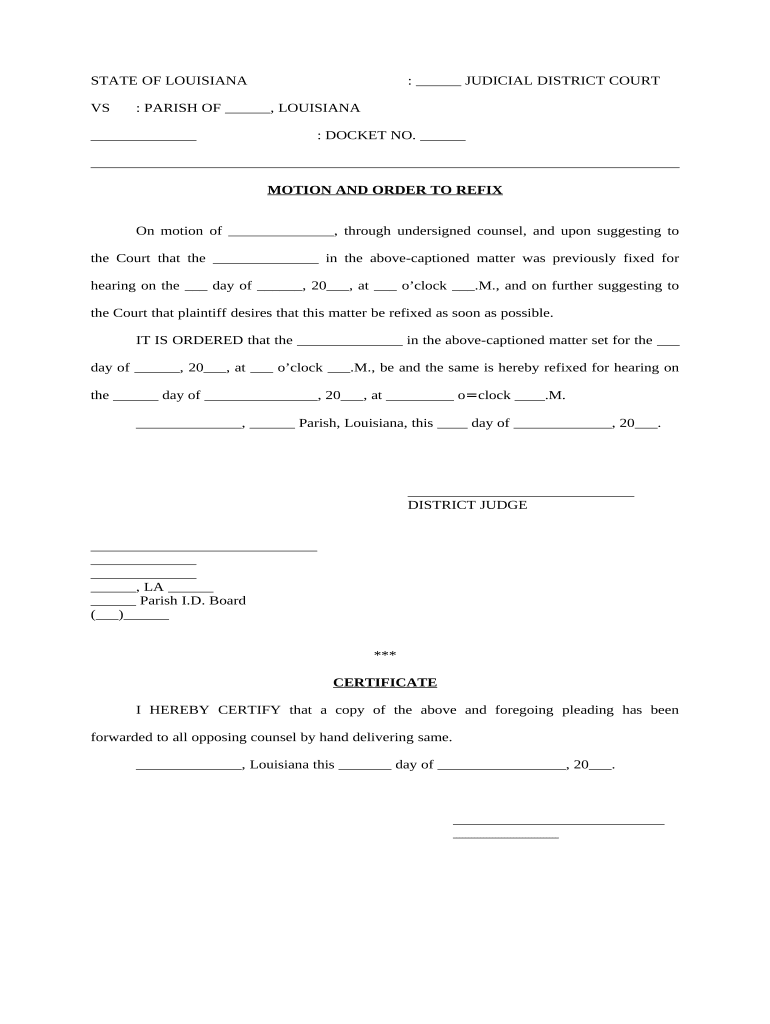
The Motion and Order to Refix Louisiana is a court filing used to request and document a change to a scheduled hearing or trial date in a Louisiana court. Parties or their attorneys file a written motion explaining the reasons for the proposed new date and request that the judge sign an order resetting the matter. Local parish court rules and the judge’s calendar control the procedure; some hearings may require notice to opposing parties, proof of service, or compliance with scheduling orders before the court will enter a refix. Electronic filing and e-signature acceptance depend on the court’s e-filing and signature rules.

Why a Clear Motion and Order to Refix Matters

A well-prepared Motion and Order to Refix Louisiana clarifies the reason for rescheduling, documents service to other parties, and helps avoid miscommunication that can lead to continuances or sanctions under local rules.

Why a Clear Motion and Order to Refix Matters

Who Typically Prepares and Signs This Document

Ensure the person submitting the motion is authorized under local rules; signature and certificate of service requirements vary by parish and court.

  • Attorneys and law firms representing parties in civil litigation who need to adjust hearing dates within court scheduling constraints.
  • Self-represented litigants who must request a new date because of conflict, emergency, or new evidence affecting readiness.
  • Court clerks or chambers staff when the court issues administrative orders to reorganize the calendar or reassign matters.

Step-by-Step: Filing a Motion and Order to Refix in Louisiana

Follow the sequence below to prepare and submit the motion, and to ensure opposing parties receive proper notice.

  • 01
    Review local rules: Confirm parish-specific filing and notice requirements before drafting.
  • 02
    Draft motion: State current date, requested date, and grounds for refix.
  • 03
    Prepare order: Include a proposed order for judge’s signature with new date and time.
  • 04
    Serve and file: Serve opposing parties and file the motion/order per court e-filing rules.

Digital Filing and eSubmission Workflow Overview

Set up your filing workflow to match the court’s electronic filing and signature preferences before submitting the motion.

Field Configuration
Document Format PDF/A for permanent records; ensure text is searchable
Signature Method Judge signs via court system; filer uses attorney signature
Authentication Use court e-filing credentials or authorized e-service account
Service Proof Attach certificate of service or e-service receipt

How Electronic Submission Typically Works for Refix Motions

A standard e-filing flow reduces processing time when it follows the court’s technical and procedural rules.

  • Upload: Upload the motion and proposed order as court-ready PDFs
  • Attach exhibits: Include supporting affidavits or medical notes if relied upon
  • File: Submit through the court’s e-filing portal using your credentials
  • Serve: Trigger e-service or attach proof of personal/mail service

Technical Requirements for Electronically Completing the Motion

When courts permit e-submission, ensure files are tamper-evident and include contact information for counsel to avoid processing delays.

  • PDF Support: PDF/A or standard PDF accepted
  • Authentication: Court e-filing login or authorized e-service
  • eSignature: Court rules determine acceptance

Essential Components to Include in a Professional Motion and Order to Refix Louisiana

The motion and proposed order should be complete, concise, and comply with the judge’s scheduling standards to maximize the chance of a prompt ruling.

Case Caption

Full court name, docket number, and party names to ensure the filing is placed in the correct case file and linked to existing pleadings.
Statement of Relief

A clear request that the hearing or trial be reset to specified date(s) and time, and whether the request is opposed or unopposed by other parties.

Factual Basis

Concise facts supporting the refix request, such as counsel conflict, emergency, new counsel appearance, or scheduling irregularities, with dates and evidence.

Proposed Order

A short, judge-ready order that the court can sign, showing the new date, any conditions, and who is responsible for notifying parties.

Certificate of Service

Describe how and when all parties were served, including method (mail, e-service) and date, to satisfy procedural notice requirements.

Signature Block

Attorney or party signature line including printed name, bar number if applicable, firm name, address, and contact information for the record.

Security, Privacy, and Compliance Considerations

ESIGN: 15 U.S.C. §7001 acceptance
UETA: State-level validity in most states
Court Exceptions: Court filings may be excluded
HIPAA: Use BAA when PHI included
Document Integrity: Use tamper-evident PDFs
Audit Trail: Preserve timestamps and signer data

Practical Tips for a Problem-Free Motion and Order to Refix

Applying consistent document standards and clear service procedures reduces the chance of rejection or delay by the court.

Confirm availability
Check the judge’s calendar and opposing counsel availability before proposing a new date to avoid repeated refix requests.
Keep proposed order simple
Provide a single, clearly worded proposed order that the judge can sign without modification to speed approval.
Document support
Attach concise supporting evidence for emergency or medical reasons rather than lengthy exhibits that obscure the request.
Match case information
Ensure caption, case number, and party names match existing docket entries exactly to avoid misfiling.

Common Preparation Errors to Avoid

  • Failing to include an accurate certificate of service, which can render the motion procedurally defective and subject to denial.
  • Proposing multiple alternative dates without checking calendars, which can create scheduling confusion and additional court work.
  • Submitting a proposed order that conflicts with scheduling orders or case-management deadlines already set by the court.
  • Using inconsistent party names or an incorrect docket number, causing the clerk to misfile or delay the motion.

Risks and Consequences of an Improper Motion and Order to Refix

Motion Denial: Improperly supported request
Scheduling Sanctions: Court may impose sanctions
Delay Costs: Additional legal expense
Default Risk: Missed deadlines risk default
E-Filing Rejection: Wrong format or metadata
Service Defect: Invalid service can void action

Typical Timing and Notice Considerations

Deadlines vary by parish and the judge’s scheduling order; always consult local rules for minimum notice periods and preferred submission windows.

Local Rule Check:

Confirm parish-specific notice period before filing

Short-Notice Requests:

Emergency refix may require affidavit and prompt notice

Service Timing:

Serve other parties per court-defined methods and deadlines

Proposed Order Timing:

Provide proposed order at filing to facilitate judge signature

Calendar Coordination:

Coordinate with clerk’s office to confirm availability

Practical Scenarios: When Parties Seek a Refix

Two concise examples show how typical circumstances produce a Motion and Order to Refix and what judges commonly expect.

Example 1

A lead attorney becomes unavailable due to emergency and requests one mutually agreed date from opposing counsel.

  • The motion includes counsel availability and a proposed order.
  • The judge typically signs when notice is proper and the proposed date fits the court calendar, reducing the need for a hearing on the motion itself.

Example 2

A party needs additional discovery that cannot be completed by the scheduled hearing date.

  • Motion explains discovery status and new readiness date.
  • Judges often reset hearings to allow completion when the request is timely, supported by specific facts, and opposing counsel receives notice.

eSignature Vendor Comparison for Preparing and Signing Refix Documents

This table compares common eSignature plan attributes relevant to preparing, signing, and sharing court documents; signNow is listed first per vendor comparison conventions.

signNow DocuSign Adobe Sign PandaDoc HelloSign
Starting Price $8/user/mo $15/user/mo $14/user/mo $19/user/mo $15/user/mo
Free Trial 7-day free trial Varies by vendor Varies by vendor Varies by vendor Varies by vendor
Bulk Send Yes (Business Premium+) Yes (plan-dependent) Yes (plan-dependent) Yes No
Audit Trail Yes Yes Yes Yes Yes
HIPAA Compliant Yes Yes Yes No No

Frequently Asked Questions About Motion and Order to Refix Louisiana

Answers to common procedural and technical questions about drafting, serving, and electronically submitting a Motion and Order to Refix in Louisiana courts.


Need help? Contact support

be ready to get more
Join over 28 million airSlate SignNow users