Caption
Case caption and docket number at the top of the filing, matching the court’s required format and parties' names exactly.
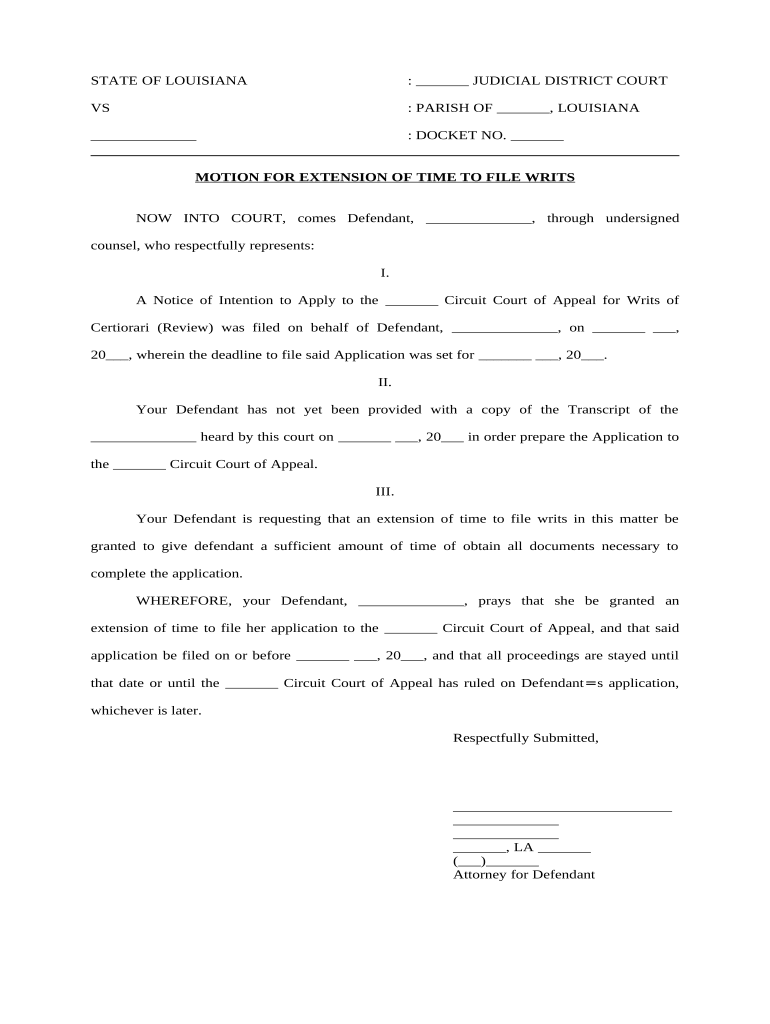
A clear, rule-based motion preserves deadlines, avoids defaults, and records the court’s approval of new timing. Under the Federal Rules and most state rules, extensions must cite the governing authority such as Federal Rule of Civil Procedure 6(b) or local equivalents, and demonstrate good cause or excusable neglect. Proper filing reduces the risk of sanctions, opposing-party objections, and procedural dismissals.

Accurate, well-supported motions help the court balance docket needs and fairness between parties when granting additional time.
Case caption and docket number at the top of the filing, matching the court’s required format and parties' names exactly.
A succinct title such as 'Motion for Extension of Time to File Response to Complaint' that clearly states the relief sought.
Brief chronology explaining why more time is needed, including specific dates, events, or logistical constraints.
Citation to controlling rules or statutes (for example, FRCP 6(b) for federal civil matters) that authorize the requested extension.
Declarations, affidavits, or exhibits that corroborate reasons for the extension and show good cause or excusable neglect.
A separate proposed order with the new deadline for the judge’s signature and a signature block for the moving party or counsel.
| Field | Configuration |
|---|---|
| Case Caption Field | Required, auto-fill from case template. |
| Relief Requested Field | Short text; validate date format. |
| Supporting Upload | PDF upload; required if asserting factual claims. |
| Signature Block | Signer authentication and date field. |
Use secure platforms that produce a court-ready PDF and preserve an audit trail to support attribution and retention obligations.
File prior to the current deadline when possible to avoid summary denial.
Federal Rule 6(b) governs enlargement of time for federal civil cases.
Appellate rules (e.g., FRAP) set strict extension caps for notices of appeal.
Many courts require a meet-and-confer certificate or specific form language.
If time is short, request expedited consideration and provide supporting declarations.
Opposing counsel receives the motion and any exhibits.
Opposing party typically has a fixed number of days to oppose per local rule.
If allowed, the moving party may file a reply brief within court-specified time.
Judge issues an order granting, denying, or partially granting relief.
A discovery response deadline approached while a key deposition was rescheduled
Lead counsel had overlapping appellate filings and asked for extra time to prepare a dispositive brief