Establishing secure connection…Loading editor…Preparing document…

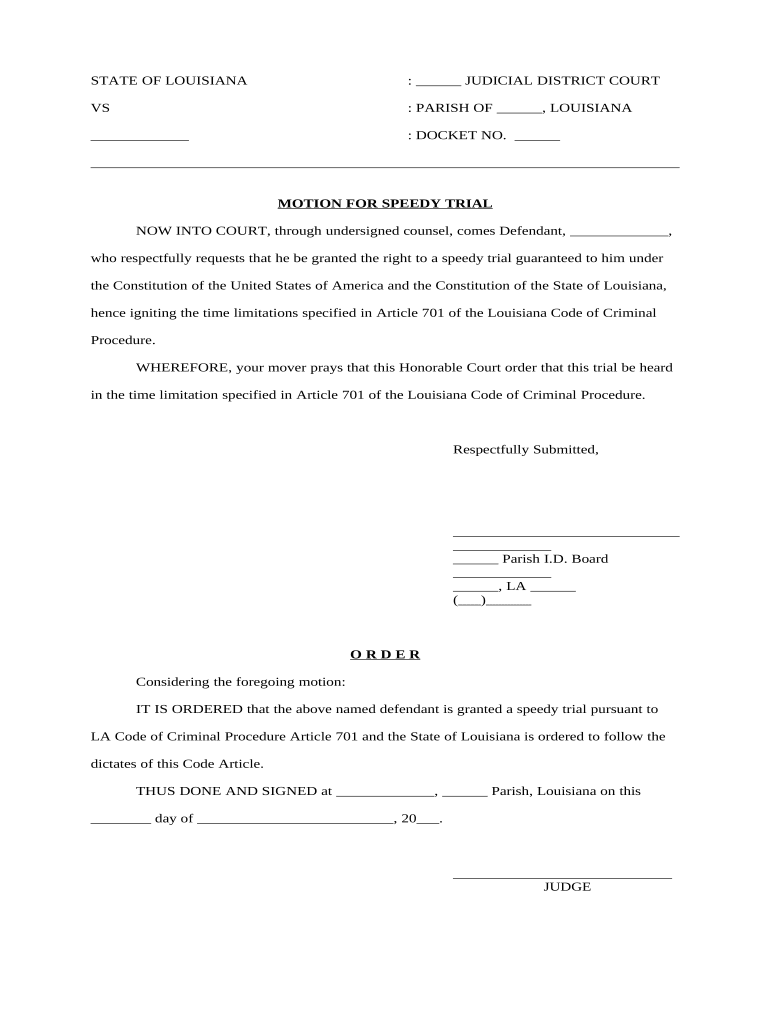
Motion for Speedy Trial

This template is fully customizable. Edit the text, fill out the fields, and send it for signature. Give it a try!
Motion for Speedy Trial

What a Motion for Speedy Trial Is and When It Applies

A Motion for Speedy Trial is a formal request to a criminal court asking that the case proceed to trial without unreasonable delay. It asserts the defendant's Sixth Amendment right to a timely trial and invokes statutory deadlines where applicable, including the federal Speedy Trial Act (18 U.S.C. §3161). The motion typically cites the procedural posture, relevant dates (arrest, indictment, arraignment), grounds for delay exclusion if any, and a requested scheduling order so the court can set prompt deadlines for discovery, pretrial motions, and trial.

Why Filing This Motion Matters

A timely motion preserves constitutional and statutory rights, reduces pretrial detention risk, and forces case scheduling. Courts may dismiss charges or shorten continuances when an unjustified delay obstructs the defendant’s right to a prompt trial.

Why Filing This Motion Matters

Who Typically Prepares and Files This Motion

Defense counsel most commonly prepares and files speedy-trial motions, though prosecutors may track related timelines. Self-represented defendants can also file the motion but should follow local rules closely.

  • Defense attorneys asserting constitutional and statutory speedy-trial protections in criminal cases.
  • Prosecutors monitoring and responding to scheduling issues and potential exclusions.
  • Self-represented defendants filing pro se motions when counsel is not retained.

Step-by-Step: How to Prepare and File the Motion

Follow a standard sequence to collect facts, draft the motion, file with the clerk, and serve opposing parties so the court can set timely deadlines.

  • 01
    Gather Case Information: Compile arrest, indictment, arraignment, and prior continuance dates.
  • 02
    Draft the Motion: State facts, cite law (Sixth Amendment; 18 U.S.C. §3161), and request specific relief.
  • 03
    File with Clerk: E-file or deliver to the court clerk per local rules.
  • 04
    Serve Opposing Counsel: Serve prosecution and file a certificate of service immediately.

Typical Filing and Service Workflow

A clear procedural flow speeds judicial review: prepare, execute, file, and serve with proof recorded in the court file.

  • Prepare Motion: Complete draft with dates, legal basis, and requested order.
  • Execute Document: Sign and date by counsel or pro se defendant.
  • File with Court: E-file or lodge paper filing per local rules.
  • Serve Parties: Provide opposing counsel and prosecutor proof of service.

Setting Up an Online Template and eFiling Workflow

Configure document fields, signer authentication, and delivery options before sending to avoid rework and ensure admissible service.

Field Configuration
Platform Choose e-sign/e-file provider compatible with court e-filing.
Authentication Email or SMS code; use stronger methods for sensitive cases.
Template Fields Pre-fill captions, dates, and certificate of service fields.
Notifications Enable automated notifications when filed and served.

Digital Signing and eSubmission Requirements

Confirm the court accepts e-filings and that your eSignature provider complies with ESIGN and local e-filing rules before submitting.

  • File Formats: PDF/A or PDF preferred.
  • Authentication: Email, SMS code, or advanced verification.
  • Integrations: Supports Microsoft 365 and Google Workspace.

Core Elements to Include in a Professional Motion for Speedy Trial

A complete motion is concise but comprehensive: identify parties, recite dates, explain delay, cite authority, request relief, and document service.

Caption

Full court caption identifying the jurisdiction, case number, and complete party names so the filing is properly docketed and routed.
Procedural History

Brief chronology of arrest, charges, arraignment, continuances, and discovery events that determine statutory timeline triggers.

Statement of Facts

Concise factual account showing elapsed time, reasons for delay, and any prejudicial effects on the defendant.

Legal Basis

Cite the Sixth Amendment and applicable statutes such as the Speedy Trial Act (18 U.S.C. §3161) or relevant state law.

Requested Relief

Specify the remedy sought: immediate trial setting, scheduling order, or dismissal with/without prejudice, tailored to case posture.

Certificate of Service

Document whom you served, how, and when; include methods and dates to show compliance with service rules.

Key Security and Compliance Considerations for eSubmission

Encryption: TLS 1.2/1.3, AES-256
Audit Trail: Detailed timestamps and IP logs
Certifications: SOC 2 Type II, ISO 27001
HIPAA: BAA required for PHI
ESIGN / UETA: Federal and state compliance
21 CFR Part 11: Available on higher tiers

Common Pitfalls to Avoid When Preparing the Motion

  • Using inconsistent names or case numbers that prevent proper docketing and service, causing administrative rejection or misfiling.
  • Failing to calculate excludable periods correctly, which can make the motion legally unsupported and harm credibility.
  • Neglecting to attach or cite necessary docket entries and continuance orders that explain delay and justify relief.
  • Omitting a certificate of service or using an improper service method can invalidate the filing and require re-service.

Consequences of Incorrect or Late Motions

Waived Rights: Delay may be deemed waiver
Dismissal Risk: Judge may dismiss charges (18 U.S.C. §3162)
Continued Detention: Defendant may remain detained longer
Evidence Issues: Lost or stale evidence risks admissibility
Sanctions: Court may sanction counsel
Reputational Harm: Credibility before the court reduced

Key Statutory and Typical Deadlines to Track

Timelines depend on federal or state law; under federal law the Speedy Trial Act creates specific benchmarks for indictment and trial scheduling.

Initial Appearance:

Typically within 24–48 hours after arrest.

Indictment Deadline:

30 days from arrest for indictment (18 U.S.C. §3161(b)).

Trial Deadline:

70 days from indictment or first appearance (18 U.S.C. §3161(c)(1)).

Excludable Delays:

Pretrial motions and other statutory exclusions pause the clock.

State Variations:

State speedy-trial timeframes vary; consult local statutes and court rules.

Sequential Milestones After Filing the Motion

Track milestone events from filing through final scheduling to ensure the court addresses the motion within appropriate timeframes.

01

Filing

Court receives motion and assigns a docket number.

02

Response Deadline

Prosecution files response within the local rule period.

03

Hearing

Court schedules a hearing if requested or deems motion submitted.

04

Scheduling Order

Judge issues trial dates and deadlines for discovery and motions.

Common eSignature Options for Filing and Signing Documents

Compare typical vendor pricing and capabilities for e-signing legal filings; signNow is listed first per comparison convention.

signNow DocuSign Adobe Sign PandaDoc HelloSign
Starting Price $8/user/mo $15/user/mo $14/user/mo $19/user/mo $15/user/mo
Free Trial 7-day free trial Varies by vendor Varies by vendor Varies by vendor Varies by vendor
Bulk Send Yes (Premium) Varies by vendor Varies by vendor Varies by vendor Varies by vendor
Audit Trail Yes Yes Yes Yes Yes
HIPAA Compliant Yes Yes Yes No No
Envelope Cap No envelope cap 100 envelopes/user/year Varies Varies Varies

Frequently Asked Questions and Troubleshooting

Answers to common procedural and technical questions about drafting, filing, e-signing, and preserving motions for speedy trial.


Need help? Contact support

be ready to get more
Join over 28 million airSlate SignNow users