Establishing secure connection…Loading editor…Preparing document…

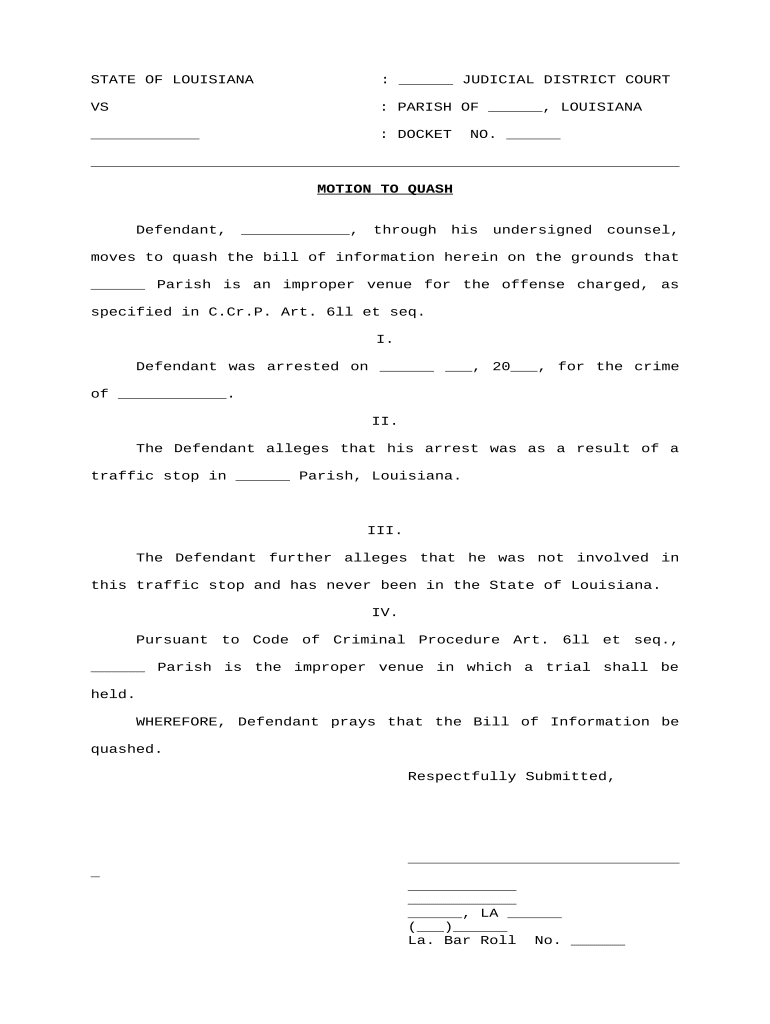
Motion to Quash

This template is fully customizable. Edit the text, fill out the fields, and send it for signature. Give it a try!
Motion to Quash

What a Motion to Quash Is and when it’s used

A Motion to Quash is a court filing asking a judge to nullify or limit a legal process, most commonly a subpoena or improper service of process. It asks the court to prevent production of documents or testimony, to strike defective service, or to dismiss process issued without legal basis. In federal practice, motions related to subpoenas cite the Federal Rules of Civil Procedure (Rule 45) and local rules; state practice follows state statutes and rules of civil procedure. Because motions are court filings, verify local e-filing and signature rules before electronic submission.

Why you might file a Motion to Quash

A Motion to Quash protects privileged or irrelevant material, prevents burdensome or overbroad discovery, and enforces procedural safeguards; it can avoid unnecessary production and shape the record before sanctions or orders issue.

Why you might file a Motion to Quash

Who typically prepares or files a Motion to Quash

The Motion to Quash is usually prepared by attorneys for parties or by third parties served with subpoenas seeking to avoid compelled disclosure.

  • Defense counsel seeking to protect privileged communications or limit discovery burdens.
  • Corporate records custodians responding as third-party subpoena recipients.
  • Self-represented parties objecting to defective service or improper subpoenas.

Who signs and files the motion

Attorney

An attorney of record signs most Motions to Quash and certifies compliance with service and local rules; signature includes bar number and contact information, and the attorney must be admitted in the filing jurisdiction or associate local counsel.

Third-Party

A third-party subpoena recipient may file a Motion to Quash on their own behalf; where court rules require counsel, a third party should consult local rules or retain counsel to avoid procedural defects.

Primary elements to include in a professional Motion to Quash

A complete Motion to Quash presents the case caption, the precise relief requested, concise factual context, legal grounds with authority, supporting declarations or exhibits, and a clear signature and certificate of service.

Case Caption

Full court name, docket number, judge designation, and complete party names as they appear on the complaint or underlying case.
Requested Relief

Specific orders sought (e.g., quash subpoena in whole/part, protective order, limit scope or timing of production).

Statement of Facts

Concise factual background describing the subpoena or service, who issued it, what it seeks, and relevant dates and locations.

Legal Grounds

Cite statutes, rules, or case law supporting relief (e.g., Federal Rules of Civil Procedure, Rule 45; state rules) and explain application to facts.

Supporting Evidence

Attach declarations, privilege logs, redacted examples, or vendor subpoenas that substantiate objections and burden arguments.

Signature Block

Movant or counsel signature, printed name, bar number, firm, address, phone, email, and date; include certificate of service.

Essential information to include in the motion

Court Caption: Full case caption
Docket Number: Court docket number
Movant Identity: Full legal name
Process Details: Subpoena or service specifics
Legal Basis: Statute or rule cited
Signature Info: Signer contact details

Step-by-step: prepare, review, and file a Motion to Quash

Follow a clear sequence from drafting to filing so the court and opposing parties receive complete, compliant filings that preserve objections and meet local deadlines.

  • 01
    Draft motion: Assemble caption, relief, facts, and legal argument.
  • 02
    Attach evidence: Add declarations, subpoena copies, and privilege logs.
  • 03
    File with court: Submit via court e-filing or clerk per local rules.
  • 04
    Serve parties: Serve all parties and file certificate of service.

How filing and service typically proceed

A Motion to Quash must be filed with the court and served on affected parties; procedures vary by federal, state, and local rules so confirm the required steps before submission.

  • File: Upload to court e-filing system or deliver to clerk.
  • Serve: Provide opposing counsel and subpoenaing party proof of service.
  • Opposition: Court may set a briefing schedule for responses and replies.
  • Hearing/Order: Court may schedule a hearing or issue a written ruling.

Online preparation: common configuration for digital workflows

When assembling a Motion to Quash in a document platform, configure fields and outputs to meet court formatting and e-filing requirements.

Document Template Use court-compliant margins and caption formatting
Signature Fields Add signer role and signature date fields
Authentication Enable email or stronger signer authentication
Export Format Export as searchable PDF for e-filing
Audit Trail Capture timestamps and IP addresses

Delivery channels and technical interoperability

Confirm the court’s accepted submission channels — many courts accept CM/ECF e-filing, some accept email, and a few require original paper filings with wet signature.

  • Document formats: PDF/A or searchable PDF preferred
  • Integrations: Connectors to case management and cloud storage
  • Authentication: Email, SMS, or higher-assurance methods

Where court rules permit electronic signing and filing, ensure the platform complies with ESIGN (15 U.S.C. ch. 96) and local e-filing requirements; for filings that are exceptions to ESIGN, follow original signature or court-specified formats.

Timing considerations and common scheduling triggers

Timing obligations for a Motion to Quash depend on the underlying process and local rules; file promptly after service and verify briefing deadlines in local and federal rules.

Respond promptly:

File as soon as practicable after receipt of subpoena

Local briefing:

Observe opponent’s response deadlines per local rules

Hearing windows:

Court may set hearing within days to weeks

Statutory limits:

Follow any jurisdictional or statutory timing rules

Emergency relief:

File ex parte if immediate stay or protection is needed

Key milestones from service to court order

Track milestones to protect rights: initial receipt, drafting the motion, filing and service, and the court’s resolution or scheduling of a hearing.

01

Receipt of Process

Date you were served and scope of request are recorded.

02

Prepare Motion

Assemble legal grounds, exhibits, and certificate of service.

03

File and Serve

Court filing and proof of service must be timely submitted.

04

Court Ruling

Judge issues order, schedules hearing, or requests supplemental briefing.

Common drafting and procedural mistakes to avoid

  • Failing to attach the subpoena or proof of service, leaving the court without necessary context for the motion.
  • Relying on broad or conclusory assertions of privilege without a supporting privilege log or declaration.
  • Missing local formatting rules for captions, signature blocks, or page limits and risking a clerk rejection.
  • Serving the motion improperly or failing to file a timely certificate of service required by local rule.

Consequences of deficient or late motions

Sanctions: Monetary penalties possible
Waiver: Objection may be waived
Denial: Motion may be denied outright
Production Order: Court may compel production
Costs: Adverse cost-shifting possible
Reputational: Credibility or discovery credibility harmed

Common eSignature vendor comparison for preparing and signing filings

Platform pricing and features vary; signNow appears first below. Confirm plan details and court e-filing compatibility before selecting a vendor for document assembly and signature capture.

signNow DocuSign Adobe Sign PandaDoc HelloSign
Starting Price $8/user/mo $15/user/mo $14/user/mo $19/user/mo $15/user/mo
Free Trial 7-day free trial Varies by vendor Varies by vendor Varies by vendor Varies by vendor
Bulk Send Yes (Business Premium) Varies by plan Varies by plan Varies by plan Varies by plan
Audit Trail Yes Yes Yes Yes Yes
Envelope Cap No envelope cap 100 envelopes/user/year Varies by plan Varies by plan Varies by plan

Representative examples of Motions to Quash in practice

Two concise examples show typical fact patterns and outcomes parties seek when filing Motions to Quash.

Case Study 1

A third-party vendor received a broad subpoena for client records and contested relevance.

  • The vendor asserted undue burden and confidentiality.
  • The court granted a narrowed order, requiring production of limited date ranges and redacted private identifiers while denying a full quash.

Case Study 2

A defendant moved to quash a subpoena seeking communications covered by attorney-client privilege.

  • The motion cited privilege and produced a privilege log.
  • The court quashed demands for privileged materials and ordered in camera review of disputed documents.

Common questions and practical answers about Motions to Quash

Answers to frequent procedural and technical questions about preparing, signing, and filing a Motion to Quash in U.S. courts.


Need help? Contact support

be ready to get more
Join over 28 million airSlate SignNow users