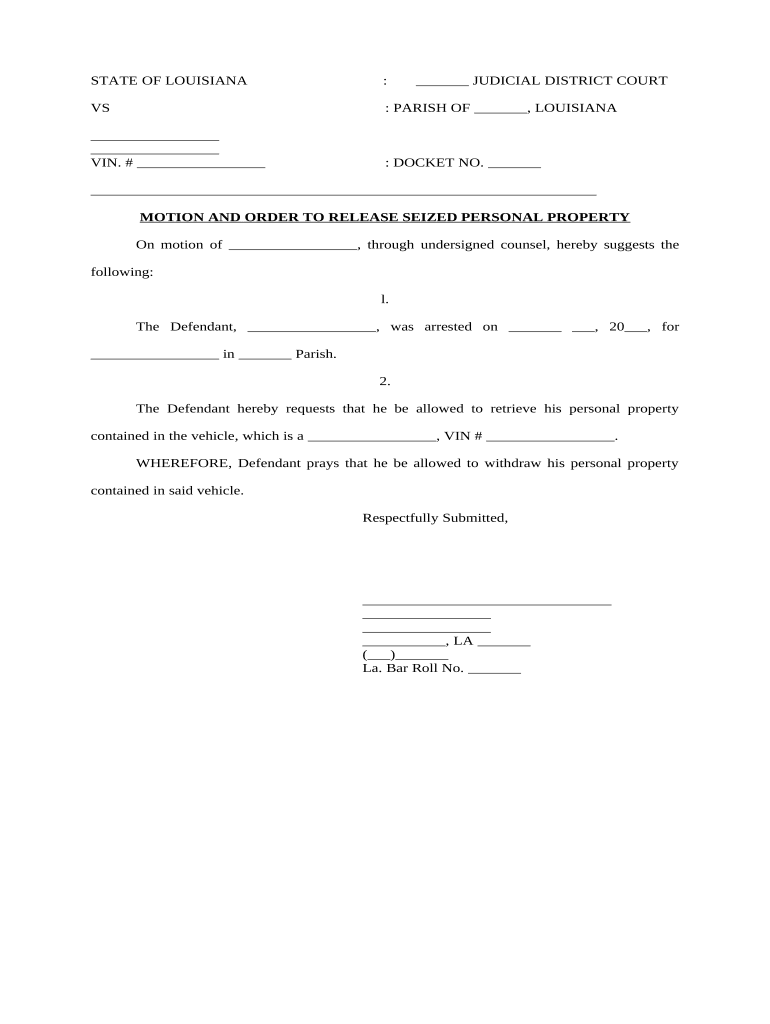
Motion for Release of Property
What the Motion for Release of Property Is
Why a Well-Drafted Motion Matters
A properly drafted Motion for Release of Property restores access to detained assets, shortens litigation timelines, and preserves property value. It creates a formal record for appeals, preserves rights against forfeiture, and clarifies competing claims for the court and custodians.
Who Typically Files or Responds
Law firms, individual owners, estate representatives, and criminal defendants commonly file this motion when property is detained pending resolution.
- Private property owners seeking return of seized personal effects or vehicles.
- Defense attorneys requesting judicial release pending criminal case disposition and evidence review.
- Estate executors or probate attorneys recovering property from estate administration.
Step-by-Step: Preparing and Filing the Motion
-
01Identify Property: List description, location, serial numbers, and custody details.
-
02Gather Evidence: Attach receipts, ownership documents, photos, and chain-of-custody records.
-
03Draft Motion: State legal basis, cite statutes, and request specific relief.
-
04File & Serve: Submit to the court clerk and serve all interested parties.
Configuring an Online Workflow for the Motion
| Field | Configuration |
|---|---|
| Template | Create an editable motion template for reuse. |
| Auto-fill | Prepopulate case and party fields |
| Signer Order | Set party and counsel signing sequence |
| Notifications | Email and optional SMS alerts |
| Audit Trail | Enable timestamps and IP logging |
How Electronic Submission Typically Works
-
Upload: Upload motion PDF and exhibits to case folder.
-
Place Fields: Add signature, date, and initials fields with roles.
-
Sign: Authorized signer authenticates and applies signature.
-
Serve: Send electronic service copies and file certificate of service.
Platform Capabilities to Check Before eFiling
For eFiling and eSignature, ensure platform supports PDF, audit trails, required authentication, and integrates with court e-filing systems where available.
- File Formats: Export and import in PDF and DOCX
- Authentication: Email, SMS code, KBA options
- Integrations: Connectors for case management and storage
Key Filing and Service Deadlines to Monitor
When to file the motion:
File as soon as custody is known and within any statutory claim period.
Service Deadline:
Serve all parties per local rule
Time for opposition or response:
Opposing parties typically have seven to fourteen days to respond unless court orders otherwise.
Scheduling a hearing on the motion:
Courts set hearing dates based on calendars; emergency hearings may be available.
If denied, appeal or seek reconsideration:
Follow appellate rules for timelines; consult counsel for preservation of issues.
Milestones from Seizure to Release
Seizure
Record date, initial custody, and inventory of property.
Motion Filed
Motion submitted with exhibits and proposed order.
Hearing
Court considers evidence, hears argument, issues ruling.
Turnover
Ordered transfer and logistics for release to claimant.
Pricing and Feature Snapshot for eSignature Vendors
| signNow | DocuSign | Adobe Sign | PandaDoc | HelloSign | |
|---|---|---|---|---|---|
| Starting Price | $8/user/mo | $15/user/mo | $14/user/mo | $19/user/mo | $15/user/mo |
| Free Trial | 7-day free trial, no credit card required | Check vendor site for trial options | Check vendor site for trial options | Check vendor site for trial options | Check vendor site for trial options |
| Bulk Send | Yes — Business Premium | Yes | Yes | Yes | Yes |
| Audit Trail | Yes | Yes | Yes | Yes | Yes |
| HIPAA Compliant | Yes — BAA available | Yes — BAA available | Yes — BAA available | Verify HIPAA support | Verify HIPAA support |
| Envelope Cap | No cap | 100 envelopes/user/year | Verify vendor limits | Verify vendor limits | Verify vendor limits |
Practical Examples of Motion Outcomes
Criminal Forfeiture
A defendant filed a Motion for Release of Property after law enforcement seized a vehicle used during an alleged offense.
- Court reviewed ownership and possession records.
- The motion included title, registration, insurance records, and affidavits; the judge ordered conditional return pending trial with inventory and proof of non-use for illicit purposes, balancing public safety and property rights.
Estate Recovery
An executor filed the motion to recover heirlooms held by a storage facility after the decedent's death and conflicting claimant assertions.
- Included probate case number and letters testamentary.
- Exhibits showed purchase receipts, photographs, and a will; facility released items after court order and stipulation on value and distribution, avoiding protracted contested litigation among heirs.
Common Pitfalls to Avoid
- Failing to provide clear ownership documentation or chain-of-custody records, which can lead the court to prioritize custodial possession over claimant assertions.
- Serving the wrong parties or failing to file proof of service on time, causing hearings to be continued or motions dismissed for defective process.
- Using vague descriptions like 'personal property' without unique identifiers, resulting in disputes about which items are subject to release.
- Omitting statutory citations or failing to explain how exceptions to forfeiture apply reduces persuasive weight and can lead to denial.
Consequences of Inaccurate or Defective Motions
Best Practices to Strengthen Your Motion
Frequently Asked Questions About Motions for Release of Property
-
How do I prove legal ownership?
Collect bills of sale, titles, registration, receipts, photographs, and witness affidavits. Provide chain-of-custody and any insurance or tax records that corroborate ownership. Courts weigh documentary evidence and credibility when deciding release motions.
-
Who must be served the motion?
Serve the prosecuting authority, custodian agency, any lienholders, and known interested parties according to applicable local rules. Proof of service must be filed; failure to serve required parties can result in denial or delayed hearing.
-
What is the typical review timeline?
Processing varies by jurisdiction and docket congestion; some motions are resolved at the first hearing, while others require briefing and evidence, taking weeks to months. Emergency motions may be expedited; consult local rules and the court clerk for scheduling expectations.
-
Is notarization or witness verification required?
Notarization is commonly required for affidavits or sworn ownership declarations; the motion itself typically need not be notarized unless local rules demand. Witness signatures or notarized affidavits strengthen claims. Check state court rules and local practice for specific requirements.
-
Can the motion be electronically signed?
Electronic signatures are generally valid under ESIGN (15 U.S.C. ch. 96) and UETA where adopted, but courts and custodians may require wet signatures for certain exhibits or notarizations. Confirm with local rules and whether a BAA or additional authentication is needed.
-
What happens if the motion is opposed?
An opposition typically triggers briefing, evidentiary submissions, and an evidentiary hearing. The court may inspect records, hear witnesses, or order limited discovery. If denied, parties may seek reconsideration or appeal under applicable procedural rules.