Establishing secure connection…Loading editor…Preparing document…

Motion for Release of Property

This template is fully customizable. Edit the text, fill out the fields, and send it for signature. Give it a try!
Motion for Release of Property

What a Motion for Release of Property Is and When It Applies

A Motion for Release of Property is a court filing asking a judge to order return of tangible or intangible property that was seized, held as evidence, or otherwise restrained. The motion explains legal and factual grounds for release, identifies the specific items, and asks the court to direct the custodian to deliver the property to a designated recipient. Typical contexts include criminal evidence, civil asset restraints, forfeiture matters, and administrative holds. The motion must show entitlement, provide supporting evidence, and include a proposed order for the judge to sign.

Why Filing This Motion Matters

A properly drafted motion preserves legal rights, clarifies ownership or custody, and provides a formal path to recover property without separate litigation. Courts expect concise factual support and legal authority to grant relief.

Why Filing This Motion Matters

Who Typically Prepares or Files This Motion

The motion's content and required attachments depend on the case type (criminal, civil, administrative) and local court rules.

  • Criminal defense attorneys seeking return of clients’ personal property after resolution of charges or dismissal.
  • Civil litigants asking for release of assets seized under writs, prejudgment attachments, or receivership orders.
  • Property custodians or law enforcement responding to petitions for release and coordinating transfer procedures.

Step-by-step: Completing and Submitting the Motion

Follow these steps to prepare and move your request through the court efficiently.

  • 01
    Draft Motion: Complete caption, facts, and requested relief.
  • 02
    Attach Evidence: Include receipts, inventory lists, and custody receipts.
  • 03
    Serve Parties: Serve opposing counsel and custodians per local rule.
  • 04
    File with Court: E-file or file at clerk's office; include proposed order.

Where the Motion Goes and Who Responds

A Motion for Release of Property moves through specific courtroom and custodial touchpoints; route it correctly to avoid delays.

  • Court Clerk: Accepts filing, issues filing stamp, and adds motion to the docket.
  • Opposing Party: May file an objection or respond within court-ordered timeframe.
  • Custodian: Evidence custodian or sheriff receives court order to effectuate release.
  • Judge: Reviews motion, schedules hearing if needed, and signs the release order.

Configuring a Digital Workflow for the Motion

Set up a predictable e-filing and e-sign workflow that matches your court and custodian requirements.

Field Configuration
Document Format PDF/A preferred
Signature Method Typed, drawn, or PKI depending on court rules
Authentication Email + SMS code or stronger ID proofing
Service Method E-service via court portal or certified mail

Digital Filing and Signature Considerations

Verify local rules for e-filing and electronic signatures before submitting; adjust authentication and notarization accordingly.

  • File Types: PDF and DOCX accepted
  • Authentication: Email, SMS, or KBA
  • Notarization: RON or in-person depending on jurisdiction

Core Sections Every Professional Motion Should Include

Organize the motion into clear, labeled sections so the court can quickly identify entitlement, facts, and requested relief.

Caption

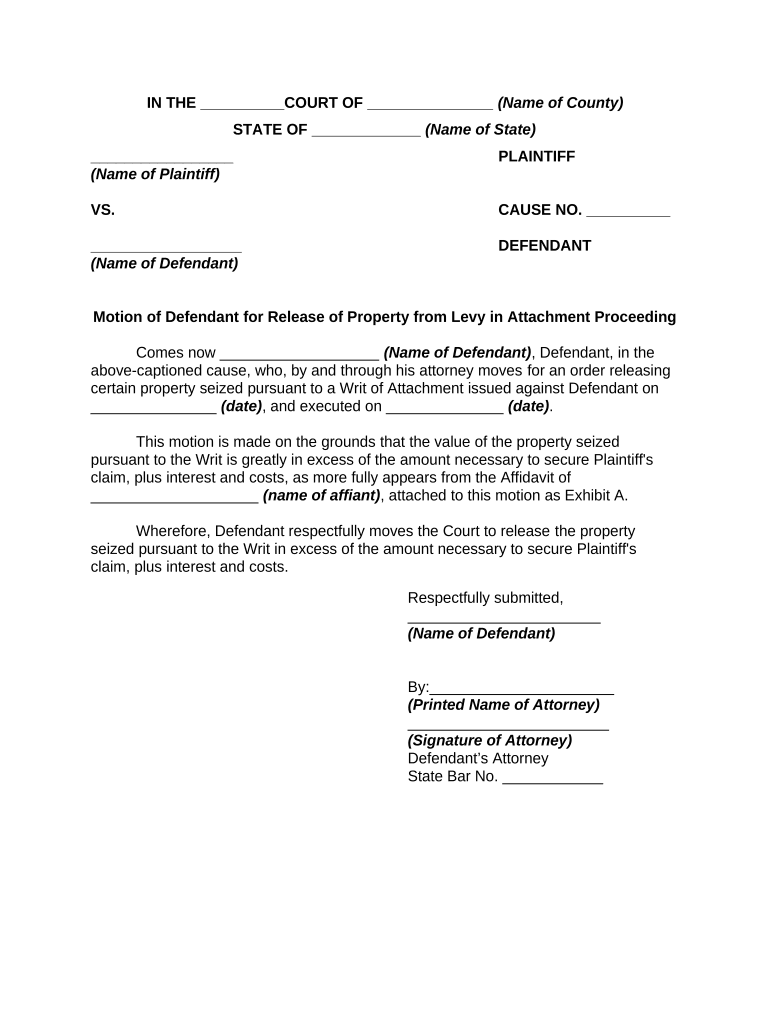
A concise caption links the motion to the case docket, identifies parties and the court, and must exactly match the case number and styling used on prior filings in that matter to avoid misplacement.
Motion Statement

A short opening paragraph stating you move for release of the specified property and identifying the custodian, the property, and the precise relief sought so the judge can see the remedy at a glance.

Statement of Facts

A factual timeline describing seizure, chain of custody, current custody location, disposition of underlying case, and any conditions that support release, including dates and documentary references.

Legal Authority

Citation of statutes, rules, or case law supporting release—e.g., forfeiture statutes, rules of criminal procedure, or state civil procedure—explaining why the court has authority to order release.

Exhibit List

A numbered list of attachments such as property inventories, receipts, case disposition documents, or identification that corroborate ownership or entitlement and facilitate clerk review.

Proposed Order

A ready-to-sign order with explicit transfer instructions, recipient identification, and any conditions for release so the judge can sign without additional drafting.

Security, Privacy, and Compliance Considerations

Encryption in transit: TLS 1.2/1.3
Encryption at rest: AES-256
Audit trail: Comprehensive event log
HIPAA support: BAA available
ESIGN/UETA compliance: Legally recognized
Certifications: SOC 2 Type II, ISO 27001

Risks and Consequences of Errors

Motion Denial: Relief may be denied
Court Sanctions: Sanctions for misconduct
Contempt Exposure: Contempt for noncompliance
Perjury Risk: False statements may be criminal
Service Defect: Improper service can void filing
Delay Costs: Extended custody and storage fees

Common Mistakes to Avoid When Preparing the Motion

  • Failing to identify property precisely, which leads the court to deny release for uncertainty about what is to be returned.
  • Omitting proof of disposition or case resolution, which may cause the court to retain property pending finality.
  • Not serving the custodian or opposing counsel correctly, resulting in procedural dismissal or rehearing requirements.
  • Submitting an unsigned or improperly authenticated order that clerks will not execute, delaying property transfer.

eSignature Pricing and Feature Comparison Relevant to Filing and Serving Documents

Use this pricing snapshot to compare basic plans and features useful for preparing, signing, and sharing court motions; confirm vendor plans before purchase.

signNow DocuSign Adobe Sign PandaDoc HelloSign
Starting Price $8/user/mo $15/user/mo $14/user/mo $19/user/mo $15/user/mo
Free Trial 7-day trial Varies Varies Varies Varies
Bulk Send Yes Yes Yes Yes No
Audit Trail Yes Yes Yes Yes Yes
HIPAA Compliant Yes Yes Yes No No
Envelope Cap No cap 100 envelopes/user/year Varies Varies Varies

Practical Tips for a Faster, Clearer Motion

Adopt consistent practices to reduce objections, shorten review time, and expedite property return.

Be Precise
Use serial numbers, account details, or photographs to uniquely identify property and avoid ambiguity.
Attach Evidence
Include custody receipts, disposition orders, and supporting affidavits to substantiate the release request.
Propose Order
Attach a ready-to-sign order specifying transfer logistics and any conditions to simplify the judge's work.
Confirm Service
Serve custodians and opposing parties using methods approved by the court and document proof of service.

Real-World Examples of Motions and Outcomes

Two concise examples illustrate typical scenarios and supporting documentation needed for success.

Criminal Evidence Release

Defendant moved for return of personal electronics after charges dismissed

  • Inventory and lab reports attached
  • Court granted release to counsel after verification and clerk-scheduled pickup with ID and chain-of-custody paperwork.

Civil Asset Release

Company petitioned for release of seized business equipment following bond posting

  • Ownership invoices and lien releases included
  • Judge signed proposed order directing sheriff to return items to named custodian within ten days.

Frequently Asked Questions About Motions for Release of Property

Answers to common questions about preparation, filing, and expected outcomes for release motions.


Need help? Contact support

be ready to get more
Join over 28 million airSlate SignNow users