Establishing secure connection…Loading editor…Preparing document…

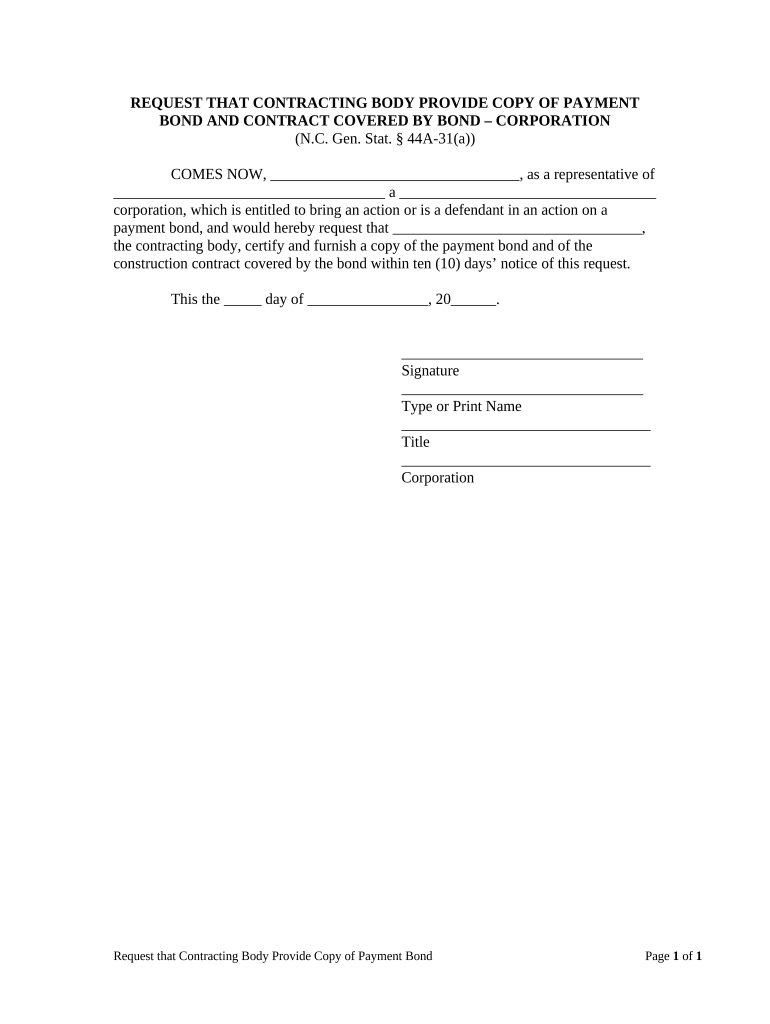
NC Bond Form

This template is fully customizable. Edit the text, fill out the fields, and send it for signature. Give it a try!
NC Bond Form

What the NC Bond Form Is and when it’s used

The NC Bond Form is a surety instrument used in North Carolina to guarantee performance, payment, or compliance for a specified obligation. It typically names a principal (the party required to post the bond), a surety company that guarantees performance, and an obligee (the party protected). Common uses include contractor license bonds, permit bonds, and court-ordered bonds. The form records the bond amount, effective date, bond number and signatures; depending on the obligee it may require notarization or agency filing before it becomes fully effective. Electronic execution is generally possible under federal and state e-signature laws.

Why the NC Bond Form matters to parties and agencies

A correctly completed NC Bond Form transfers financial risk to a licensed surety, secures regulatory or contractual compliance, and is often a prerequisite for permits, licensure, or contract award. Proper form completion reduces disputes, speeds agency acceptance, and preserves legal enforceability under U.S. e-signature frameworks.

Why the NC Bond Form matters to parties and agencies

Who typically completes and relies on an NC Bond Form

The NC Bond Form involves multiple parties with distinct roles: the principal prepares and signs, the surety issues and countersigns, and the obligee accepts and files the bond.

  • Contractors and subcontractors who must post license or performance bonds for public and private projects.
  • Developers or permit applicants required by local government or permitting authorities to secure obligations.
  • Surety underwriters and compliance officers who review, countersign and retain bond documentation for claims.

Step-by-step: completing the NC Bond Form

Follow these sequential steps to prepare, sign, and submit a valid NC Bond Form to the obligee or filing office.

  • 01
    Prepare: Collect contract/permit details and underwriting documents.
  • 02
    Populate: Fill principal, surety, obligee, amount, effective date fields accurately.
  • 03
    Authenticate: Obtain required signatures and any notary or witness acknowledgment.
  • 04
    Submit: Send the completed bond to the obligee or file with the relevant agency.

How to configure an electronic bond workflow

Set up an e-signing workflow that tracks each signer, enforces required fields, and records an audit trail for compliance.

Field Configuration
Principal Contact Email, name, and signer role
Surety Signer Designate authorized issuer as signer
Notary Step Conditional field shown if notary required
Final Delivery Automatic copy to obligee and document repository

Typical electronic submission flow for bonds

An eSubmission workflow reduces manual routing and creates an auditable sequence from upload to final delivery.

  • Upload: Sender uploads the bond PDF or template.
  • Assign: Place signature and date fields for each party.
  • Authenticate: Signers authenticate via email, SMS, or stronger methods.
  • Archive: Signed bond and audit trail are stored and distributed.

Technical considerations for eSigning and eFiling

Choose a platform that supports secure signing, notarization workflows, and reliable delivery to obligees or agencies.

  • Document Formats: PDF, DOCX supported
  • Integrations: Connect with cloud storage and ERPs
  • Authentication: Email/SMS/KBA and stronger options

Essential elements included in a professional NC Bond Form

A complete bond form explicitly records parties, amount, effective dates, and the surety's commitment language; include additional data fields that obligees commonly require.

Parties

Full legal names of principal, surety and obligee to prevent ambiguity in claims and enforcement.
Bond Amount

Clear numeric and written amount, currency, and any aggregate limits or conditions applicable to coverage.

Scope

Concise description of what the bond guarantees (performance, payment, permit compliance) and any material exclusions.

Effective Term

Start and end dates for coverage, renewal terms, and automatic termination triggers if any.

Signature Blocks

Designated signature and title lines for principal and authorized surety representative; include notary block if required.

Claim Directions

Instructions for filing a claim against the bond and contact information for the surety and obligee.

Supporting documents to attach with the NC Bond Form

Obligees commonly require supplementary evidence such as the underlying contract, power of attorney for the surety signatory, and corporate resolutions.

Underlying Contract

Attach the contract, permit, or solicitation that creates the bonded obligation so the bond’s scope can be verified against contractual terms.

Surety Power of Attorney

Include a power of attorney or issuance certificate that verifies the surety representative is authorized to execute bonds on the insurer’s behalf.

Proof of Licensing

If required, attach the principal’s contractor license or business registration used by the obligee to confirm eligibility.

Notary Acknowledgment

When notarization is required, provide the executed acknowledgment or jurat and certifying notary signature and seal.

Security and compliance features to expect for electronic bonds

Transport Encryption: TLS 1.2/1.3
Data at Rest: AES-256 encryption
Audit Trail: Detailed signing timestamps and IP logs
Certifications: SOC 2 Type II, ISO 27001
Regulatory Compliance: ESIGN, UETA, 21 CFR Part 11
Healthcare Controls: HIPAA support with BAA available

Potential consequences of an incorrect or incomplete bond form

Bond Forfeiture: Claim exposure to the surety
License Impact: Delays or denials of licensure or permits
Financial Liability: Costs to resolve claims or correct defects
Filing Rejection: Agency rejects incomplete submission
Invalid Signature: Improper signing may void the bond
Recordkeeping Failure: Inability to defend against later claims

Common mistakes when preparing an NC Bond Form

  • Using an incorrect legal name for the principal that does not match government records, which can invalidate the bond and complicate claims.
  • Entering the wrong bond amount or currency, causing the obligee to reject the form or the surety to refuse coverage for excess sums.
  • Skipping required notarization or witness blocks when agency rules mandate them, leading to filing rejection or delayed acceptance.
  • Failing to attach required supporting documents such as the power of attorney for the surety or the related contract, which many obligees require for acceptance.

Practical tips for accurate and efficient completion

Adopt consistent verification steps and retain copies to reduce rejections and protect all parties.

Verify legal names and registrations
Confirm the principal and surety legal names against state business filings and the surety’s underwriting records. Mismatched names are a frequent cause of agency rejections and claim disputes; correct names speed acceptance.
Confirm surety authority
Obtain the surety’s power of attorney or issuance certificate and verify the representative signing the bond is authorized. This prevents later disputes over the surety's obligation to respond to claims.
Use a structured eWorkflow
Implement conditional fields for notary, role-based signing order, and automated delivery to the obligee. An audit trail and retained copies expedite responses to claims or administrative inquiries.
Retain complete records
Keep the executed bond, supporting documents, and the signing audit trail for the recommended retention period. These records are essential if a claim is later asserted or if an agency audits compliance.

Real-world scenarios where NC Bond Forms are used

Below are two scenario summaries showing typical bond use and outcomes in North Carolina workflows.

Public Works Performance Bond

A contractor bidding a county road project procures a performance bond to meet the solicitation requirements.

  • The bond guarantees contract completion according to the project specifications.
  • When the contractor later failed to complete work, the obligee presented a claim and the surety funded completion, protecting public funds and ensuring project continuity.

Permit Compliance Bond

A developer posts a permit bond to secure environmental remediation obligations tied to a local permit.

  • The bond assures the permitting agency the remediation will be completed.
  • After the developer defaulted, the agency used the bond funds to hire contractors to finish remediation and enforce compliance without prolonged litigation.

eSignature vendor comparison for handling NC Bond Forms

Compare typical pricing and feature indicators across common eSignature vendors; signNow is listed first per standard comparison format.

signNow DocuSign Adobe Sign PandaDoc HelloSign
Starting Price $8/user/mo $15/user/mo $14/user/mo $19/user/mo $15/user/mo
Free Trial 7-day trial Varies Varies Varies Varies
Bulk Send Yes Yes Yes Yes No
Audit Trail Yes Yes Yes Yes Yes
HIPAA Compliant Yes Yes Yes No No

Frequently asked questions about NC Bond Forms and eSigning

Answers to common concerns about electronic execution, notarization, validity and recordkeeping for NC Bond Forms.


Need help? Contact support

be ready to get more
Join over 28 million airSlate SignNow users