Establishing secure connection…Loading editor…Preparing document…

New Hampshire Easement

This template is fully customizable. Edit the text, fill out the fields, and send it for signature. Give it a try!
New Hampshire Easement

What a New Hampshire Easement Is and when it’s used

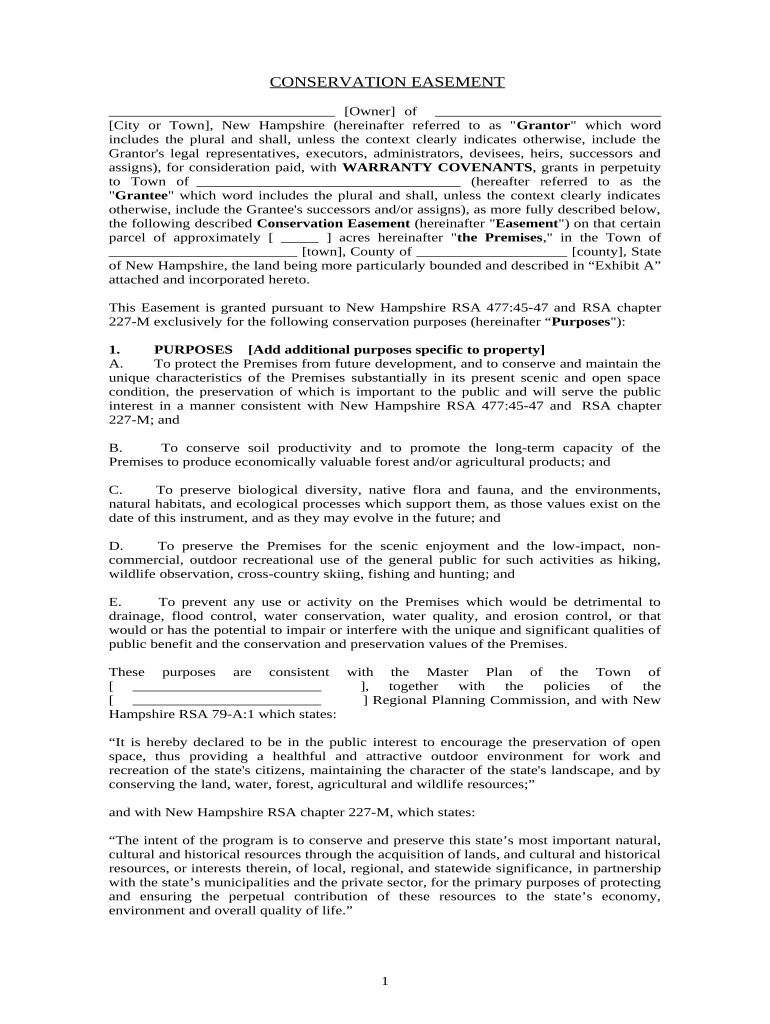
A New Hampshire Easement is a written legal instrument that grants a person or entity a defined right to use another party’s land for a specific purpose while the owner retains title. Common easement types include access, utility, conservation, and drainage. In New Hampshire the easement should identify the grantor and grantee, describe the property with a precise legal description or reference to a recorded survey, set the easement scope and duration, and include execution and acknowledgment language suitable for recording at the county Registry of Deeds.

Why establishing a clear easement matters

A written, recorded easement clarifies rights and obligations, reduces boundary disputes, preserves marketable title, and provides a public record that binds future owners.

Why establishing a clear easement matters

Who commonly prepares or signs a New Hampshire easement

Each party’s responsibilities differ: grantors execute and notarize; grantees accept and use per terms; title professionals ensure recordation and indexing.

  • Property owners granting use or access rights for utilities, driveways, or conservation purposes.
  • Municipalities and utilities seeking recorded access or maintenance rights across private land.
  • Developers, lenders, and title companies requiring clear title and recorded encumbrances.

Core elements every professional New Hampshire easement should include

A complete easement balances brevity with legal precision: identify parties, define the right, locate the land, specify duration, state consideration, and provide recording language.

Parties

Full legal names and entity types for grantor(s) and grantee(s), including company registration or trustee details where applicable.
Scope

Clear description of permitted use (e.g., ingress/egress, utility lines, drainage), limits on activities, and any access hours or restrictions.

Legal Description

Metes-and-bounds or recorded map reference that unambiguously locates the easement area; attach survey exhibit when available.

Duration

State whether perpetual, for a fixed term, or conditional; include termination events and renewal or release procedures.

Consideration

Record the amount or nature of consideration (monetary, covenant, or public benefit) and payment/reimbursement terms if any.

Recording Clause

Acknowledgment language and direction to record at the appropriate county Registry of Deeds; reference to indexing and tax map numbers.

Step-by-step: executing a New Hampshire easement

Follow a consistent sequence from drafting through recording to ensure enforceability and clarity.

  • 01
    Draft and Review: Prepare instrument and attach survey or exhibit.
  • 02
    Confirm Parties: Verify legal names and authority to grant rights.
  • 03
    Sign and Notarize: Execute before a notary and gather required witnesses if applicable.
  • 04
    Record Document: File the executed instrument at the county Registry of Deeds promptly.

How to set up an online easement workflow

Configure a digital workflow that mirrors the physical signing and recording steps to reduce friction and maintain an audit trail.

Field Configuration
Document Template Use a locked PDF with fillable legal-description and signature fields.
Signer Authentication Require email and one-time code or stronger ID verification for grantors.
Notary / RON Setup Enable remote online notarization fields if state-accepted and notary participates.
Final Storage Automate delivery of signed PDF and certificate to all parties and title agent.

Where to send or record a executed New Hampshire easement

After execution, deliver properly acknowledged originals to the county Registry of Deeds and distribute copies to stakeholders.

  • County Registry: Record the original easement with the Registry of Deeds for the county where the property is located.
  • Title Company: Provide a copy to the title company or agent for indexing and title updates.
  • Grantee / Grantor: Send executed, stamped copies to both parties for their records.
  • Lender or Municipality: Where applicable, furnish copies to mortgagees or local governments that have an interest.

Digital signing and file format considerations

Ensure remote notary sessions, if used, comply with New Hampshire acceptance rules and produce a notarized original or registry-approved electronic package for filing.

  • Supported Formats: PDF/A and PDF
  • Authentication: Email or SMS codes
  • Recording Output: Flattened signed PDF

Typical timelines and processing expectations

Timelines vary by complexity and county—allow time for title checks, notarization, and Registry processing.

Drafting Time:

1–14 days depending on survey or title review needs

Execution and Notarization:

Same day to a few days once parties are available

Recording Turnaround:

Often 1–10 business days; county volumes affect timing

Title Update:

Allow 1–4 weeks for title company indexing and client reporting

Survey Lead Time:

2–6 weeks if a new survey or exhibit is required

Key milestones from negotiation to recorded easement

A concise milestone view helps coordinate parties, notaries, and the Registry of Deeds.

01

Negotiation Complete

Finalize terms and draft the instrument for review.

02

Survey and Exhibits

Prepare and attach any required maps or legal descriptions.

03

Execution & Acknowledgment

Sign, notarize, and collect any required witness attestations.

04

Recordation

Submit original to the Registry and distribute recorded copies.

Common risks and consequences of an incorrect easement

Unenforceable Terms: Ambiguous language may render rights unenforceable.
Title Defects: Improper recording can cloud title or trigger litigation.
Boundary Disputes: Inaccurate legal descriptions lead to neighbor conflicts.
Invalid Signatures: Missing notarization or improper signer authority voids document.
Tax Consequences: Incorrect consideration language can affect tax reporting.
Insurance Gaps: Lack of clear maintenance obligations can affect coverage.

Essential data elements to include in the easement

Grantor: Full legal name
Grantee: Full legal name
Property: Metes-and-bounds
Scope: Defined permitted uses
Consideration: Amount or description
Execution: Signature and notarization

Two common New Hampshire easement scenarios

Practical case examples illustrate how easements are used and recorded in routine transactions.

Private Drive Access

A homeowner requests a permanent ingress/egress easement to access a road

  • Purpose limited to vehicular and pedestrian use
  • The recorded easement references a survey exhibit, allocates maintenance responsibility, and is indexed by the county Registry of Deeds to preserve marketable title.

Utility Line Easement

A utility secures a perpetual easement for underground lines

  • Includes installation and relocation rights
  • The instrument includes indemnity, restoration obligations, and recording instructions so the utility can perform work and maintain a public record of rights.

Practical tips for accurate, efficient easement completion

Follow these practices to reduce rework, avoid recording delays, and protect title interests.

Use Precise Descriptions
Always use a full metes-and-bounds description or recorded map reference; attach a labeled exhibit to prevent ambiguity in boundary or area identification.
Confirm Authority
Verify signatory authority for corporate or trustee grantors and obtain evidence of corporate resolution or power of attorney when required.
Coordinate with Title
Send the draft instrument to the title company before execution to confirm wording for insurability and indexing.
Record Promptly
Record the executed original as soon as feasible to establish priority and reduce risk of competing claims or liens.

Frequently asked questions about New Hampshire easements

Answers to common procedural and legal questions about drafting, signing, and recording easements in New Hampshire.


Need help? Contact support

Typical eSignature vendor pricing and capabilities for easement workflows

Compare basic pricing and critical features for electronic signing and high-volume workflows; signNow is listed first per vendor ordering rules.

signNow DocuSign Adobe Sign PandaDoc HelloSign
Starting Price $8/user/mo $15/user/mo $14/user/mo $19/user/mo $15/user/mo
Free Trial 7-day free trial Varies by vendor Varies by vendor Varies by vendor Varies by vendor
Bulk Send Yes Yes Yes Yes No
Audit Trail Yes Yes Yes Yes Yes
HIPAA Compliant Yes Yes Yes No No
be ready to get more
Join over 28 million airSlate SignNow users