Establishing secure connection…Loading editor…Preparing document…

Notice of Appeal Form

This template is fully customizable. Edit the text, fill out the fields, and send it for signature. Give it a try!
Notice of Appeal Form

What the Notice of Appeal Form Is and when it’s used

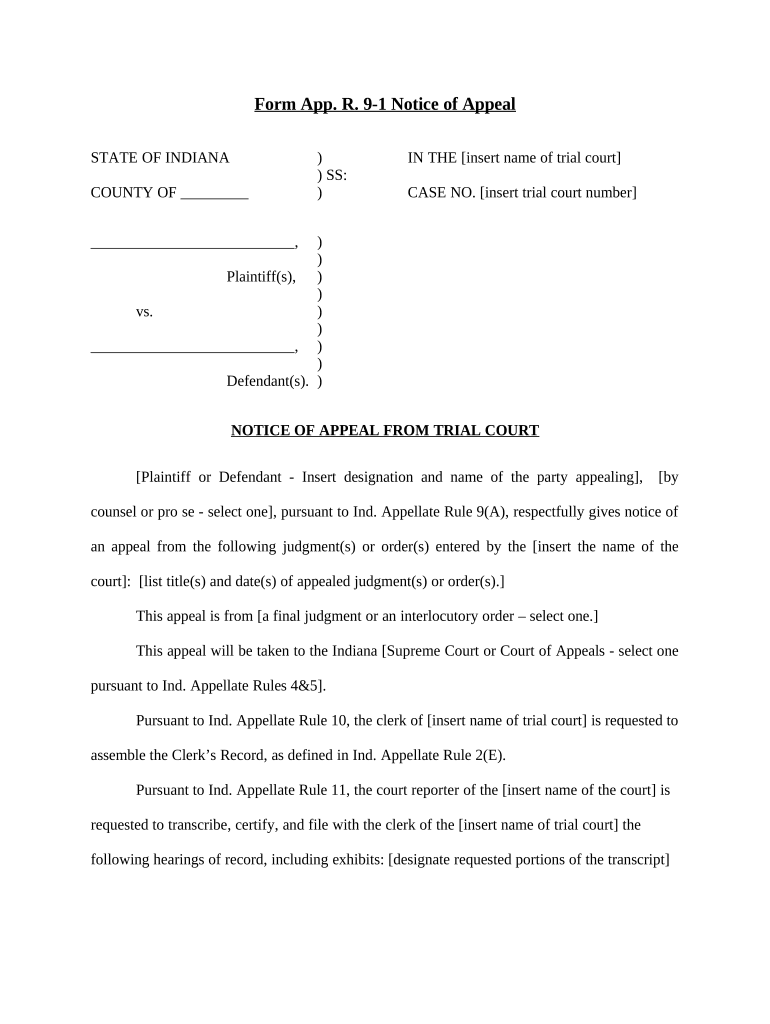
A Notice of Appeal Form is the formal written filing that a party submits to a court to begin an appellate review of a lower-court judgment or order. It identifies the case, the parties appealing, the judgment being appealed, and the court to which the appeal is taken. Filing the notice triggers appellate deadlines and preserves the appellant’s right to seek review. Procedures, required content, and timelines differ between federal courts, state appellate courts, and administrative tribunals, so local rules govern format, service, and filing method.

Why the Notice of Appeal Form matters

Filing a correct Notice of Appeal starts the appellate clock, preserves issues for review, and notifies opposing parties and the court. Accurate, timely submission prevents waiver of appellate rights and reduces the risk of dismissal for procedural defects.

Why the Notice of Appeal Form matters

Who typically prepares and files a Notice of Appeal

Several parties and professionals commonly complete this form depending on the matter and court.

  • Appellants and litigants who disagree with a final judgment and intend to seek appellate review.
  • Attorneys and paralegals who prepare appellate pleadings and ensure compliance with appellate rules.
  • Court clerks and filing services when submitting documents on behalf of parties under local filing procedures.

Choose the filer based on who controls appellate strategy, understands local appellate rules, and can meet strict filing deadlines.

Step-by-step: filing a Notice of Appeal

Follow these core steps in sequence to preserve appellate rights and meet procedural requirements.

  • 01
    Confirm finality: Verify the order is final or appealable
  • 02
    Calculate deadline: Determine the appellate filing period from the judgment date
  • 03
    Prepare notice: Complete form with accurate case caption and judgment details
  • 04
    File and serve: File with the clerk and serve opposing parties per local rules

How the Notice of Appeal moves through the system

The filing and service process triggers administrative and appellate steps; track each stage carefully.

  • Clerk Filing: Court clerk accepts, stamps, and assigns appellate docket number
  • Service on Parties: Serve opposing counsel and parties using required service method
  • Record Preparation: Lower-court record and transcripts are designated and ordered
  • Briefing and Scheduling: Appellate deadlines for briefs and oral argument are set

Setting up an electronic filing workflow

Configure e-filing and service steps to match local court and appellate rules.

Field Configuration
Document Template Create a Notice of Appeal template with auto-populated case caption
Signer Assign attorney or party signer and add contact details
Service Method Set required service options (email, e-service, mail)
Filing Channel Choose court e-file provider or manual clerk filing

Digital filing and eSignature considerations

Confirm the court accepts electronic filing and whether e-signatures are permitted for your notice.

  • Accepted Formats: PDF is widely accepted; ensure PDF/A or court-specified format
  • Authentication: Use the court’s e-file identity method or an accepted signer authentication
  • Service Compliance: E-service must follow local rules for proof, timestamps, and recipient addresses

Where courts permit e-signatures, use solutions that provide audit trails, signer attribution, and retention compatible with appellate record requirements.

Common filing windows and timing checkpoints

Different courts set different appeal periods; calculate deadlines from the judgment entry and note any extensions for government parties.

Federal Civil Appeals:

30 days standard for most civil cases

Government Parties:

Longer periods (often 60 days) for the United States as a party

Criminal Appeals:

Shorter or jurisdiction-specific periods; check criminal rules

Administrative Appeals:

Deadlines set by agency statute or regulation

Extensions:

Limited extensions may be available by motion or statute

Key milestones after filing the Notice of Appeal

Track these sequential milestones to manage the appellate timeline and document record.

01

Notice Filed

Clerk acceptance and appellate docket assignment

02

Record Designation

Parties designate record on appeal and order transcripts

03

Briefing Schedule

Appellant opening brief, respondent brief, and reply brief deadlines

04

Oral Argument

Court schedules argument or decides on briefs alone

Common procedural pitfalls to avoid

  • Missing the filing deadline because the wrong judgment entry date was used.
  • Incorrect or incomplete case caption that prevents matching the record.
  • Failing to serve all required parties using the court’s prescribed method.
  • Omitting required attachments such as the judgment copy or docket entries.

Consequences of a flawed or late Notice of Appeal

Dismissal Risk: The appeal can be dismissed for untimely filing or defective notice
Waiver of Issues: Procedural defects may cause waiver of appellate arguments
Cost Exposure: Court may impose costs or sanctions for improper filings
Delay: Errors create additional pleadings and procedural delays
Record Gaps: Incomplete record designation limits issues on review
Denial of Relief: Substantive relief may be foreclosed if procedural steps fail

Essential data points to include and preserve

Case Caption: Exact party names
Docket Number: Lower-court number
Judgment Date: MM/DD/YYYY entry date
Appellant Name: Full legal name
Service Proof: E-service receipt or mail certificate
Signature Block: Signed and dated

What a complete professional Notice of Appeal contains

A properly prepared notice includes identifying information, precise references to the judgment, and evidence of proper service to meet appellate rules.

Identification

Complete case caption, court name, and lower-court judge or department information so the appellate clerk can match the matter.
Judgment Reference

Clear citation of the judgment or order being appealed, including date and docket entry number to avoid ambiguity.

Parties Listed

Names of all appellants and designation of whether appeal is by plaintiff, defendant, or other party with standing.

Relief Noted

A short statement that the filing constitutes a Notice of Appeal and the scope of the review sought by the appellant.

Service Statement

A certificate or proof of service showing how and when opposing parties were served in compliance with local rules.

Signature

Signature of appellant or counsel with contact details and bar number if required by the court.

Practical tips for accurate and efficient completion

Use these habits to reduce objections and rejections when filing a Notice of Appeal.

Double-check dates and numbers
Verify the judgment entry date and docket number against the official court record to prevent deadline miscalculations.
Use court templates
When available, use the appellate court’s prescribed form or sample notice to meet formatting expectations.
Preserve the record
Order transcripts and designate the record promptly to avoid briefing problems later.
Log service proof
Retain stamped envelopes, e-service confirmations, or certificates of service for the appellate file.

eSignature vendor comparison for filing and serving a Notice of Appeal

Select an eSignature provider that supports secure PDF output, audit trails, and integrations for court e-filing. Below is a high-level pricing and feature comparison with signNow listed first.

signNow DocuSign Adobe Sign PandaDoc HelloSign
Starting Price $8/user/mo $15/user/mo $14/user/mo $19/user/mo $15/user/mo
Free Trial 7-day free trial Varies by vendor Varies by vendor Varies by vendor Varies by vendor
Bulk Send Yes (Business Premium) Yes Yes Yes No
Audit Trail Yes Yes Yes Yes Yes
HIPAA Compliant Yes Yes Yes No No

Examples: when a Notice of Appeal is used

These concise scenarios show typical contexts for filing a Notice of Appeal.

Civil Judgment Appeal

A plaintiff receives a final adverse judgment and files a Notice of Appeal to the state appellate court within the prescribed period.

  • The notice identifies the judgment and parties.
  • The appellant orders transcripts and files the opening brief according to the briefing schedule, preserving the record for review.

Administrative Agency Appeal

A licensee disputes an agency order and files a Notice of Appeal to the appropriate tribunal or court.

  • The notice complies with agency statutes on timing and service.
  • The appellant designates the administrative record and seeks judicial review while meeting specialized service and jurisdictional requirements.

Frequently asked questions about the Notice of Appeal Form

Answers to typical procedural and practical questions about preparing, filing, and correcting a Notice of Appeal.


Need help? Contact support

be ready to get more
Join over 28 million airSlate SignNow users