Establishing secure connection…Loading editor…Preparing document…

Notice to Creditors

This template is fully customizable. Edit the text, fill out the fields, and send it for signature. Give it a try!
Notice to Creditors

What a Notice to Creditors Is and when it’s used

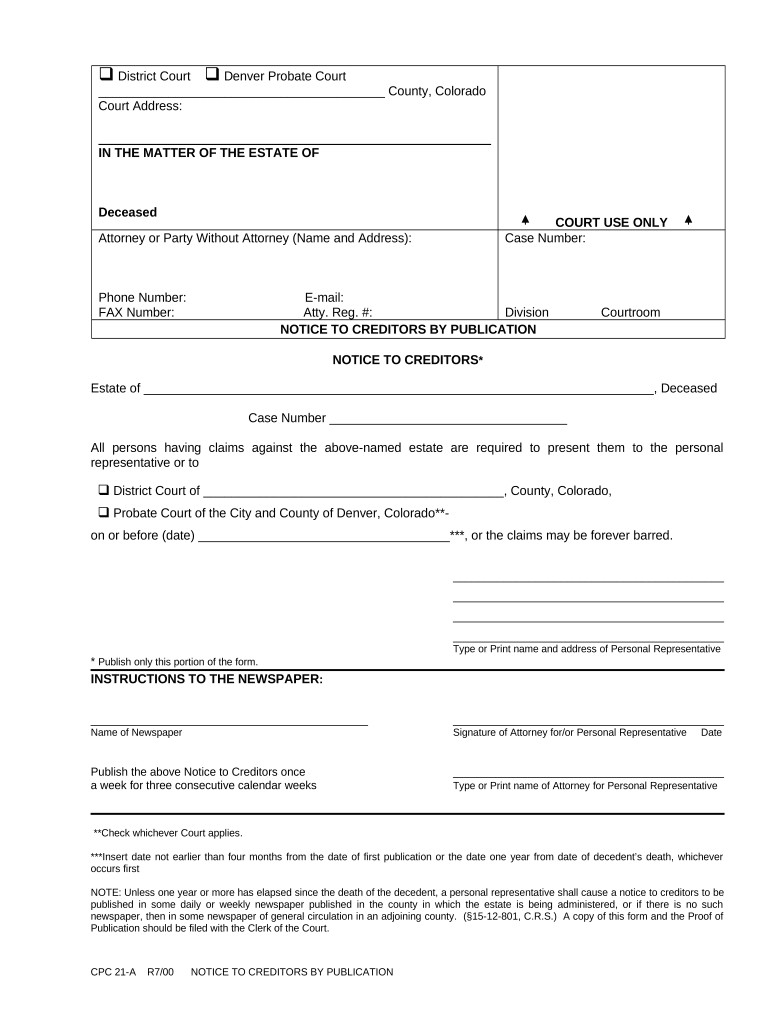
A Notice to Creditors is a formal public or private notice published or served during probate to inform unknown or known creditors that a decedent's estate is open and that claims must be presented within a statutory period. It identifies the personal representative or administrator, describes where claims should be filed, and sets a deadline prescribed by state law or the probate court. The notice protects the estate and its fiduciaries by creating a defined claims window and enabling the representative to distribute assets once the response period expires.

Why issuing a clear Notice to Creditors matters

A properly completed notice notifies potential claimants, establishes a legally recognized deadline for claims, and limits personal liability for the estate representative once the claims period closes.

Why issuing a clear Notice to Creditors matters

Who prepares and who receives a Notice to Creditors

The notice is typically prepared by the estate representative or their attorney and is served to known creditors and published if required by state law.

  • Executor or Personal Representative — Prepares, files, and serves the notice; manages estate administration and responds to claims.
  • Probate or Estate Attorney — Drafts compliant language, determines jurisdictional deadlines, and files proof of service with the court.
  • Creditors and Claimants — Receive the notice and must present timely claims with supporting documentation to preserve recovery rights.

Step-by-step: preparing and issuing a Notice to Creditors

Follow a consistent sequence to draft, approve, serve, and record the notice so service deadlines and proof requirements are met.

  • 01
    Gather case details: Collect court file number, decedent data, and fiduciary contact information.
  • 02
    Draft notice text: Use jurisdictional language required by the probate code and include clear claim instructions.
  • 03
    Serve or publish: Serve known creditors directly and publish in required newspapers if the court mandates it.
  • 04
    File proof: File affidavits of service or publication with the probate court to document compliance.

Core elements every professional Notice to Creditors includes

A complete notice combines statutory language, clear deadlines, and practical instructions so creditors and the court can identify and process claims efficiently.

Caption

Court name and case number must be exact; this ties the notice to the open estate and ensures the clerk accepts proof of service.
Decedent Info

Full legal name, date of death, and last known residence to allow potential creditors to confirm identity and jurisdiction.

Representative Details

Name, mailing address, and contact method for the estate representative or attorney where claims must be sent.

Statutory Language

Text required by state probate law specifying the consequences of failing to present a claim within the deadline.

Claim Instructions

How to present a claim, required attachments (invoices, contracts), and the exact deadline date in MM/DD/YYYY format.

Proof of Service

Affidavit of mailing, personal service, or publication details required by the court to show legal notice was given.

Data and security items to track when handling notices

Encryption: TLS 1.2/1.3 in transit
At-Rest Protection: AES-256 encrypted storage
Access Control: Role-based permissions
Audit Trail: Timestamps and IP logs
HIPAA Consideration: BAA required if PHI included
Retention Flag: Preserve signed record copies

Risks of an incorrect or untimely Notice to Creditors

Claims Barred: Improper service may not toll claim deadlines
Personal Liability: Representative may face exposure for wrongful distributions
Court Rejection: Incomplete proof of service can delay probate closing
Increased Costs: Repeat publication or service raises estate expenses
Creditor Lawsuits: Failed notice can invite litigation against the estate
Tax Consequences: Delayed administration can complicate filings

Common preparation mistakes to avoid

  • Using an incorrect case caption or wrong court name that causes the clerk to reject the filed proof of service and requires reissuance.
  • Failing to include the precise claim deadline in MM/DD/YYYY format, which creates uncertainty for creditors and may extend the estate administration timeline.
  • Neglecting to publish in the legally required newspaper or omitting publication dates, resulting in insufficient notice and possible court objections.
  • Relying on informal delivery without filing an affidavit of service; absence of documented service often prevents final discharge of fiduciary duties.

How electronic completion and delivery typically works

An electronic workflow streamlines drafting, signing, and recording proof of service while maintaining an audit trail for the probate record.

  • Upload document: Import PDF or DOCX version of the notice into the signing platform.
  • Place fields: Add signature, date, and text fields for the representative and notary if required.
  • Authenticate signer: Use email link, SMS code, or stronger authentication as required by jurisdiction.
  • Record proof: Capture audit trail, certificate of completion, and export signed PDF for court filing.

Recommended digital workflow settings for Notice to Creditors

Configure signing steps to ensure identity verification, clear signature evidence, and retrievable proof for court filings.

Field Configuration
Signer Authentication Email+SMS code or KBA where required
Signature Type Adopt visible e-signature with audit trail
Reminders Automated reminders to signers and publishing contacts
Certificate Export Export signed PDF with completion certificate

Platform and file requirements for e-signing

Choose a platform that supports PDF and DOCX, audit trails, and the authentication level your jurisdiction requires.

  • File Formats: PDF and Word (DOCX) supported
  • Integrations: Works with cloud storage and case management
  • Authentication: Email, SMS, or advanced options

Deadlines and timing considerations for notices

Timing requirements for Notice to Creditors vary by state and by whether the court orders a specific claims period; verify local probate code for exact dates.

Statutory Claim Periods:

Varies by state; some set fixed months, others rely on court schedule.

Publication Schedule:

If required, publish for the number of weeks mandated by statute.

Mailing Deadlines:

Mailing dates often start the claim window for mailed service.

Court Filing:

File affidavits of service or publication promptly to document compliance.

Response Window:

Creditors must file claims within the stated deadline to preserve rights.

Comparison: signNow and other e-signature vendors for Notice to Creditors workflows

Key vendor differences affect cost, bulk sending, HIPAA support, and envelope or usage caps; signNow is listed first for easy comparison.

signNow DocuSign Adobe Sign PandaDoc HelloSign
Starting Price $8/user/mo $15/user/mo $14/user/mo $19/user/mo $15/user/mo
Free Trial 7-day free trial Varies by plan Varies by plan Varies by plan Varies by plan
Bulk Send Yes (Business Premium) Yes Yes Yes Varies
Audit Trail Yes Yes Yes Yes Yes
HIPAA Compliant Yes (BAA available) Yes Yes No No

Real-world examples: Notice to Creditors use in practice

Practical examples show how organizations prepare notices, deliver proof of service, and close estates while preserving legal protections.

Optica Ventures (Brian Fitzgibbons)

The team standardized notice templates to reduce errors and speed service.

  • They tracked proof and completion centrally.
  • "The interface is simple and easy-to-use for our team; more importantly, it is just as easy for our customers."

Martin Properties (Tim Martin)

Property manager used digital notices to reach creditor vendors statewide.

  • Audit trail resolved a billing dispute quickly.
  • "I can process and execute all of these documents online with 100% compliance and built-in security. Whether on mobile or working offline, I can get forms back to their necessary parties efficiently."

Frequently asked questions about Notices to Creditors

Answers to common questions about preparation, service, electronic signing, and recordkeeping for Notices to Creditors.


Need help? Contact support

be ready to get more
Join over 28 million airSlate SignNow users