Establishing secure connection…Loading editor…Preparing document…

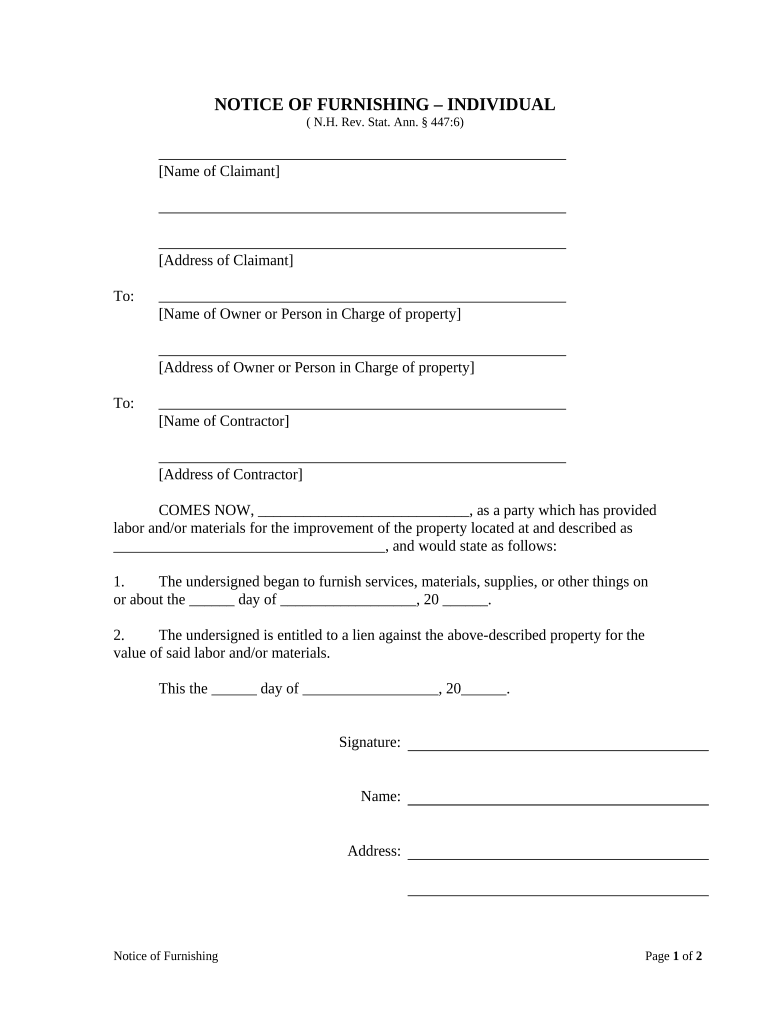
Notice of Furnishing New Hampshire

This template is fully customizable. Edit the text, fill out the fields, and send it for signature. Give it a try!
Notice of Furnishing New Hampshire

What the Notice of Furnishing in New Hampshire is and when it’s used

A Notice of Furnishing is a written communication used in construction contexts to inform the property owner, lender, or general contractor that a supplier, subcontractor, or contractor has furnished labor, materials, or services to a project. In many jurisdictions the notice supports a party’s right to pursue a mechanic’s lien, prompt payment, or payment bond claim; exact legal effect depends on state lien and notice statutes. For New Hampshire users, this document clarifies who provided work or materials, the date range of furnishing, and contact information so downstream parties can address payment or dispute issues promptly.

Why a clear Notice of Furnishing matters

Issuing a timely, accurate Notice of Furnishing preserves remedies, improves payment traceability, and reduces surprise disputes on construction projects. For subcontractors and suppliers it demonstrates diligence and creates a documented trail that owners, lenders, and prime contractors can use to validate claims and resolve payment issues.

Why a clear Notice of Furnishing matters

Who typically prepares and receives this notice

The Notice of Furnishing is commonly prepared by subcontractors, material suppliers, and specialty contractors as part of standard project administration.

  • Subcontractors and suppliers who need to preserve lien or bond rights and document deliveries or services.
  • Prime contractors and construction managers who track trade coordination, invoices, and change orders.
  • Property owners, lenders, or title agents who must know which parties have furnished work to a property.

Identify the party with the primary payment risk and ensure the notice is sent to the owner, lender, and general contractor as appropriate.

Core parts of a professional Notice of Furnishing

A well-constructed notice is concise, factual, and includes identifiers that recipients use to confirm delivery and project status quickly.

Project ID

Project name, physical address, and job number so recipients immediately identify the property and contract affected by the furnishing.
Sender details

Full legal name, business entity type, mailing address, phone, and email for the furnishing party responsible for billing and follow-up.

Description of work

Clear summary of goods or services furnished, including material types, labor categories, or invoice reference numbers to tie notice to specific deliveries.

Furnishing dates

Start and end dates (or specific delivery dates) for the labor or materials provided so timelines align with contract and lien periods.

Amount claimed

Stated outstanding balance or invoiced amounts, ideally with invoice numbers and dates to speed reconciliation between parties.

Delivery route

How and when notice was sent (mail, email, RON, or hand-delivery) plus proof or certificate of transmission to support timing claims.

Required information commonly included

Sender name: Full legal
Recipient name: Owner/lender/GC
Project address: Street, city
Dates furnished: MM/DD/YYYY
Invoice reference: Invoice #
Contact details: Phone/email

Step-by-step: preparing and sending the Notice of Furnishing

Follow these steps to prepare a clear notice, verify recipients, and create proof of delivery for recordkeeping and potential claim support.

  • 01
    Confirm parties: Identify owner, lender, and GC to receive notice.
  • 02
    Complete form: Fill required fields with exact legal data.
  • 03
    Attach invoices: Include invoice copies or delivery receipts.
  • 04
    Send and document: Transmit by chosen method and keep proof.

How to configure an online notice workflow

Set up repeatable fields, recipient groups, and delivery verification in your e-signature or document platform to streamline multi-project use.

Field Configuration
Recipient groups Owner | Lender | GC routing by role
Required fields Project address, sender name, dates
Delivery proof Audit trail + read receipts
Template reuse Save as template with auto-fill fields

Where to file, send, and archive the notice

Deliver the notice to every party who may affect payment or title and ensure a copy is archived for future claim support.

  • Owner delivery: Send to owner contact on project documents.
  • Lender notice: Notify lender listed on the mortgage or loan docs.
  • General contractor: Provide GC for coordination and invoice resolution.
  • Internal archive: Store signed notice and proof in project folder.

Digital signing and proof requirements for reliable delivery

Use an eSignature process that captures an audit trail, timestamp, and sender/recipient attribution to support notice timing and delivery claims.

  • Audit trail: IP, timestamp, action log
  • Authentication: Email or SMS code
  • Document formats: PDF or DOCX preferred

Retain signed copies and delivery evidence in your records; where possible choose platforms that support exportable audit certificates and secure storage.

Typical timing and deadlines to watch for

Timing obligations differ by state and project contract; check applicable lien statutes and contract terms to confirm notice windows.

Issue promptly:

Send notice soon after first furnishing.

Invoice alignment:

Match notice dates to invoice dates.

Lien filing window:

May require filing within months after last furnishing.

Payment bond claims:

Bond claim timelines differ from lien deadlines.

Contract-specific terms:

Follow any shorter contract notice periods.

Common mistakes to avoid when preparing the notice

  • Using an informal or incomplete description of work that prevents recipients from matching the notice to invoices.
  • Sending notice to the wrong party or outdated contact details, which can void statutory protections in some jurisdictions.
  • Failing to keep proof of delivery such as certified mail receipts, email read receipts, or RON audit logs.
  • Combining disputed and undisputed amounts without separating them, complicating resolution and potential bond claims.

Risks and consequences of incorrect or late notice

Loss of lien rights: Possible
Payment delays: Likely
Bond claim denial: Risk
Contract breach: Possible
Increased legal fees: Probable
Disputed balances: More common

Real-world examples of Notice of Furnishing usage

These short case arcs illustrate how contractors use a clear notice to resolve payment issues and preserve remedies.

Optica Ventures — subcontractor notice

A subcontractor recorded deliveries and issued a Notice of Furnishing to owner and GC after partial payment was delayed.

  • The notice referenced invoices and delivery dates to clarify the outstanding balance.
  • The documentation led to a prompt reconciliation and release of withheld funds without formal lien filing, per the parties' subsequent accounting.

Martin Properties — timely documentation

A small contractor used a templated notice to notify the lender and owner immediately after substantial deliveries.

  • The template included invoice numbers and a delivery log.
  • Having clear proof of furnishing reduced administrative delays during project closeout and supported the contractor’s payment discussions.

Practical tips for accurate, efficient notice preparation

Adopt repeatable habits and tools to reduce errors and support enforceability in potential disputes.

Use a standardized template
Maintain a single template that includes all required fields, delivery options, and attachments so every notice contains the same verifiable information and minimizes omissions.
Record delivery proof
Retain certified mail receipts, email headers, or eSignature audit certificates with timestamps so you can demonstrate timely delivery if a statutory deadline is contested.
Separate disputed amounts
List undisputed balances separately from disputed charges to reduce grounds for withholding and simplify negotiations while preserving rights for the disputed portion.
Coordinate with counsel
When deadlines or statutory wording are unclear, seek a brief legal review to confirm whether additional steps (filing a lien, bond claim, or notarial act) are required to preserve remedies.

Frequently asked questions about Notices of Furnishing in New Hampshire

Answers address common execution, timing, and evidence questions relevant to contractors, suppliers, and owners.


Need help? Contact support

Comparing eSignature providers for sending and storing Notices of Furnishing

Platform selection affects cost, delivery proof, and compliance. The table compares starting price, trial availability, bulk send, audit trail, HIPAA compliance, and envelope limits.

signNow DocuSign Adobe Sign PandaDoc HelloSign
Starting Price $8/user/mo $15/user/mo $14/user/mo $19/user/mo $15/user/mo
Free Trial 7-day free trial Available Available Available Available
Bulk Send Yes Yes Yes Yes No
Audit Trail Yes Yes Yes Yes Yes
HIPAA Compliant Yes Yes Yes No No
be ready to get more
Join over 28 million airSlate SignNow users