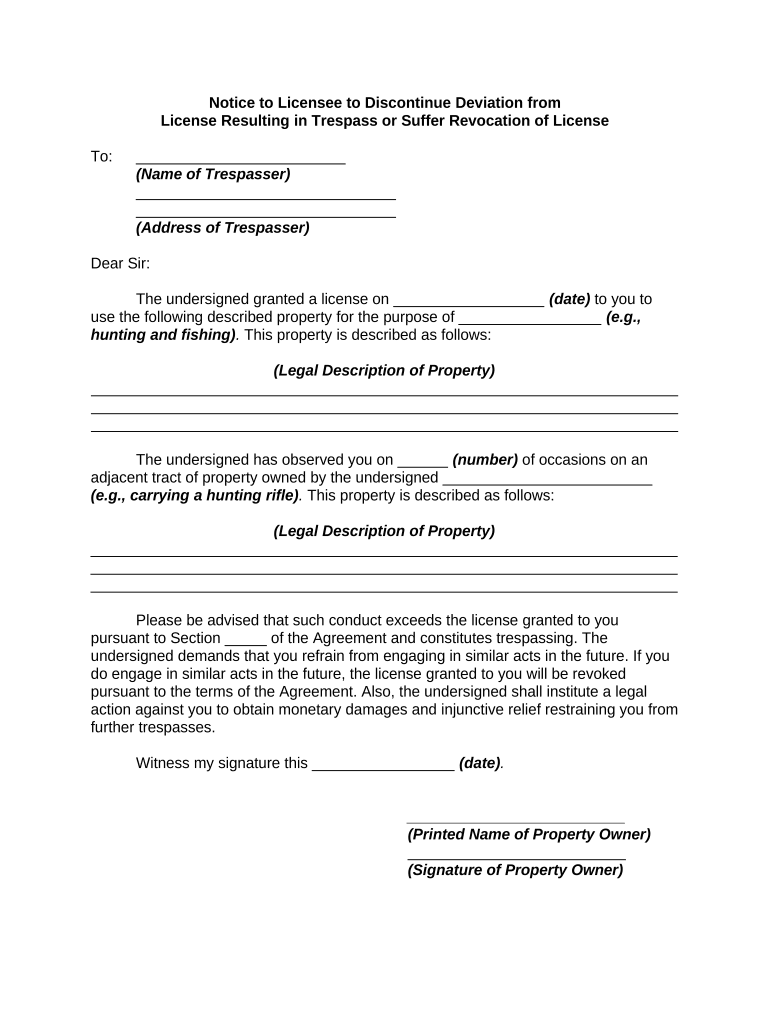
Notice of Trespass
What a Notice of Trespass Is and when it’s used
Why issuing a clear Notice of Trespass matters
A clear written notice preserves legal options, documents the owner’s intent to exclude, and gives law enforcement or courts objective evidence if enforcement becomes necessary. It reduces ambiguity about permitted areas and can deter repeat incidents when delivered properly.
Who typically prepares and receives these notices
Recipients include individuals observed trespassing, repeat violators, or groups identified during an incident; delivery method affects legal weight.
- Private property owners who wish to exclude specific individuals or groups from their land or buildings.
- Commercial property managers and security teams enforcing rules on retail, office, or industrial sites.
- Public agencies or parks staff restricting access to secure or protected areas.
Step-by-step: preparing and delivering a Notice of Trespass
-
01Draft: Complete all required fields with exact details.
-
02Document: Take photos or notes about the incident location and time.
-
03Deliver: Give notice in-person or by a reliable method and record witnesses.
-
04Retain: Keep a signed copy and proof of delivery in your records.
How a Notice of Trespass typically moves from draft to enforcement
-
Create: Prepare the notice with precise names, dates, and descriptions.
-
Deliver: Provide the notice personally or by a verifiable method.
-
Record: Store signed copies, witness statements, and photos.
-
Enforce: If trespass continues, provide records to police or pursue civil remedies.
Digital workflow settings to use when sending notices online
| Field | Configuration |
|---|---|
| Authentication | Email verification or SMS code for signer identity |
| Signature Type | Electronic signature with timestamp and audit trail |
| Retention Policy | Store signed copies with audit trail for required period |
| Notifications | Enable delivery receipts and completion alerts |
Technical choices for eDelivery and evidence preservation
Preserve the audit trail, attachment evidence, and delivery receipts to support any subsequent enforcement action or legal challenge.
- Integrations: Use systems like Salesforce or NetSuite for record linking
- File formats: Export signed notices as PDF/A for long-term storage
- Authentication: Select SMS or KBA when identity verification is important
Timing considerations and immediate actions after an incident
Immediate Response:
Secure safety and document the incident right away
Notice Delivery:
Serve a written notice as soon as practicable
Police Report:
File a report if there is ongoing or violent trespass
Evidence Retention:
Retain photos, witness statements, and notices promptly
Follow-up:
Monitor the property and reissue notices if needed
Key milestones from incident to potential legal action
Incident Recorded
Photograph and log the occurrence immediately.
Notice Issued
Deliver written notice and document method of delivery.
Observation Period
Monitor whether prohibited conduct continues after notice.
Enforcement Decision
Decide whether to contact police or seek civil relief.
Common preparation mistakes that weaken a notice
- Failing to include a clear description of prohibited areas, which creates uncertainty about enforcement boundaries.
- Not documenting delivery method and witnesses, leaving no proof that the excluded party received notice.
- Using vague language about prohibited conduct instead of specific acts or locations in the property.
- Discarding original signed copies or audit logs, which removes the primary evidence for later disputes.
Legal risks and consequences if a Notice of Trespass is incorrect
Comparing common eSignature vendors for sending Notices of Trespass
| signNow | DocuSign | Adobe Sign | PandaDoc | HelloSign | |
|---|---|---|---|---|---|
| Starting Price | $8/user/mo | $15/user/mo | $14/user/mo | $19/user/mo | $15/user/mo |
| Free Trial | 7-day free trial | Varies | Varies | Varies | Varies |
| Bulk Send | Yes | Yes | Yes | Yes | No |
| Audit Trail | Yes | Yes | Yes | Yes | Yes |
| Envelope Cap | No cap | 100 envelopes/user/year | Varies | Varies | Varies |
Practical examples of Notices of Trespass in common scenarios
Retail Property Manager
A shopping center manager documents repeated loitering near a store entrance and prepares a notice naming the prohibited area and hours.
- Manager hands the notice directly to the individual during business hours.
- The manager keeps a signed copy, logs the incident, and shares records with security and police if trespass continues.
Private Landowner
A rural landowner observes unauthorized ATV use across private trails and drafts a notice detailing the restricted parcels and GPS coordinates.
- Notice is posted at trailheads and mailed to a known neighbor address.
- The owner retains photos, the dated notice, and witness statements to support future civil action if trespass persists.
Frequently asked questions about Notices of Trespass
-
Can I deliver the notice by email?
Yes, email is acceptable in many circumstances if you can demonstrate receipt and the recipient’s identity. Keep delivery receipts, message headers, and any read receipts or corroborating witness statements as evidence.
-
Is a notary required for the notice?
Not usually required for a basic trespass notice, but some jurisdictions or specific enforcement paths may require notarization. When in doubt, notarize or use remote online notarization if state law permits for added evidentiary weight.
-
What if the recipient refuses to accept the paper notice?
Document the refusal with a witness and photograph, then consider alternative service methods such as posting in a visible location, mailing by certified mail, or using electronic delivery with proof of access.
-
Can a Notice of Trespass be used in court?
Yes, a properly completed and documented notice with proof of delivery can support civil or criminal trespass proceedings by establishing the owner’s intent and the recipient’s knowledge of exclusion.
-
How long should I retain the notice?
Keep signed notices and supporting evidence for the active exclusion period plus several years; follow federal standards where applicable and consult state-specific guidance when statutes prescribe longer retention.
-
When should I consult an attorney?
Seek legal advice if the trespass involves suspected criminal conduct, complex property rights, potential wrongful exclusion claims, or if you plan to pursue court-ordered relief.