Claimant identity
Full legal name, contact information, and relationship to the property owner; include representative or counsel information when applicable, to ensure proper service and communication.
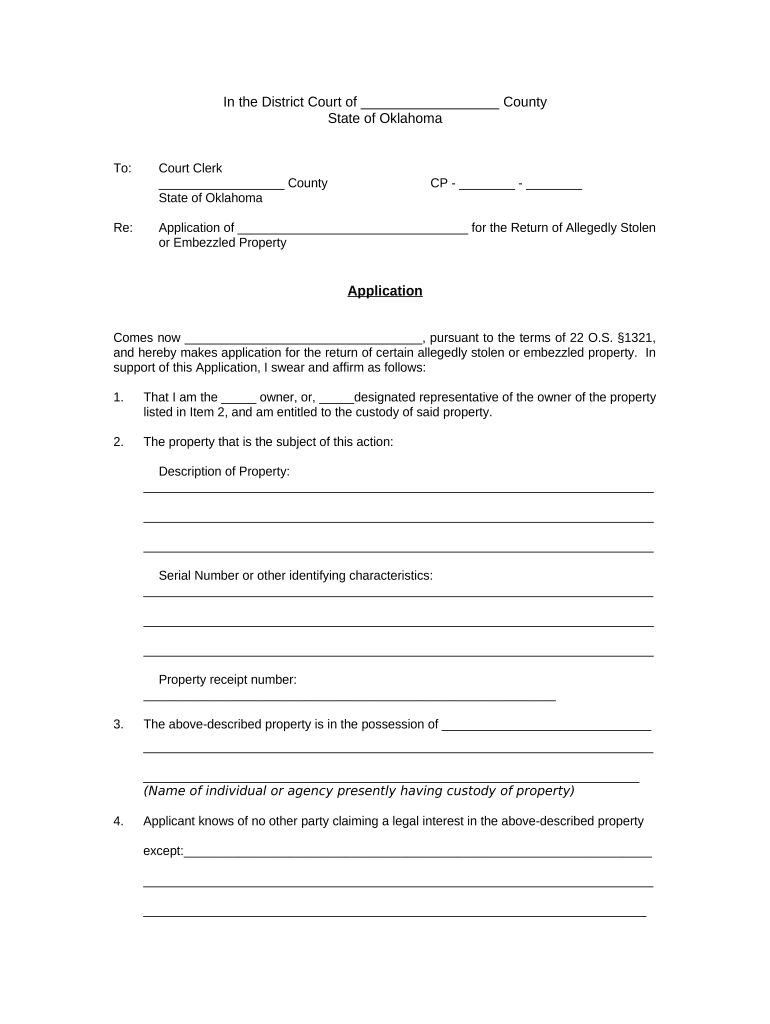
Filing the application creates a documented, statutory pathway to recover property, request immediate remedies, and preserve evidence; it starts a court-supervised process that can result in return orders or other relief.

Parties should ensure accurate ownership documentation and service procedures before filing to avoid delays or dismissal.
Full legal name, contact information, and relationship to the property owner; include representative or counsel information when applicable, to ensure proper service and communication.
Full name, address, and any known aliases or business DBA names; accurate respondent identification reduces service issues and misdirected orders.
Itemize property with identifying data such as serial numbers, VINs, photos, and estimated value to support return and evidentiary preservation requests.
Chronological description of events leading to loss with dates, locations, and witnesses; concise and factual narratives help the court assess urgency and merits.
Attach police reports, receipts, photographs, bills of sale, or inventory lists; label exhibits and reference them in the application for easy review.
Specify exact orders sought—immediate return, temporary possession, preservation of evidence, or damages—so the court can tailor remedies efficiently.
| Field | Configuration |
|---|---|
| Document assembly | Combine form with labeled exhibits |
| Verification | Notarize or swear affidavit as required |
| Filing method | E-file where available or in-person filing |
| Service method | Personal or statutory service; certified mail |
Verify that the chosen platform meets legal and court requirements, and that you can produce a complete audit trail for the record.
Court assigns case number immediately on filing.
Respondent must be served per court rules—often within days to weeks.
Judge may rule on emergency relief in 24–72 hours in urgent cases.
Hearing typically set within weeks; depends on docket and service completion.
Enforcement occurs after signed order and proper notice.
Assemble exhibits, complete application, and file with the court.
Effectuate service according to Oklahoma rules and return proof of service.
Appear with evidence; judge may issue interim or final orders.
Arrange recovery with law enforcement or civil process after order.
| signNow | DocuSign | Adobe Sign | PandaDoc | HelloSign | |
|---|---|---|---|---|---|
| Starting Price | $8/user/mo | $15/user/mo | $14/user/mo | $19/user/mo | $15/user/mo |
| Free Trial | 7-day free trial | Varies by vendor | Varies by vendor | Varies by vendor | Varies by vendor |
| Bulk Send | Yes | Yes | Yes | Yes | Varies |
| Audit Trail | Yes | Yes | Yes | Yes | Yes |
| HIPAA Compliant | Yes | Yes | Yes | No | No |
| Envelope Cap | No cap | 100 envelopes/user/year | Varies by plan | Varies by plan | Varies by plan |