Establishing secure connection…Loading editor…Preparing document…

Letter Regarding Restraining Order Compliance

This template is fully customizable. Edit the text, fill out the fields, and send it for signature. Give it a try!
Letter Regarding Restraining Order Compliance

What the Letter Regarding Restraining Order Compliance Is

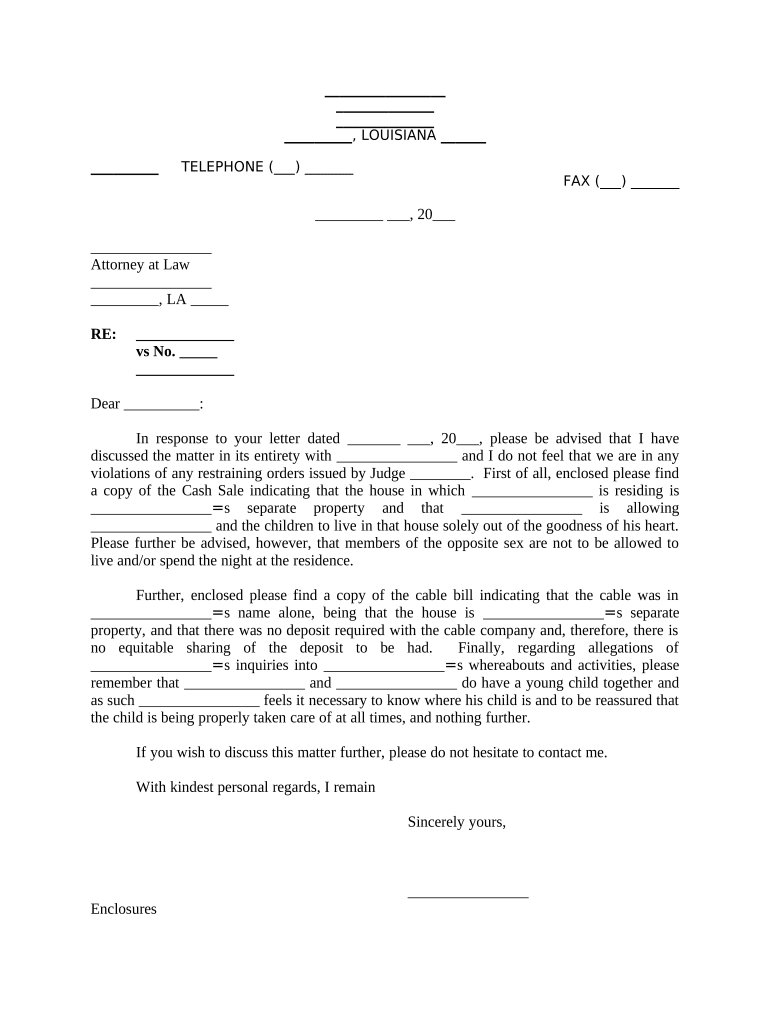
A Letter Regarding Restraining Order Compliance documents a recipient's acknowledgement and planned compliance with the terms of a court-issued restraining order. Typically prepared by a respondent, third-party custodian, employer, or service provider, the letter records specific actions taken or to be taken to avoid contact, to secure property, or to comply with court directives. It serves as a written record delivered to the requesting party or filed with the court to show intent and steps taken, and it often accompanies proof of service, identification, or other supporting documents to demonstrate compliance.

Why a Clear Compliance Letter Matters

A concise compliance letter preserves evidence of cooperation, reduces miscommunication with enforcing parties, and provides a formal record for the court or law enforcement.

Why a Clear Compliance Letter Matters

Who Typically Prepares or Receives This Letter

Common participants include respondents, attorneys, employers, property managers, law enforcement, and courts.

  • Respondent or defendant: Confirms steps taken to avoid contact and to secure belongings.
  • Employer or school official: Documents workplace or campus adjustments and protective measures.
  • Attorney or court clerk: Files or transmits the letter as part of the court record.

The letter is shared with the requesting party, court, or any entity required to verify compliance.

Step-by-Step: How to Complete the Letter

Follow these sequential steps to draft, verify, and deliver a compliant letter.

  • 01
    Gather case details: Collect the court name, case number, and order date.
  • 02
    State facts clearly: Summarize the order terms and your compliance actions.
  • 03
    Attach proof: Add copies of the order, IDs, or service receipts as needed.
  • 04
    Deliver and retain: Send to the court and keep an executed copy for records.

Digital Workflow Setup for Preparing and Sending the Letter

Configure an electronic workflow to assemble, sign, and file the letter with secure traceability.

Field Configuration
Document template Pre-fill case number, court name, and order date
Required attachments Attach order copy and proof of service fields
Signer authentication Use email or SMS code; consider ID verification for added assurance
Retention policy Set automatic archive for the required retention period

How eSubmission Works for This Letter

A typical eSubmission flow reduces handling time and creates an audit trail for compliance verification.

  • Upload document: Attach the drafted letter and supporting exhibits.
  • Place fields: Add signature, date, and optional witness fields.
  • Authenticate signer: Send email or SMS verification to the signer.
  • Send and record: Deliver to court or recipient and capture audit metadata.

Technical Requirements and Integration Considerations

Ensure the platform supports secure upload, signature authentication, and audit trail capture.

  • File formats: Supports PDF and DOCX uploads
  • Authentication: Email, SMS, KBA, or third-party ID options
  • Integrations: Connects with case management and cloud storage

Verify integrations with your court filing system or records management platform to streamline filing and retention.

Security and Legal Compliance Essentials

Transmission: TLS 1.2/1.3 in transit
Data storage: AES-256 encryption at rest
Legal frameworks: ESIGN and UETA supported
Healthcare: HIPAA compliance (BAA required)
Audit trail: Timestamped sign events
Certifications: SOC 2 Type II and ISO 27001

Core Elements to Include in a Professional Compliance Letter

A complete letter contains identifying details, a clear statement of compliance, documentation attachments, signatory information, delivery proof, and retention instructions.

Case Identification

Court name, docket number, judge, and order date should be clearly stated to tie the letter to the specific case.
Compliance Statement

A plain, factual declaration of the steps taken to comply with each numbered term of the restraining order.

Supporting Proof

Attach a copy of the order, evidence of changed locks or no-contact agreements, and proof of service when available.

Signatory Details

Full name, title or role (respondent, employer), contact details, and a dated signature block for authentication.

Recipient Information

Name and role of the party or court receiving the letter and the method of delivery used.

Retention Note

State how long the sending party will retain records and how to request copies for verification.

Timing Expectations for Drafting and Submitting the Letter

Timeliness affects enforceability and the ability to demonstrate good-faith cooperation to the court or enforcing party.

Immediate acknowledgment:

Draft and sign the letter as soon as compliance actions occur, ideally within 24–72 hours.

Proof of service:

Provide proof of delivery or service within the timeframe required by the court or recipient.

Court filing:

File with the clerk per local court rules if the court requires a compliance notice.

Employer notifications:

Inform employers or safety officers promptly to implement workplace protections.

Retention start:

Keep the executed letter and attachments from the date of signing for the required retention period.

Key Milestones from Action to Record

Track these milestones to ensure the compliance letter is created, delivered, and retained correctly.

01

Incident or Order Received

Identify when the order was served and note the effective date.

02

Actions Taken

Document immediate steps such as relocation, no-contact measures, or security changes.

03

Letter Drafted

Prepare the letter with attachments and sign it promptly.

04

Delivery and Filing

Send to recipient, file with court if required, and archive the record.

Common Mistakes to Avoid When Preparing the Letter

  • Leaving out the court case number or quoting an incorrect order date, which can unlink the letter from the case.
  • Using vague language like 'I will try' instead of concrete actions and dates that show compliance.
  • Failing to include supporting attachments such as the order copy or proof of changed access, weakening the evidence.
  • Not retaining a signed copy or failing to capture delivery proof, which hinders later verification or disputes.

Potential Consequences of an Incorrect or Incomplete Letter

Contempt Risk: May support a contempt finding
Civil Liability: Possible damages or injunctions
Criminal Exposure: Violations can lead to criminal charges
Evidence Excluded: Incomplete proof may be disregarded by the court
Employment Impact: Workplace disciplinary action possible
Enforcement Delay: Poor documentation can slow protective measures

eSignature Provider Comparison for Preparing and Signing Compliance Letters

Compare vendor pricing and capabilities relevant to secure delivery, audit trails, HIPAA compliance, and envelope limits when choosing a platform.

signNow DocuSign Adobe Sign PandaDoc HelloSign
Starting Price $8/user/mo $15/user/mo $14/user/mo $19/user/mo $15/user/mo
Free Trial 7-day free trial Varies by plan Varies by plan Varies by plan Varies by plan
Bulk Send Available (Business Premium) Available Available Available Limited
Audit Trail Yes Yes Yes Yes Yes
HIPAA Compliant Yes (BAA available) Yes (BAA available) Yes (BAA available) No No
Envelope Cap No envelope cap 100 envelopes/user/year Varies Varies Varies

Frequently Asked Questions About the Letter Regarding Restraining Order Compliance

Answers to common questions about validity, delivery, signatures, and evidence of compliance.


Need help? Contact support

be ready to get more
Join over 28 million airSlate SignNow users