Establishing secure connection…Loading editor…Preparing document…

Louisiana Amended Order for Custody

This template is fully customizable. Edit the text, fill out the fields, and send it for signature. Give it a try!
Louisiana Amended Order for Custody

What the Louisiana Amended Order for Custody Is

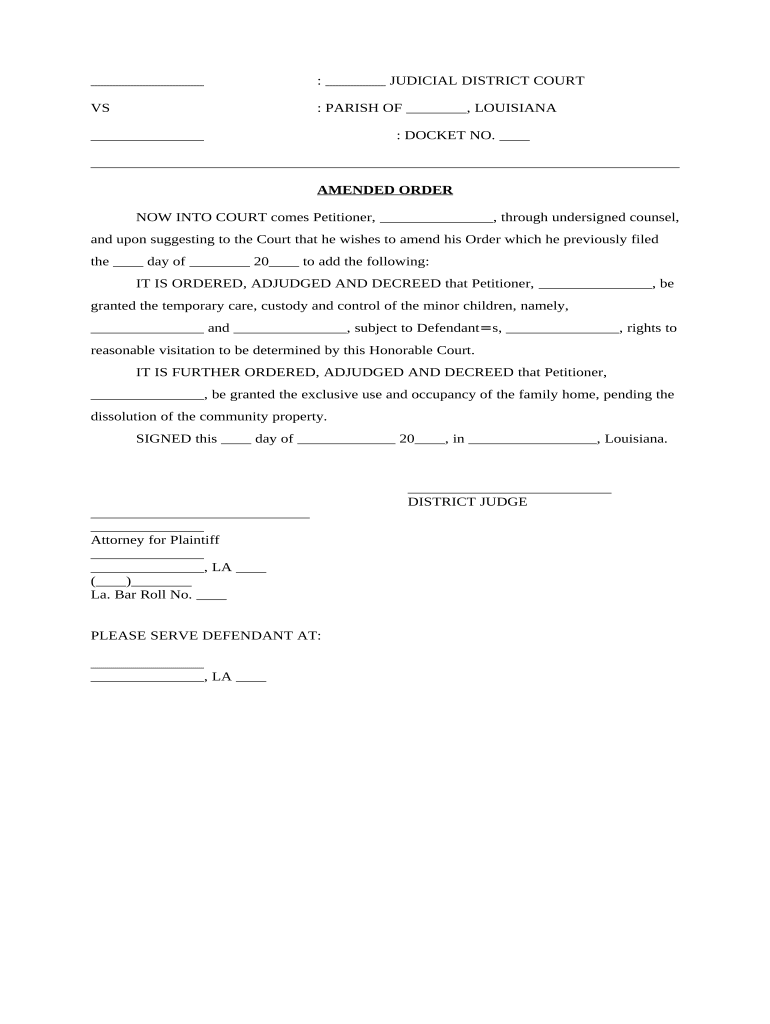
A Louisiana Amended Order for Custody is a court document used to modify an existing custody order entered by a family court. It identifies the original case, explains the factual or legal basis for the requested change, and sets out revised custody and visitation terms. The amended order is submitted to the court for review and signature and typically requires service on the other party and compliance with local family-court procedures before it becomes enforceable.

Why an Amended Custody Order Matters

An amended order legally documents agreed or court-ordered changes to custody, visitation, or decision-making responsibilities and ensures enforceability. Electronic filing and e-signature options can streamline preparation and secure chain-of-custody when permitted under ESIGN and state law.

Why an Amended Custody Order Matters

Who Typically Prepares and Uses an Amended Order

Parties should confirm local court procedures before filing to ensure the amendment is accepted and enforceable.

  • Parents and guardians who need to formalize a change in physical custody or parenting time and provide proof to schools, medical providers, and enforcement agencies.
  • Family law attorneys who prepare pleadings, ensure compliance with procedural rules, and represent clients at modification hearings.
  • Court clerks and judges who process filings, schedule hearings, and enter the amended order as a new court record.

Core Elements Found in a Professional Amended Order

A well-prepared amended order is clear, cites the original judgment, and includes all elements the court needs to adopt new custody terms.

Case Caption

Full court name, docket number, and party names exactly as in the original order to ensure proper case identification and docketing.
Reference to Original

Precise citation to the original order date and paragraph numbers being changed so the court and parties can trace preexisting terms.

Amended Provisions

Clear, numbered paragraphs stating the new custody, visitation, or decision-making arrangements to replace or supplement the original terms.

Supporting Facts

A concise statement of changed circumstances or agreement details that justify the modification under Louisiana family law procedures.

Signature Block

Judge's signature line, date, and clerk’s entry fields; if parties sign, include signature, printed name, and date fields for each signatory.

Service and Notice

Proof of service section or certificate confirming the other party was served per court rules and the method used.

Information Required on the Form

Case Number: Provide original docket number.
Court Name: Enter full court designation.
Party Names: Full legal names of both parents.
Child Details: Child name(s) and birthdate(s).
Requested Change: State new custody terms.
Signatures: All required signatures and dates.

Step-by-Step: Preparing and Submitting an Amended Order

Follow these sequential steps to prepare an amendment that the court can docket and enforce.

  • 01
    Gather Documents: Collect original order, proposed amendment, and supporting proofs.
  • 02
    Complete Form: Fill fields accurately and reference exact paragraphs to modify.
  • 03
    Serve Opposing Party: Provide notice as required by local rules before filing.
  • 04
    File with Court: Submit the amendment to the clerk and request entry or hearing.

Configuring an Online Workflow for the Amended Order

When preparing the amendment electronically, set up a simple workflow for review, authentication, and filing.

Field Configuration
Authentication Email with SMS code or ID verification for signer assurance
Signature Type Electronic signature with audit trail; consider notarization if required
File Format Use PDF/A or PDF for court submissions
Routing Order Party A → Party B → Attorney → Filing clerk

Where to File and How the Document Moves Through Court

Understand each routing step so the amendment is accepted and processed by the court.

  • File with Clerk: Submit the amended order to the court clerk for docketing or hearing placement.
  • Serve Other Party: Provide proof of service to the court using accepted methods.
  • Request Hearing: If required, ask the clerk to schedule a modification hearing.
  • Judge Signs: Judge reviews and signs or sets conditions during the hearing.

Digital Signing and Technical Requirements

Verify the court’s e-filing portal rules and whether remote notarization or in-person signatures are required for this document type.

  • File Types: PDF and DOCX supported; courts commonly require PDF for e-filing
  • Authentication: Email, SMS, or stronger ID verification methods may be used
  • Integrations: Systems integrate with platforms like Salesforce and Microsoft 365 for document routing

Consequences of an Incorrect or Improperly Filed Amendment

Rejection: Clerk may refuse to accept filing
Delay: Hearing postponed or docketing delayed
Nonenforceable: Order may not be legally effective
Contempt Risk: Failure to follow procedures can lead to contempt
Privacy Exposure: Improper sharing may trigger HIPAA concerns
Perjury/False Statements: Factual misstatements can carry legal penalties

Common Mistakes That Cause Delays

  • Failing to reference the exact paragraphs of the original order leads to confusion and rejection by the clerk.
  • Using inconsistent party names or misspelled names causes misdocketing and may require re-filing.
  • Not serving the other party properly prevents the court from proceeding and can nullify the amendment.
  • Assuming electronic signature acceptance without checking local court rules results in invalid or rejected filings.

Typical Timing and Processing Expectations

Timing varies by court, but these are common scheduling and processing timeframes to plan around.

Service Period:

Serve the opposing party per local rules before filing or hearing.

Hearing Scheduling:

Courts may schedule modification hearings 30–90 days after filing.

Clerk Processing:

Clerks typically docket and scan filings within 3–14 business days.

Judge Review:

Judge signs or issues a ruling at or after the hearing.

Effective Date:

The order’s effective date is set in the document or by court ruling.

Key Milestones in the Amendment Process

Track these stages from preparation through final entry to avoid missed steps or deadlines.

01

Prepare Petition

Draft amended order and gather supporting evidence.

02

Serve Parties

Provide notice to the opposing party as required.

03

File with Court

Submit amendment to clerk for docketing or hearing.

04

Entry or Hearing

Judge signs the order or issues a modification ruling.

Illustrative Scenarios Where an Amendment Is Used

These anonymized examples show common reasons and practical outcomes when parties use an amended custody order.

Relocation Example

A custodial parent seeks to move across parish lines and proposes a revised visitation schedule.

  • The other parent objects and requests a hearing.
  • The parties present a proposed amended order at the hearing; the judge adopts a modified schedule, and the clerk files the signed amendment as the new enforceable order.

Changed Circumstances

A significant change in a parent’s work hours necessitates different parenting time.

  • Parents agree to a new schedule in mediation.
  • They file a joint amended order reflecting the mediated terms; the court signs and the amended order is entered as the enforceable arrangement.

eSignature Vendor Comparison for Completing Custody Documents

This table compares signNow with common eSignature vendors on price and core features relevant to document preparation and secure signing.

signNow DocuSign Adobe Sign PandaDoc HelloSign
Starting Price $8/user/mo $15/user/mo $14/user/mo $19/user/mo $15/user/mo
Free Trial 7-day free trial Yes Yes Yes Yes
Bulk Send Yes Yes Yes Yes No
Audit Trail Yes Yes Yes Yes Yes
HIPAA Compliant Yes Yes Yes No No

Frequently Asked Questions About Amending Custody Orders

Answers to common questions about whether amendments can be e-signed, notarized, and how to avoid filing problems.


Need help? Contact support

be ready to get more
Join over 28 million airSlate SignNow users