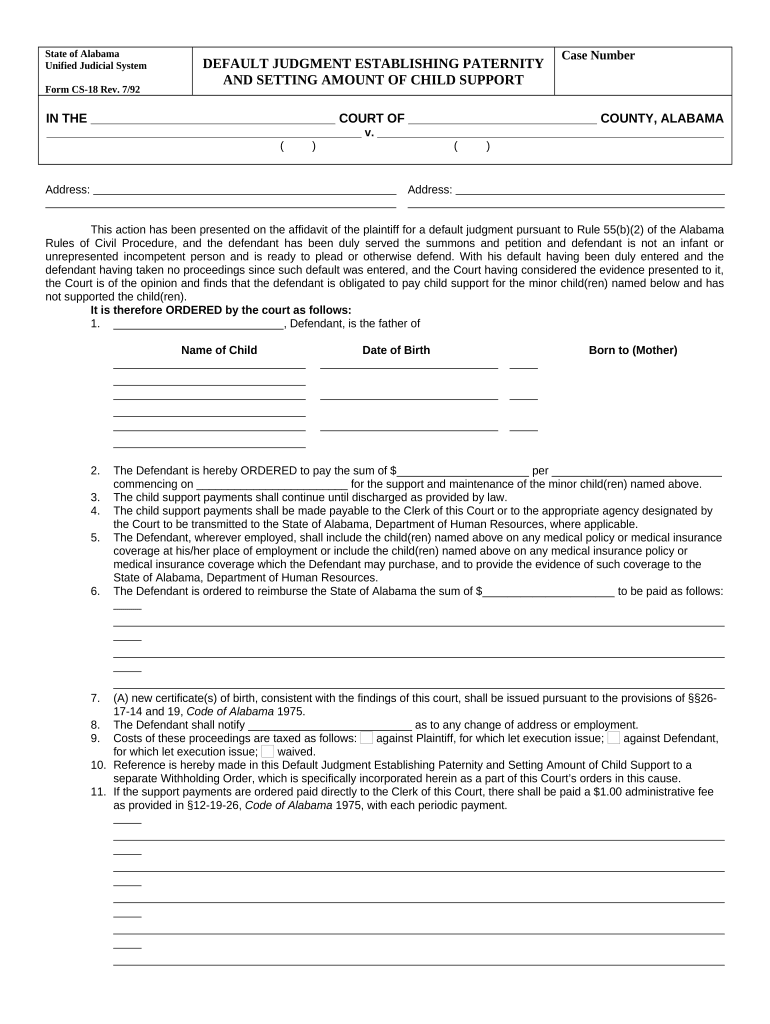
Alabama Default Judgment Establishing Paternity and Setting Amount of Child Support
What this Alabama default judgment form does and when it applies
Why a default judgment matters for child support and paternity in Alabama
A default judgment provides a clear, enforceable determination of parentage and a court-ordered child support obligation when the opposing party does not defend. It enables enforcement actions, income withholding, and modification procedures tied to a formal court record.
Who prepares, files, and uses this default judgment
Each party should confirm local court practices and required attachments before submitting the proposed default judgment for entry to avoid processing delays.
- Petitioners and parents who initiated the paternity or support action.
- Family law attorneys preparing pleadings and proposed judgments.
- Clerks of court and child support enforcement units executing and enforcing orders.
Step-by-step: completing and submitting the proposed default judgment
-
01Prepare filings: Assemble complaint, affidavit of service, financial affidavits, and proposed judgment.
-
02Verify service: Confirm proof of service or publication meets Alabama rules before requesting default entry.
-
03Draft findings: Include concise factual findings and legal conclusions supporting paternity and the support amount.
-
04File and submit: File with the clerk and request the judge’s review/entry; follow local e-filing procedures if available.
How to customize and submit the judgment using an online workflow
| Document Format | PDF/A | Use court-preferred PDF/A for filings |
|---|---|
| Signature Method | Judge signs in‑court | Court may require original judge signature |
| Party Signatures | Attorney e‑sign | Use platform audit trail when allowed |
| Attachments | Affidavits | Include proof of service and financial statements |
| E‑file Method | Court portal | Submit via local e‑filing system if available |
Where to file and how the default judgment moves through the court
-
Filing with Clerk: Petitioner files proposed judgment and supporting documents with the county circuit or family court clerk.
-
Judicial Review: Judge or magistrate reviews pleadings and may hold a brief hearing or sign off on submitted findings.
-
Entry and Docketing: Clerk enters the judgment on the docket and stamps the official order.
-
Distribution: Court provides certified copies to parties and child support enforcement agencies as appropriate.
Digital signing and e‑submission: technical considerations
If the court requires original judge signatures or notarized originals, prepare physical copies for in‑court signing and submission to the clerk.
- File Types: PDF, PDF/A accepted
- Authentication: Email or SMS code for party consent
- Integrations: Court portals accept uploads from common cloud storage
Penalties and legal risks of incorrect or incomplete default judgments
Common mistakes to avoid when preparing the default judgment
- Failing to attach proof of service or publication can prevent entry and lead to dismissal.
- Relying on oral statements instead of sworn affidavits weakens factual findings.
- Omitting precise payment terms or payee information causes enforcement confusion.
- Using inconsistent party names across documents creates identity and garnishment issues.
Typical timelines and processing expectations
Service Deadline:
Comply with local rules for service timing before requesting default
Clerk Review:
Clerk processing often 1–4 business days depending on docket
Judicial Review:
Judge review may take days to weeks based on calendar and contested items
Entry Time:
Entry typically occurs within 1–30 days after submission
Appeal Period:
Time to challenge or move to set aside varies by rule and party circumstances
Key milestones from filing to enforcement
1. File Proposed Judgment
Submit judgment with supporting affidavits to the clerk for docketing.
2. Clerk Confirms Service
Clerk verifies proof of service and completeness of filings.
3. Judicial Entry
Judge enters the default judgment or requests supplemental materials.
4. Enforcement Actions
Issued order enables withholding, contempt, or collection procedures.
Practical examples: how default judgments are applied
Case Study 1
Petitioner files with affidavit of service showing respondent evaded service
- Court enters default after review of uncontested facts
- The entered judgment establishes paternity, sets $500 monthly support, and directs immediate income withholding and arrears calculation.
Case Study 2
Parent files for support and attaches financial affidavit and child birth certificate
- Respondent fails to appear despite proper service attempts
- Court issues default judgment with retroactive support to the date of filing and instructs clerk to notify child support enforcement.
Tips for accurate and efficient completion
eSignature vendor comparison relevant to filing and executing court documents
| signNow | DocuSign | Adobe Sign | PandaDoc | HelloSign | |
|---|---|---|---|---|---|
| Starting Price | $8/user/mo | $15/user/mo | $14/user/mo | $19/user/mo | $15/user/mo |
| Free Trial | 7-day free trial | Trial available | Trial available | Trial available | Trial available |
| Bulk Send | Yes | Yes | Yes | Yes | No |
| Audit Trail | Yes | Yes | Yes | Yes | Yes |
| HIPAA Compliant | Yes | Yes | Yes | No | No |
Frequently asked questions about default judgments, paternity, and child support
-
Can I e-sign a proposed default judgment?
Possibly, but courts often require judicial signature and may treat family law decrees and court orders as exceptions under ESIGN/UETA rules. Check local court rules and the court’s e-filing policy before relying on electronic signatures.
-
What if the respondent was not properly served?
Improper or insufficient service is a common basis to vacate a default judgment. Ensure affidavits of service meet Alabama court rules or seek alternative authorized service methods prior to entry.
-
How is child support amount determined?
Courts use statutory guidelines, income disclosures, and relevant factors to set support. Include complete financial affidavits and child support worksheets to support the proposed amount.
-
Can a default judgment be modified later?
Yes. Support orders are generally modifiable for a material change in circumstances, but modification procedures, notice, and jurisdictional rules must be followed.
-
Who enforces the judgment?
Once entered, the judgment can be enforced by the clerk, child support enforcement agency, or a party through income withholding, contempt motions, or collection remedies authorized by state law.
-
What records should I keep?
Retain certified copies, payment records, service affidavits, and related financial documentation for at least three to seven years and longer if tax or enforcement matters continue.