Parties
Identify owner, contractor, subcontractors, and any project stakeholders. Include legal names, business addresses, contact information, and authorized signers; state relationship to property owner or tenant.
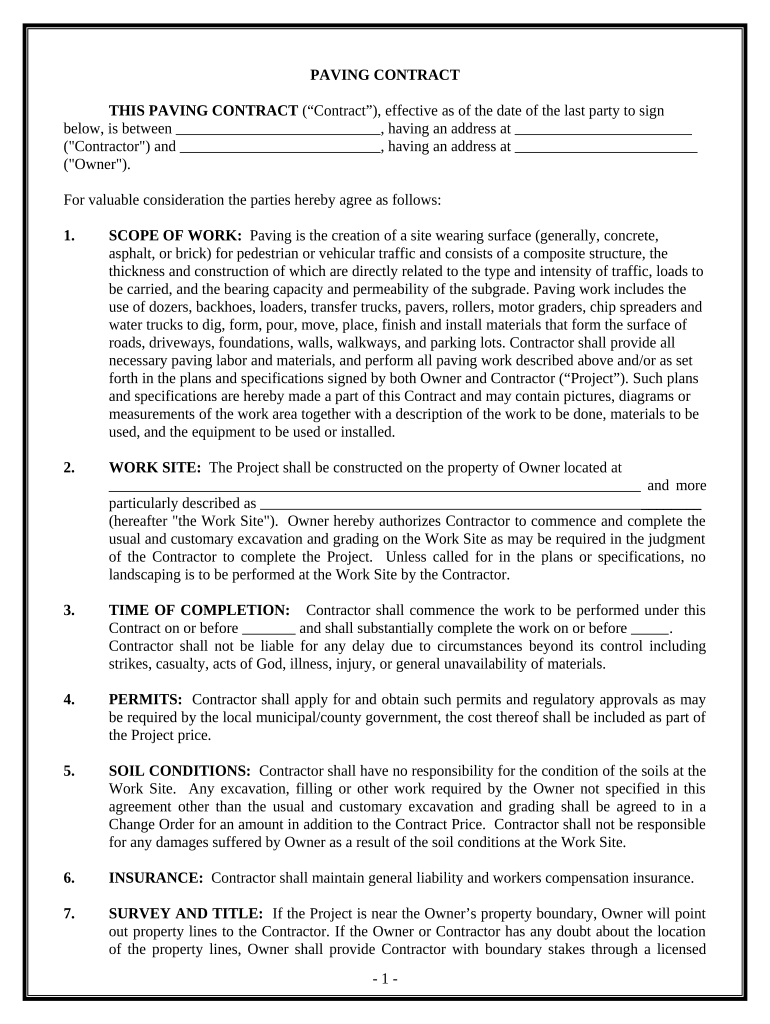
Using a Paving Contract clarifies expectations, allocates risks, and documents payment triggers and warranty obligations. It reduces project disputes, supports permit and inspection compliance, and provides a clear basis for claims or change orders while preserving enforceable rights under state contract and construction law.

Property owners, municipal procurement officers, general contractors, and paving subcontractors use a Paving Contract to document scope, schedule, and payment terms before work begins.
Identify owner, contractor, subcontractors, and any project stakeholders. Include legal names, business addresses, contact information, and authorized signers; state relationship to property owner or tenant.
Define paving limits, base preparation, material types, mix designs, compaction criteria, thicknesses, and measurable acceptance tests. Reference drawings, technical specs, and measurement units to avoid ambiguity.
Provide start and completion dates, critical milestones, weather contingencies, inspection windows, and liquidated damages or incentives tied to timely completion to manage performance risk effectively.
List lump-sum or unit rates, mobilization, retainage percentage, payment schedule, tax treatment, and the approved method for pricing change orders with supporting cost breakdowns.
Specify minimum insurance types and limits, require naming owner as additional insured, and include bond requirements for public projects or when required by the owner.
State governing law, venue, and preferred dispute method such as mediation followed by arbitration or litigation. Include timelines for notice and escalation of claims and remedies.
| Field | Configuration |
|---|---|
| Template | Pre-fill fields, attach exhibits |
| Signer Order | Set owner then contractor signing |
| Authentication | Email + SMS code or KBA |
| Notifications | Automated reminders and copy distribution |
Use e-delivery, email links, or integrations to share the Paving Contract with signers and stakeholders.
Submit permits before mobilization; municipal review varies.
Contractor mobilizes and begins site preparation.
Tie payments to measurable completion checkpoints.
Pavement acceptance testing and stormwater sign-off required.
Warranty period typically begins at final acceptance.
| signNow | DocuSign | Adobe Sign | PandaDoc | HelloSign | |
|---|---|---|---|---|---|
| Starting Price | $8/user/mo | $15/user/mo | $14/user/mo | $19/user/mo | $15/user/mo |
| Free Trial | 7-day free trial | Varies by vendor | Varies by vendor | Varies by vendor | Varies by vendor |
| Bulk Send | Yes | Varies by vendor | Varies by vendor | Yes | Varies by vendor |
| Audit Trail | Yes | Yes | Yes | Yes | Yes |
| HIPAA Compliant | Yes | Yes | Yes | No | No |
| Envelope Cap | No envelope cap | 100 envelopes/user/year | Varies by plan | Varies by plan | Varies by plan |
Tim Martin of Martin Properties used e-signing to execute paving and property improvement contracts without in-person signings, reducing turnaround time.
Brian Fitzgibbons at Optica Ventures implemented online signing for contractor agreements and site work contracts to streamline approvals across remote sites.
Facilities or project owners use Paving Contracts to define deliverables, holdbacks, and acceptance testing. They focus on warranties, insurance, and performance milestones, and they retain signed contracts for permitting, payment approvals, and potential lien or warranty claims.
Project managers and contractors use the contract to confirm scope, schedule, unit pricing, and quality standards. They require clear change order procedures, payment milestones, and instructions for testing and documentation to secure timely payment and manage subcontractor obligations.