Establishing secure connection…Loading editor…Preparing document…

Performance Goals Summary

This template is fully customizable. Edit the text, fill out the fields, and send it for signature. Give it a try!
Performance Goals Summary

What a Performance Goals Summary Is and when it’s used

A Performance Goals Summary is a concise written record that captures an employee’s objective targets, success metrics, timelines, and any development actions tied to performance reviews. It summarizes agreed goals for a review period, clarifies expectations between manager and employee, and serves as a reference for progress tracking, compensation decisions, and development planning.

Why documenting goals improves clarity and accountability

A clear Performance Goals Summary aligns expectations, reduces misunderstandings about responsibilities and measurement, and creates an auditable record for HR and managers to reference during reviews or disputes.

Why documenting goals improves clarity and accountability

Typical users and reviewers of a Performance Goals Summary

Use the summary as both a planning document and a documented record for performance conversations and HR processes.

  • Employees and individual contributors who need documented targets and measurable outcomes.
  • Managers and supervisors who draft, approve, and monitor performance goals.
  • Human resources teams that store summaries for review cycles, compensation, and compliance.

Core elements to include in a professional summary

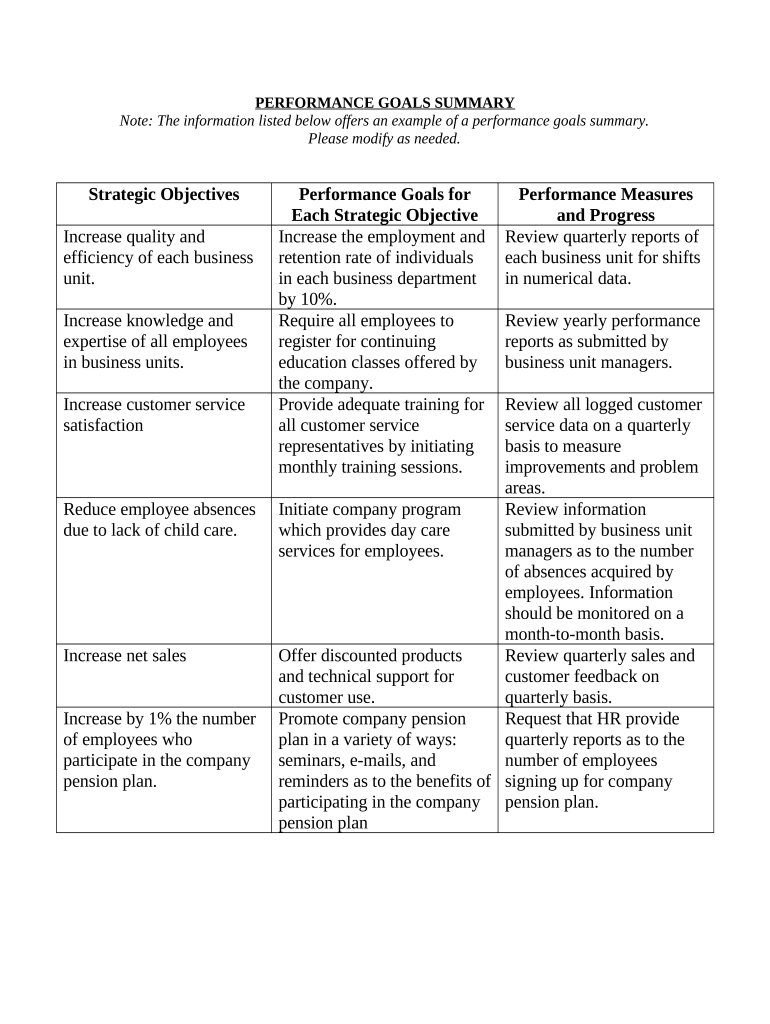
A robust Performance Goals Summary groups objectives into measurable items with ownership, timelines, success criteria, and links to development or resources required to meet each goal.

Goal Title

Short, specific name for the objective so it can be referenced consistently in coaching and reporting.
Description

Concise explanation of the goal and its business context so stakeholders understand purpose and priority.

Success Criteria

Quantifiable metrics or outcomes (e.g., revenue targets, error rates, project milestones) that define success.

Owner

Named person accountable for delivery and updates; clarifies responsibility across cross-functional work.

Timeline

Start and target completion dates to set expectations for interim check-ins and final assessment.

Support Actions

Training, resources, or approvals required to achieve the goal, including dependent tasks or stakeholders.

Required fields and key data points

Employee Name: Full legal name
Employee ID: Internal identifier or HRIS number
Position: Job title and department
Review Period: Start and end dates
Goal Metrics: Specific KPIs or targets
Signatures: Manager and employee acknowledgment

Step-by-step: complete a Performance Goals Summary

Follow these steps to create a clear, enforceable summary that supports measurement and development.

  • 01
    Draft Goals: List 3–5 prioritized objectives with concise titles and descriptions.
  • 02
    Define Metrics: Attach measurable success criteria for each goal.
  • 03
    Set Dates: Assign start and target completion dates; note interim checkpoints.
  • 04
    Review & Sign: Manager and employee review together and sign the final summary.

Configure the digital workflow for review and approval

Typical settings control routing, reminders, and access for managers, employees, and HR.

Field Configuration
Routing Order Manager → Employee → HR
Reminders Automatic reminders at 7 and 3 days before due date
Access Manager edit, employee view+sign
Audit Trail Enable timestamps and IP logging

Digital signing and platform requirements

Ensure the chosen platform meets your security and retention policies and can export a tamper-evident signed copy for HR records.

  • Supported Formats: PDF, DOCX, HTML
  • Authentication: Email link, SMS code, or stronger methods
  • Integrations: Connectors for HRIS, Google Workspace, Microsoft 365

Where the completed summary should go and who receives it

A completed Performance Goals Summary should be routed to HR and retained in the employee file, with copies available to manager and employee.

  • Manager: Keeps editable copy and updates progress
  • Employee: Receives signed copy for personal tracking
  • Human Resources: Stores official signed copy in HRIS or document archive
  • Payroll/Comp: Receives summary if compensation decisions depend on outcomes

Typical timelines and dates to track

Key dates ensure goals are set, reviewed, and closed within the correct performance cycle.

Goal-Setting Deadline:

Set at start of cycle; often within first 30 days

Interim Checkpoints:

Quarterly or mid-cycle progress reviews

Final Review Date:

End of review period; used for rating decisions

Documentation Retention:

Save signed summary per retention policy

Dispute Window:

Allow 14–30 days for corrections or appeal

Milestones from goal creation to closeout

Follow this sequence so goals are documented, monitored, and archived with clear ownership.

01

Create Goals

Draft objectives and success metrics within the first review window.

02

Manager Review

Manager provides feedback and confirms feasibility of metrics.

03

Employee Acknowledgment

Employee reviews and signs to confirm understanding.

04

Closeout & Archive

Complete final assessment, sign off, and store in HR records.

Common mistakes to avoid when preparing summaries

  • Vague goals without measurable criteria that make evaluation subjective.
  • Missing dates or inconsistent timelines that cause misalignment with review cycles.
  • Failure to record required approvals or signatures, limiting enforceability.
  • Poor version control that leaves outdated goals active in HR systems.

Operational and compliance risks from incorrect summaries

Performance Disputes: Incomplete records can hinder fair appeal or grievance resolution
Compensation Errors: Incorrect goal documentation may cause unjustified pay adjustments
Data Retention Failures: Not retaining signed summaries can violate internal policy or audit needs
Legal Risks: Inaccurate records may affect wrongful termination or discrimination claims
Authentication Gaps: Unsigned or poorly authenticated documents may lack legal effect under ESIGN
Privacy Concerns: Storing summaries insecurely can expose personal performance data

Illustrative examples across common use cases

These short examples show how a Performance Goals Summary can be structured for different roles.

Sales Representative

Set quarterly ARR target and activity metrics to drive pipeline growth

  • Goal tied to $250K ARR and 25 qualified opportunities
  • Manager checks weekly, mid-quarter coaching provided, signed and archived for commission eligibility and year-end review.

Software Engineer

Define feature delivery and code quality objectives aligned to product roadmap

  • Deliver two major features and maintain <1% defects post-release
  • Progress tracked at sprint demos, peer review required, and completion conditions recorded for performance rating.

eSignature pricing snapshot for Performance Goals Summary workflows

Compare typical starting prices and feature availability for common eSignature vendors when selecting a platform to manage Performance Goals Summaries.

signNow DocuSign Adobe Sign PandaDoc HelloSign
Starting Price $8/user/mo $15/user/mo $14/user/mo $19/user/mo $15/user/mo
Free Trial 7-day free trial Varies by plan Varies by plan Varies by plan Varies by plan
Bulk Send Yes Yes Yes Yes No
Audit Trail Yes Yes Yes Yes Yes
HIPAA Compliant Yes Yes Yes No No
Envelope Cap No envelope cap 100 envelopes/user/year Varies by plan Varies by plan Varies by plan

Frequently asked questions and common issues

Answers to common questions about preparing, signing, and storing a Performance Goals Summary.


Need help? Contact support

be ready to get more
Join over 28 million airSlate SignNow users