Scope
Specify which documents are included (personnel records, performance notes) and which are excluded (medical files, employer privileged notes).
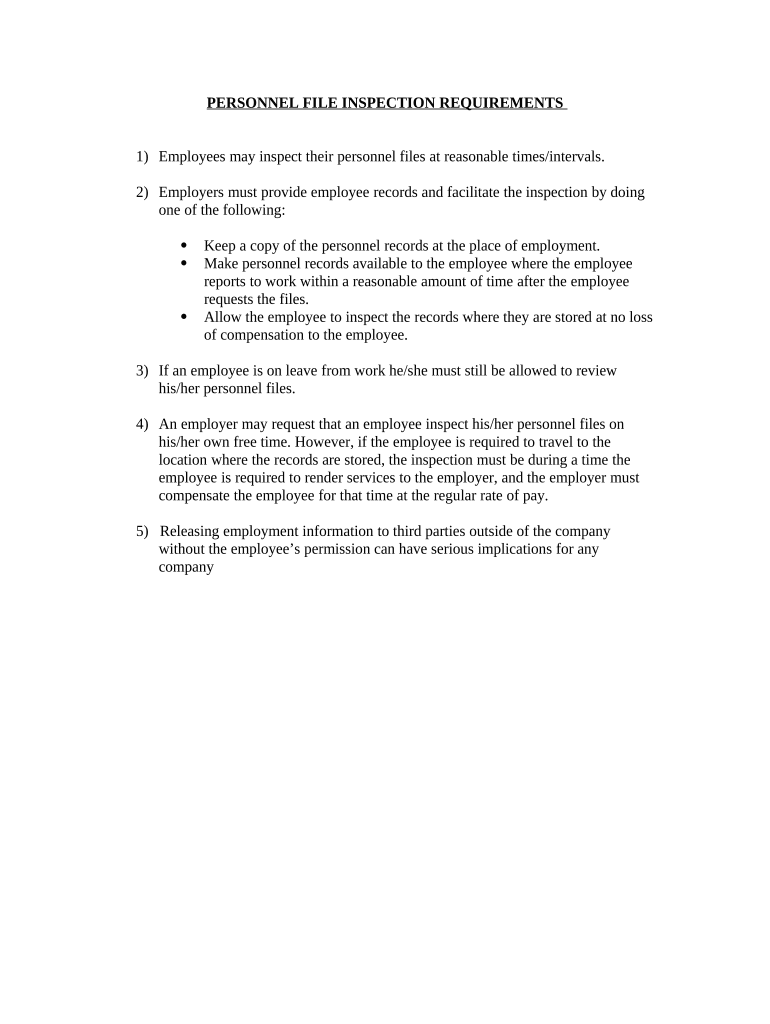
Consistent inspection procedures reduce legal risk, improve employee trust, and simplify record production for audits or disputes. A documented process clarifies timelines, copy fees, and redaction practices so requests are handled uniformly and defensibly across locations.

Employers, HR professionals, in-house counsel, and payroll or benefits administrators use personnel file inspection guidance to respond to employee requests and to prepare for regulatory reviews.
Apply these requirements whenever an employee requests access, when responding to subpoenas, or during internal audits that review personnel records.
Specify which documents are included (personnel records, performance notes) and which are excluded (medical files, employer privileged notes).
Standardize how employees submit requests (written/email) and capture the request date and desired output (inspection vs copies).
Require reasonable identity proof before releasing records; use employee ID, government ID, or secure company authentication.
Define what to redact (third-party personal data, privileged legal notes) and who approves redaction decisions.
Set internal deadlines that meet or beat statutory response windows and assign responsible owners for each step.
Log each request, the documents provided, any fees charged, and copies of communications for compliance audits.
| Field | Configuration |
|---|---|
| Request Intake | Secure web form with required fields and date-stamped submission. |
| Authentication | Single sign-on or two-factor verification before file access. |
| Redaction Approval | Role-based approval step before producing copies. |
| Delivery | Secure PDF with audit log entry and optional watermarking. |
Choose platforms that support secure file access, audit logs, and configurable redaction to meet legal and privacy obligations.
Integrations with HRIS, document management, and eSignature systems reduce manual work and maintain a defensible audit record of how and when records were produced.
Many states require inspection or copies within 21–30 days; California requires 30 days (Cal. Lab. Code §1198.5).
Retain I-9s for 3 years after hire or 1 year after termination, whichever is later (8 CFR §274a.2).
Maintain access logs and retain PHI records per HIPAA: 6 years (45 CFR §164.530(j)).
Keep payroll and tax records per IRS guidance—typically at least 3 years from filing (IRC §6501(a)).
Suspend routine destruction when litigation or audit is reasonably anticipated; preserve relevant records immediately.
Optica implemented a standardized intake form and digital delivery to cut lookup time.
The center centralized record access and added role-based approvals for sensitive items.
| signNow | DocuSign | Adobe Sign | PandaDoc | HelloSign | |
|---|---|---|---|---|---|
| Starting Price | $8/user/mo | $15/user/mo | $14/user/mo | $19/user/mo | $15/user/mo |
| Free Trial | 7-day free trial | Varies | Varies | Varies | Varies |
| Bulk Send | Yes | Yes | Yes | Yes | No |
| Audit Trail | Yes | Yes | Yes | Yes | Yes |
| HIPAA Compliant | Yes | Yes | Yes | No | No |