Establishing secure connection…Loading editor…Preparing document…

Petition for Probate and Possession Heirship or Descent Affidavit

This template is fully customizable. Edit the text, fill out the fields, and send it for signature. Give it a try!
Petition for Probate and Possession Heirship or Descent Affidavit

What the Petition for Probate and Possession Heirship or Descent Affidavit Is

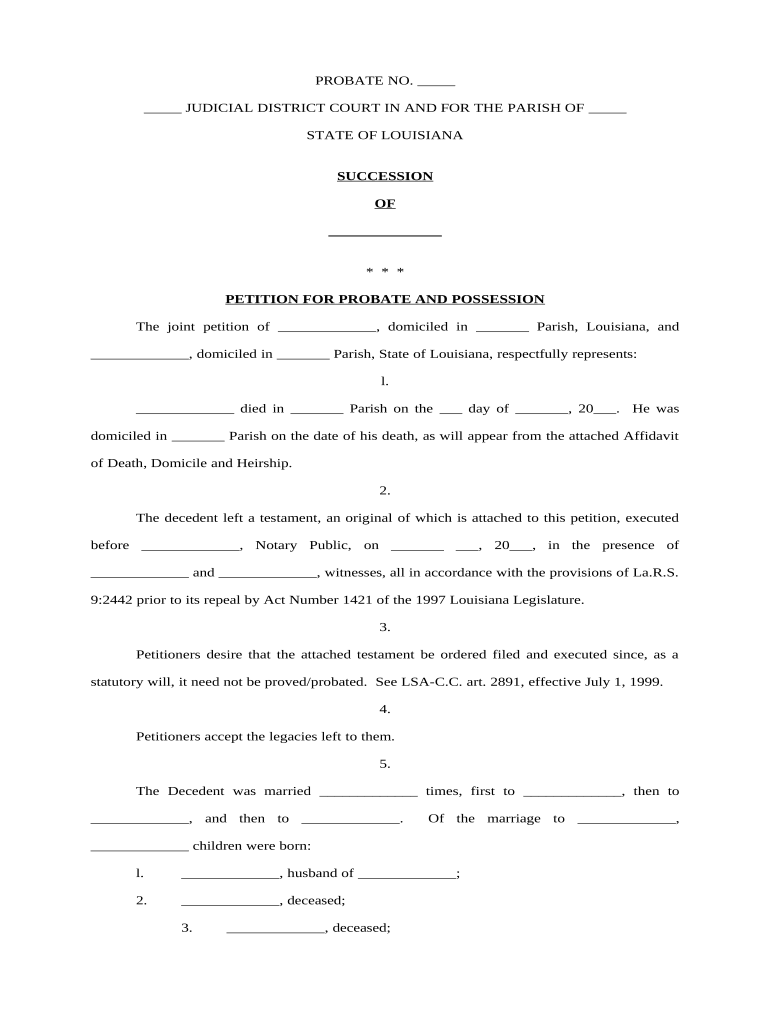
The Petition for Probate and Possession Heirship or Descent Affidavit is a court filing used to establish legal heirs, transfer possession of decedent property, or clear title when someone dies intestate or when a personal representative seeks authority to possess estate assets. It combines a formal petition to the probate court with sworn statements identifying heirs and describing property, and it typically requires supporting documents such as a death certificate, estate inventory, and proof of kinship. Because probate procedures and affidavit content vary by jurisdiction, the petition must conform to local court rules, statutory forms, and any witness or notarization requirements before filing.

Why this Petition Matters for Estate Administration

This petition speeds title transfer and clarifies ownership when there is no probated will or when an estate requires court acknowledgement of heirs. It reduces future disputes by creating a court record of heirship and possession rights and provides the legal basis for transferring real or personal property to successors.

Why this Petition Matters for Estate Administration

Who Typically Prepares and Files This Petition

Common filers include estate attorneys, appointed personal representatives, and close family members acting as pro se petitioners.

  • Personal representatives and executors preparing estate inventories and seeking court authority to distribute assets.
  • Heirs or beneficiaries securing title to real property or possession of personal property after a relative's death.
  • Estate attorneys assembling affidavits, exhibits, and legal citations to support heirship claims in probate court.

Regardless of who files, coordinating required supporting documents, following local clerk procedures, and meeting notarization or witness requirements reduces the chance of rejection or delay.

Core Components of a Professional Petition and Heirship/Descent Affidavit

A complete petition bundles structured case information, sworn heirship statements, and exhibits so the court can rule on possession and title matters without unnecessary follow-up.

Court Caption

Includes county, court name, case number space, and proper party names to ensure the clerk files the petition in the correct probate docket and links supporting records correctly.
Decedent Details

Full legal name, date of death, last residence, and social security or identifying information that distinguishes the decedent from similarly named individuals for court and title search accuracy.

Heirship Statement

A sworn list of heirs showing relationship, current addresses, and shares or priorities under intestacy rules to support distribution and reduce later ownership disputes.

Property Description

Clear legal descriptions for real property and itemized lists for personal property, including parcel numbers, to enable accurate recording and transfer instruments.

Supporting Exhibits

Attach certified death certificate, wills (if any), prior deeds, beneficiary designations, and proof of kinship such as birth or marriage records to substantiate claims.

Signature and Verification

Signature block for petitioner and notary or witness statements as required by the jurisdiction, plus a clear request (prayer) for relief and court orders sought.

Step-by-Step Filing Workflow

Follow these sequential actions to prepare, execute, and file the petition with minimal rework.

  • 01
    Gather Documents: Collect death certificate, title documents, and proof of kinship before drafting.
  • 02
    Draft Petition: Complete form sections, property descriptions, and sworn heirship statement.
  • 03
    Execute and Notarize: Sign in presence of required witnesses and obtain notarization or RON as allowed.
  • 04
    File with Court: Submit petition and exhibits to the probate clerk and pay filing fees.

Customizing and Completing the Petition Online

When preparing the petition digitally, set field behaviors and signer order to match court requirements and evidence needs.

Field Online Setting
Signature Field Require signer order; lock signature after signing
Date Field Auto-fill MM/DD/YYYY when signer completes
Notary/Acknowledgment Enable RON or notary block per jurisdiction selection
Attachments Make death certificate and deeds required uploads

End-to-End Process for eFiling or eSubmission

This sequence outlines how a digital petition moves from preparation to courthouse acceptance or recordation.

  • Prepare: Assemble petition and exhibits in final PDF form
  • Place Fields: Add signature, date, and notarization fields
  • Sign and Notarize: Signers complete and notarization is performed or RON recorded
  • File or Record: Submit to probate clerk or county recorder per local rules

Distribution Channels and Technical Requirements

Choose delivery methods that match court acceptance policies (electronic filing, in-person delivery, or recorded submission).

  • PDF / DOCX: Submit final petition as PDF; editable drafts in DOCX for review
  • Email / Secure Link: Use secure email or signing links for remote signer access
  • RON or In-Person: Enable Remote Online Notarization where the state permits

Verify the receiving agency's preferred format and transmission method to avoid clerk rejections; maintain copies and audit trails for recordkeeping and potential appeals.

eSignature Solutions Compared for Executing Probate Petitions and Heirship Affidavits

Compare basic pricing and core capabilities across common eSignature vendors to evaluate cost, HIPAA support, and envelope limits for estate workflows.

signNow DocuSign Adobe Sign PandaDoc HelloSign
Starting Price $8/user/mo $15/user/mo $14/user/mo $19/user/mo $15/user/mo
Free Trial 7-day trial Varies by plan Varies by plan Varies by plan Varies by plan
Bulk Send Yes Yes Yes Yes Yes
Audit Trail Yes Yes Yes Yes Yes
HIPAA Compliant Yes Yes Yes No No
Envelope Cap No cap 100 envelopes/user/year Varies by plan Varies by plan Varies by plan

Security and Compliance Considerations for Digital Petitions

Encryption: TLS 1.2/1.3 in transit, AES-256 at rest
Audit Trail: Timestamp, IP, and action log retained
HIPAA / BAA: HIPAA-compliant with BAA available
Authentication: Multi-factor or knowledge-based options
Regulatory Standards: ESIGN, UETA, 21 CFR Part 11 support
Access Controls: Role-based permissions and document versioning

Consequences of an Incorrect or Incomplete Petition

Delayed Probate: Extended timelines and added court costs
Title Defect: Risk of failed recording or chain-of-title issues
Financial Liability: Personal liability for misdistributed assets
Rejection: Clerk returns filing for supplementation
Fraud Allegations: Potential civil claims if evidence is inadequate
Increased Fees: Additional attorney and re-filing costs

Common Preparation Mistakes to Avoid

  • Using inconsistent name formats for the decedent and heirs which causes title search mismatches and administrative delays.
  • Failing to attach a certified death certificate or referring to an uncertified copy that the clerk will not accept.
  • Providing vague property descriptions rather than proper legal descriptions required for recording and transfer instruments.
  • Skipping required witness signatures or incorrect notarization format that leads to rejection or court orders for re-execution.

Best Practices to Improve Accuracy and Speed

Adopt consistent preparation, verification, and submission steps to reduce rework and protect all parties' interests.

Verify Names and Dates
Cross-check the decedent's and heirs' full legal names, dates of birth, and social identifiers against government records and certificates to prevent identity mismatches during title searches or clerk review.
Assemble Certified Attachments
Include certified death certificates, recorded deeds, and primary documents proving kinship so the clerk has verifiable exhibits and the court record is complete before disposition is requested.
Match Local Form Requirements
Use the probate court's required caption and any jurisdiction-specific affidavits; courts often provide local templates or checklists that reduce the chance of a motion to amend or a filing refusal.
Record and Preserve Audit Trails
When using electronic workflows, retain signed copies, audit trails, and RON session recordings where applicable to substantiate execution, notary actions, and chain-of-custody for future title or estate inquiries.

Real-World Examples of Digital Heirship and Probate Workflows

These short arcs illustrate how organizations use secure electronic workflows to complete probate-related filings and maintain compliant records.

Tim Martin — Martin Properties

A regional property manager streamlined estate transfers after an owner death using digital petitions for title transfer

  • The team reduced in-person signings by consolidating evidence and signatures online
  • I can process and execute all of these documents online with 100% compliance and built-in security. Whether on mobile or working offline, I can get forms back to their necessary parties efficiently.

John Butler — Fertility Centers of Illinois

An executive team needed reliable electronic attestation for sensitive client records and related estate paperwork

  • They required HIPAA-grade controls and strong audit trails for legal proof
  • The airSlate SignNow team has been exceptional, responsive, the API has been great, and we're extremely happy that we chose airSlate SignNow as a company.

Who Has Authority to Sign This Petition

Personal Representative / Executor

The court-appointed personal representative or executor signs petitions and sworn affidavits requesting possession or distribution; their authority is derived from the probate appointment order and they must follow fiduciary duties and court supervision.

Attorney of Record

An attorney authorized by the estate or personal representative may sign on behalf of the estate in accordance with local rules; the attorney's entry of appearance and relevant power-of-attorney documentation should be filed with the court.

Frequently Asked Questions About the Petition and Heirship Affidavit

Answers to common procedural questions and execution concerns aimed at reducing filing errors and clarifying statutory constraints.


Need help? Contact support

be ready to get more
Join over 28 million airSlate SignNow users